
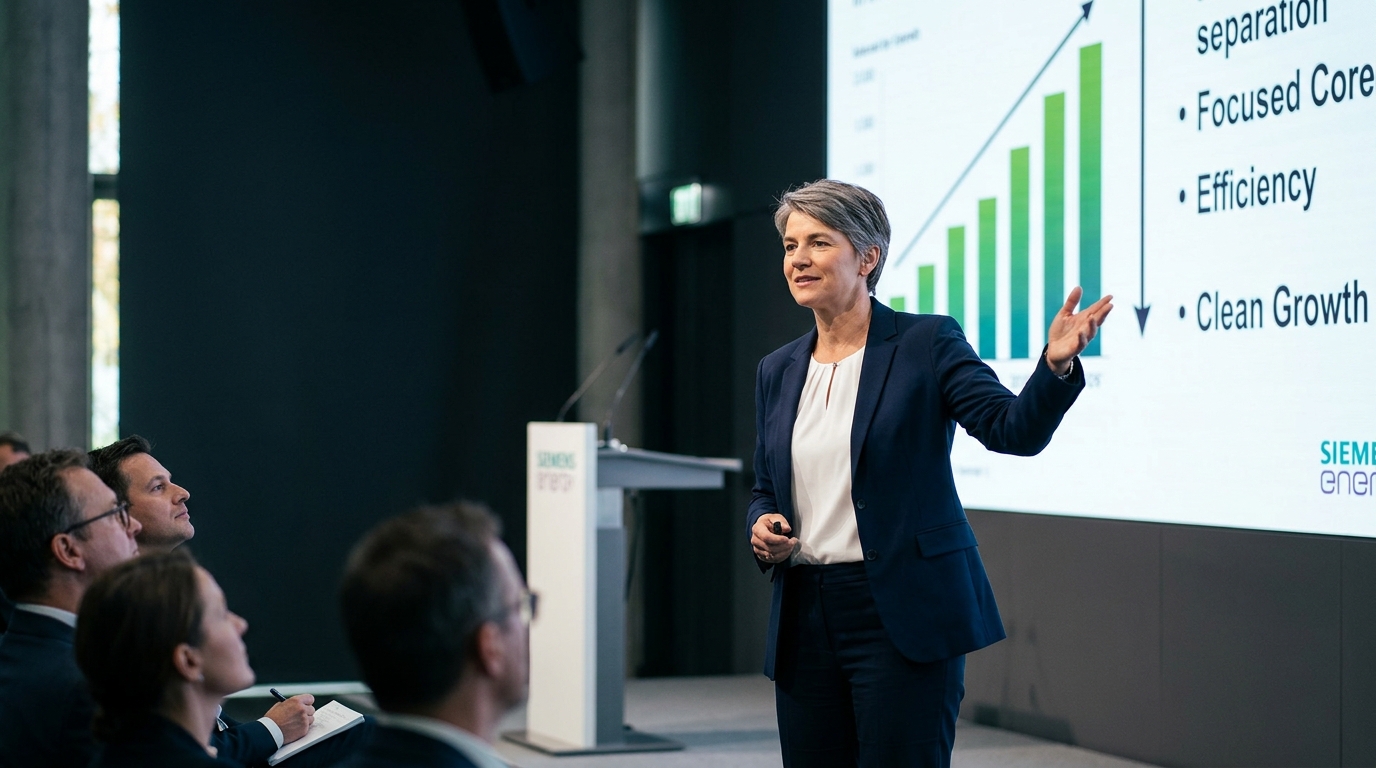
While GE Vernova spent Tuesday absorbing a SoftBank write-down that briefly erased about 6% of its market value, Siemens Energy was delivering numbers that made the question of power-sector leadership look a lot less complicated. The German company reported fiscal 2026 results this morning and the stock rose 7.8%.
The core figures: revenue of €44.243 billion in fiscal 2026, compared with €39.077 billion in fiscal 2025, a rise of roughly 13%. Net income increased sharply to €4,129 million, with basic EPS of €4.44. The profit margin before special items more than doubled to 12.4%, beating the company’s own raised guidance. Free cash flow pre-tax reached €8.799 billion, above the company’s earlier guidance of €8 billion.
Now the guidance, which is where this story gets interesting. For fiscal year 2027, Siemens Energy expects comparable revenue growth of 14% to 16% and a profit margin before special items of 14% to 16%. Net income of around €5 billion and free cash flow pre-tax of around €10 billion are expected. Both figures require meaningful step-ups from fiscal 2026 actuals, but they are grounded in something tangible: an order backlog of €164 billion that gives the company high visibility into 2030.
Book-to-bill ratio was strong at 1.54 for the fiscal year, meaning Siemens Energy is booking orders faster than it ships revenue. That is not a coincidence, it reflects years of AI data center construction and grid upgrade spending flowing into backlogs for gas turbines, transformers, and switchgear. The backlog is effectively a multi-year revenue lock, which is precisely what distinguishes Siemens Energy’s visibility argument from the demand-question cloudiness now hanging over GE Vernova after SoftBank disclosed a $3.7 billion charge related to electricity-generating equipment it had pre-purchased for AI data center sites in the United States.
The 2030 Ambition
For fiscal year 2030, Siemens Energy is targeting compound annual comparable revenue growth between 12% and 14%, and a profit margin before special items of 20% to 22%. The midpoint of that margin range, 21%, would represent roughly a 70% improvement over the 12.4% the company just posted. By 2030, management wants to roughly triple profit before special items. CEO Christian Bruch committed to double-digit annual EPS growth through 2030. These are aggressive targets, and the market is now being asked to decide how much of that path is already priced in after a 7.8% one-day move.
The Structural Decision
Alongside the numbers, Siemens Energy confirmed it is proceeding with the separation of its Transformation of Industry business. The company has begun preparations to separate its Transformation of Industry division into a standalone company as it sharpens its focus on power generation and transmission. That unit generated €5.821 billion in revenue in fiscal 2026, with a 2030 margin target of 14% to 16%, well below the 20% to 22% the core group is chasing. Siemens Energy expects the separation will permit Transformation of Industry to explore options ranging from bringing in external investors to a potential capital markets transaction.
The logic is straightforward: without a structural change, the unit’s growth is limited by an investment focus on power generation and power transmission, which offers higher immediate payback. Separating it frees capital allocation for Gas Services and Grid Technologies, the two divisions that delivered comparable revenue growth of 20.3% and 26.2% respectively in fiscal 2026. The carved-out company is initially expected to operate under Siemens Energy’s brand, Omterra, once launched.
The Bull and Bear Case
The bull case is structural: a €164 billion backlog, a margin trajectory that has moved from negative territory three years ago to 12.4% today, and a credible path to ~€10 billion in free cash flow pre-tax next year. The company will propose a dividend of €2.30 per share for fiscal 2026, more than three times the €0.70 paid for fiscal 2025, with shareholder returns for fiscal 2026 totaling €5 billion including buybacks. Siemens Energy is also expanding its share buyback program, planning to repurchase up to an additional €9 billion of its own shares through the end of fiscal year 2030.
The bear case is valuation. The stock has surged well over 300% since 2024, and the 2030 targets are now public, which means the market will be calibrating every quarterly result against them. Any miss on backlog conversion, turbine delivery timing, or Siemens Gamesa’s wind recovery could compress the multiple quickly. Positive free cash flow pre-tax at Siemens Gamesa is not targeted until fiscal 2028, and that division remains a drag on consolidated margins in the near term.
What to Watch
Three things matter most from here. First, whether the Transformation of Industry separation attracts credible buyers at a valuation that unlocks hidden value for Siemens Energy shareholders. Second, whether Grid Technologies and Gas Services can sustain their combined growth as capacity constraints eventually bite. Third, the pace of Siemens Gamesa’s margin recovery, which is the biggest gap between today’s group margin and the 2030 target. By 2030, management’s ambition is a Siemens Gamesa margin between 8% and 10%. The backlog gives confidence. Execution is the only open question.