
November 2, 2026
Bonus Content: BYD’s 305,743 BEVs in One Month Signal a Surge in Metals Demand
Tim Plaehn here.
Most dividend stocks only pay you once every three months.
But with this little-known $15 gold investment, you could get paid every Friday.
In one month, those weekly payments could add up to $1,127.
I call them Friday Golden Payments.
See here how to collect gold income every Friday.
To your income,
Tim Plaehn
Chief Income Strategist, Investors Alley
BYD’s 305,743 BEVs in One Month Signal a Surge in Metals Demand
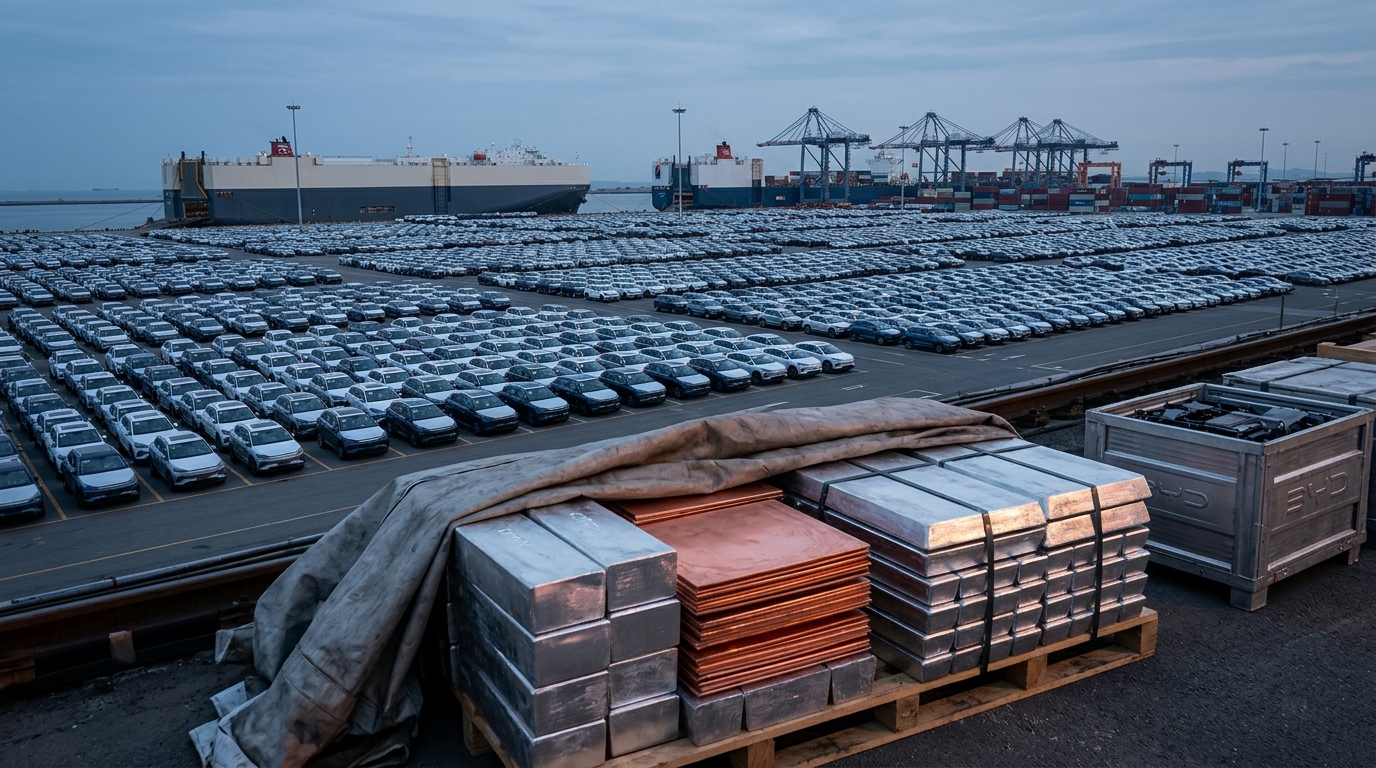
The headline from China’s EV sector this week is BYD’s October delivery report. But the number that matters most to precious metals investors is not total NEV sales. It is the 305,743 pure battery-electric passenger vehicles BYD delivered in a single month.
BYD sold 305,743 battery electric passenger vehicles in October, up 37.38% year on year and 11.94% from September, setting a record for the third consecutive month. BEVs accounted for 63.28% of its passenger vehicle sales in October, up from 50.95% a year earlier, highlighting a further shift in its sales mix toward fully electric models.
That shift matters to anyone holding lithium, copper, or silver. A battery electric vehicle consumes materially more of each than a plug-in hybrid, and the mix is moving decisively in the BEV direction.
What’s Driving the Market
Start with copper. Battery electric vehicles require about 83 kilograms of copper versus about 23 kilograms in conventional vehicles, according to estimates cited by the U.S. Department of Energy and the Copper Development Association. BYD’s 305,743 BEVs alone therefore represent demand equivalent to roughly 25,000 tonnes of copper in a single month from a single manufacturer. That is before counting Geely’s 214,996 NEV sales in October, Leapmotor’s 106,127 deliveries, or Xpeng’s record 50,237.
Silver follows a similar logic. Battery electric vehicles typically contain an estimated 25 to 50 grams of silver, according to Metals Focus research for the Silver Institute. Battery electric vehicles also use more silver per unit than internal combustion vehicles, and EVs are projected to become the largest source of automotive silver demand by 2027, according to Oxford Economics research published by the Silver Institute in December 2025.
Lithium sits at the center of all of it. On October 30, battery-grade lithium carbonate in China was assessed at 93,500 yuan per metric ton in one widely cited spot benchmark, highlighting how prices can remain soft even as EV volumes keep setting records. The market is caught between recognizing genuine demand momentum and absorbing ongoing supply growth.
The Investment Opportunity
The October data also revealed a meaningful divergence among EV makers that shapes how this demand translates to commodities. NIO delivered 34,246 electric vehicles in October 2026, representing an 8.4% decrease from September and a 15.2% decline compared to October 2025. Li Auto’s October 2026 vehicle deliveries totaled 29,025 units, marking a 43.6% decrease compared to 51,443 units delivered in October 2025. Both declines ended meaningful growth streaks.
The divergence matters because commodity demand from China’s EV sector is not monolithic. It is increasingly concentrated in the manufacturers winning market share. BYD and the companies scaling beside it are the demand engine; names losing ground are shrinking their metals footprint at the same time.
For precious metals investors, the most direct exposure is through silver, where the industrial demand argument is structural rather than cyclical. Solar remains the dominant silver industrial demand growth story, and EV-related silver demand is still smaller by comparison in most industry breakdowns. But the EV portion compounds with volume. Each month BYD sets a new BEV record, that incremental silver demand becomes more difficult to dismiss as marginal.
The industrial metals case is not purely about volume, however. Supply-chain failures inside the clean-energy build-out can disrupt the metals demand signal even when EV delivery numbers keep climbing.
Risks to Monitor
Lithium supply is not tightening fast enough to match BYD’s volume growth. BMI has forecast global lithium production growth of 13.2% year on year in 2026, led by Australia and China. That pace of supply expansion keeps a ceiling on prices even as demand breaks monthly records.
Copper faces a different constraint: the structural deficit is real but distant. Analysts generally expect the supply-demand crossover to arrive in the late 2020s, meaning near-term price action depends more on global growth sentiment than on EV volume data alone.
Bottom Line
BYD’s third consecutive monthly record for battery-electric vehicles is not merely a scorecard for one automaker. It is a running measure of how fast China’s EV fleet is shifting toward the vehicle type that pulls the most copper, lithium, and silver per unit. In overseas markets, BYD’s exports surged 102.84% year on year to 170,194 units, extending that demand signal well beyond China’s borders. The investors best positioned are those who treat each BYD delivery record less as an automotive story and more as a forward order for the metals that make it possible.