
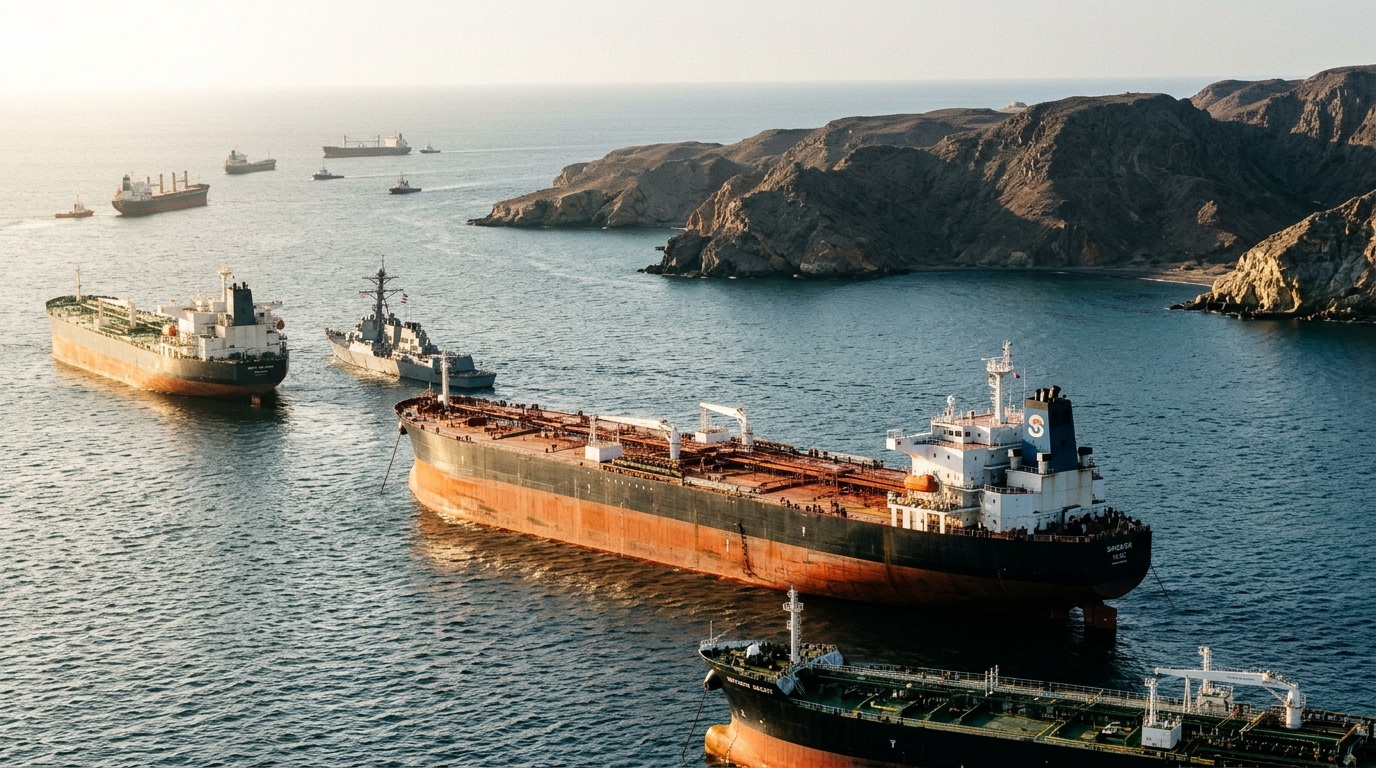
Two markets are looking at the same strait and reaching opposite conclusions. Choose carefully which one you believe.
Brent crude fell about 4% Monday, November 2, 2026, trading around $109 a barrel in early dealings, as Iran signaled that talks in Qatar could reopen the Strait of Hormuz within two days if the U.S. meets several conditions. The crude market heard that and sold.
The freight market heard something else entirely.
What the Freight Market Sees
Iran’s Persian Gulf Strait Authority said it would take “legal action” against all Sinokor vessels starting November 1, a fleet-wide warning that maritime trade press described as the first of its kind from the authority. Sinokor’s scale is the point: Bloomberg’s analysis of ship-tracking data put Sinokor Group’s September Hormuz crude movements at about 105.6 million barrels, roughly 40% of the crude crossing, more than the next three owners combined (Bahri, KOTC, and ADNOC’s shipping unit) at 97.3 million barrels.
Sinokor’s fleet claims in the original draft do not hold up cleanly. Reporting this year has focused on Sinokor’s aggressive buying spree and its growing influence in the compliant VLCC market, but the specific figures in the draft (93 VLCCs owned as of August 2026; 72 VLCCs acquired in 2026 for $5.854 billion) are not consistently supported across verifiable primary reporting. That is not a shipping company. It is a chokepoint within a chokepoint.
The PGSA has not clarified what “legal action” will involve, and its statement does not explicitly announce attacks against every Sinokor vessel. That ambiguity is the point. Cargo owners, charter parties, and insurers now must price a risk they cannot quantify on a fleet that carries roughly two-fifths of the crude making the crossing.
What the Insurance Market Already Priced In
The war-risk insurance market, which has been right about Hormuz more often than crude futures this year, is not offering comfort. Reuters reporting and industry briefings have described additional war-risk premiums in the high single digits of hull value for some Hormuz transits at points this year, and Reuters has reported benchmark VLCC earnings on the Middle East-to-China route reaching record territory around $1.27 million per day in late September. Brokerage SSY has also said that, even after adjusting for inflation, rates are the highest since the first supertankers entered service in the 1960s.
A ban on the dominant fleet owner does not ease those economics. It tightens them. Fewer viable hulls means higher rates for whoever remains willing to transit. The operators positioned to collect that premium are the Western-listed names. Frontline (FRO) reported profit of $659.2 million for the second quarter ended June 30, 2026. DHT (DHT), Teekay Tankers (TNK), and International Seaways (INSW) sit in the same current.
Which Market Is Reading Tehran Correctly
The crude market’s read today rests on a draft proposal, unconfirmed conditions, and a negotiating channel that has already strained under this year’s fighting. Tehran’s simultaneous posture, pursuing diplomacy while its Hormuz authority escalates pressure on the biggest mover of crude through the strait, is not the behavior of a party moving toward settlement.
The talks are taking place against the backdrop of attacks and attempted disruptions affecting tankers in and around the Strait of Hormuz, which have driven up global energy and shipping costs. That backdrop did not soften when the Sinokor warning took effect on Saturday. It intensified.
What to Watch
Tuesday’s U.S. midterm elections are the most immediate variable. Reporting over the past week has described President Trump as preferring to let diplomacy run a bit longer before considering further major military escalation, with the timing tied in part to the midterms. A shift in that posture, in either direction, will be the cleanest catalyst for the next leg in both crude and freight. Watch also for any enforcement action against a Sinokor vessel in the strait. The first incident under the new warning, if it comes, will settle the question of which market was right far faster than any diplomatic communique from Doha.