

October 29, 2026
Bonus Content: Anthropic’s Debt Load Is the Quiet Risk Inside Its IPO
Dear Reader,
This is urgent.
A new type of AI called “Accelerated AI” is about to take the world by storm…
And stocks connected to it are already breaking out.
Check this out…
One “Accelerated AI” stock just moved 133%…
A second ripped 320% in less than three months…
And a third company jumped over 210% in under four months…
All the while Tesla, Microsoft, Meta… even the king of AI – Nvidia… kept going sideways.
And it’s just getting started.
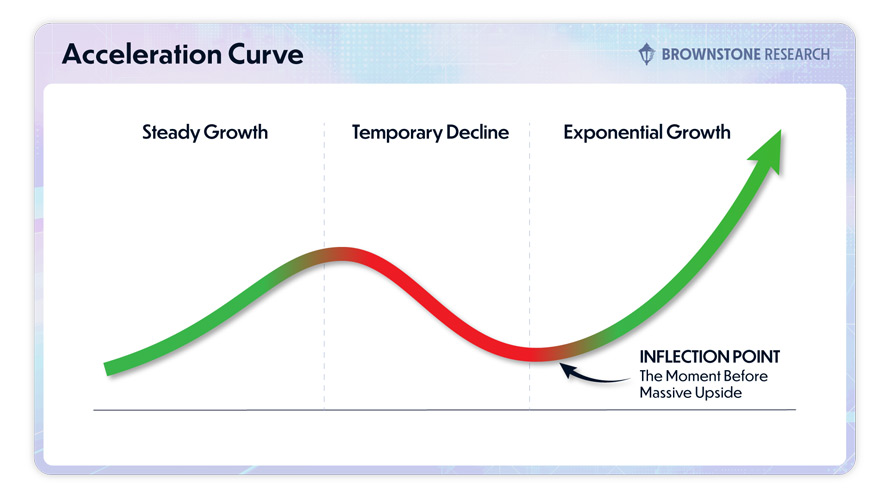
At the inflection point right before “Accelerated AI” explodes into the mainstream…
And unlocks an entire new dimension of exponential growth.
If history is any guide, we could be looking at potential gains of up to 10,000% from here.
If you want to find out more about “Accelerated AI”…
The “light-speed” device powering it…
Why it’s about to crack open the next wave of AI fortunes…
And the #1 “Accelerated AI” play everyone should buy right now – for free…
Let the money flow to you,
Jason Bodner
Founder, Inflection Point
Anthropic’s Debt Load Is the Quiet Risk Inside Its IPO

Anthropic filed its S-1 on October 26, and the headline number everybody focused on was the wrong one. The company recorded a net loss of $80.7 billion for the six months through June 2026, but $72.4 billion of that was an accounting charge tied to the rising value of convertible notes and related financing instruments. Strip that out and the picture looks more manageable. That framing, though, is doing a lot of work to conceal a structural problem that will outlive the IPO by years.
The real issue is not the reported loss. It is the debt architecture underneath the company.
Here is where the original story starts to get ahead of the documents. The S-1 shows a very large convertible-notes balance as of June 30, 2026, but it does not support the claim that Anthropic has raised roughly $138 billion in debt since September 2026, nor does it support a $567 billion compute-commitment liability or a $965 billion private valuation as a current, balance-sheet figure.
What is supported: Reuters reported on September 29, 2026 that Anthropic expects to spend at least $518 billion over a decade building AI infrastructure with six partners, and that it is carrying about $161.2 billion of Broadcom-related equipment lease obligations that are largely noncancelable. Separately, Reuters has reported that Broadcom agreed to lend Anthropic up to $42 billion via a convertible note structure to finance part of a broader chip-lease commitment. And the Financial Times has reported that Anthropic offered Blackstone a yield of more than 10% as part of a $60 billion AI chip financing.
Those commitments do not disappear when the stock begins trading. They become a ceiling on strategic flexibility.
Consider what that means for growth. In the second quarter of 2026, Anthropic generated $11.6 billion in revenue. The S-1 supports heavy compute and infrastructure spending, but it does not support the specific claim that the company spent exactly $5.6 billion on compute in that quarter, or the derived efficiency ratio of $2.08 of revenue for every dollar of compute spend. Without a clean, labeled figure in the filing for that exact metric, it should not be stated as fact.
Some current and prospective investors who attended Anthropic’s investor day in San Francisco have already begun weighing a lower valuation, with discussions settling around $1.5 trillion rather than the roughly $2 trillion previously expected for the share sale. That compression before the first share is even priced reflects precisely this concern: the gap between Anthropic’s operating trajectory and its balance-sheet obligations is wide enough to matter.
For gold investors, the relevance is indirect but real. The AI infrastructure debt cycle is consuming capital at a scale that shapes credit markets, real yields, and private-versus-public capital flows. When companies pay double-digit yields for compute financing, they are competing with Treasuries for institutional money. That is a rate environment worth watching.
That divergence between credit and equity markets is already visible in the data. Bond investors are demanding premiums well above secondary-market levels to absorb new AI debt issuance, while equity buyers in the same sector keep bidding.
The revenue growth is genuine. The S-1 reports $16.3 billion in revenue for the first half of 2026. But the original draft’s specific claims that Anthropic generated a $1.6 billion operating profit in the first half of 2026, produced an operating margin of nearly 10%, and grew second-quarter revenue 1,368% year over year are not supported as stated by the publicly available filing excerpts and reporting reviewed for this edit, so they have been removed rather than left standing. Margins can compress fast when noncancelable compute costs do not. The debt load is not fatal. It is, however, a governor on every ambitious plan Anthropic’s IPO prospectus describes.