
October 29, 2026
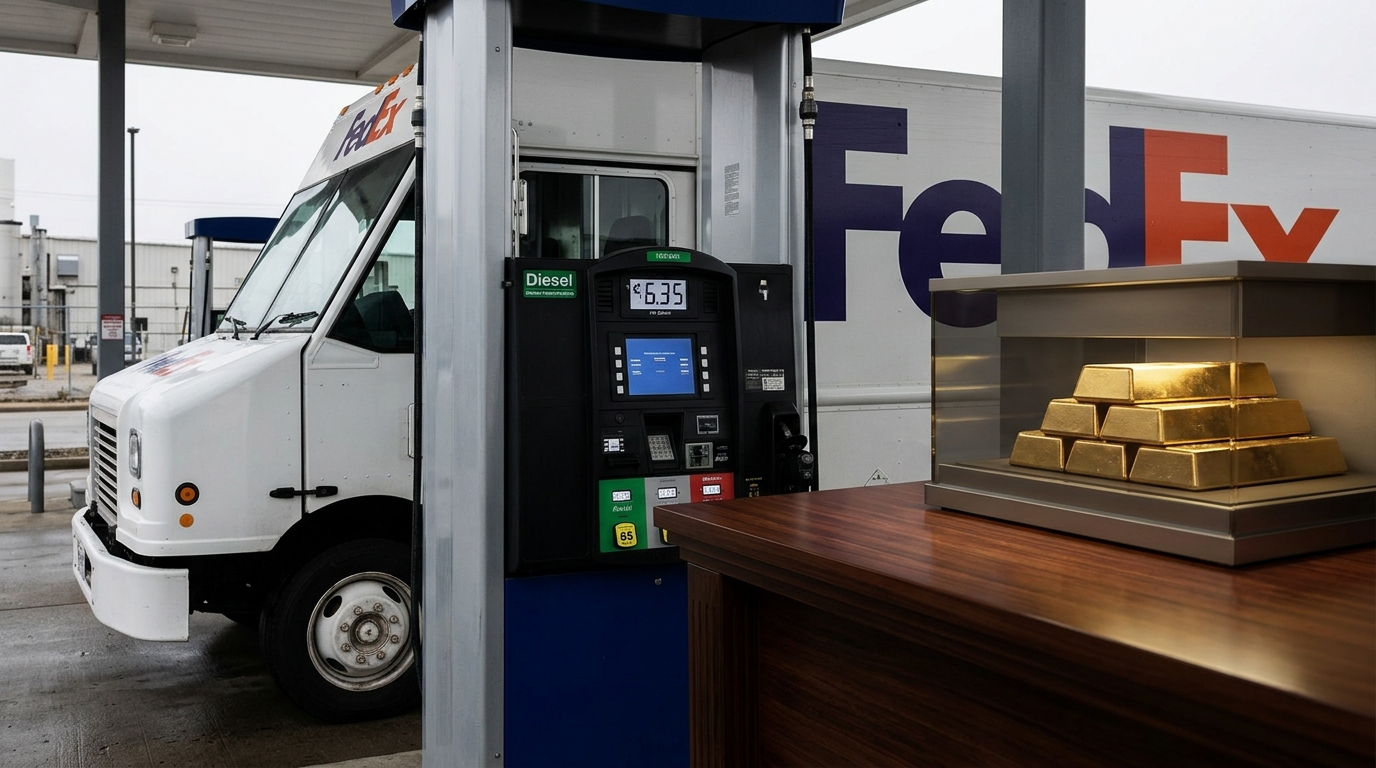
FedEx’s fuel surcharges show energy costs are still embedded, a backdrop that is helping keep gold above $4,000.
FedEx reported quarterly results after Tuesday’s close that, on their face, look like a straight corporate success story: revenue up about 12%, adjusted earnings per share up 28% to $3.74, full-year adjusted EPS guidance raised to $18.00 to $18.60, and $2 billion of share buybacks completed in the June-to-September period alone. A clean beat. The company also disclosed that it completed the $1.4 billion sale of FedEx Supply Chain to CMA CGM on October 1, sharpening its focus on its core parcel and freight network.
One Rule Change Sparked a 681% Surge – Could This Be the Next?
In 1993, one rule change sent retirement money flooding into real estate – a 681% surge. When Bitcoin’s door opened, Larry Benedict traded it for 42% in a day.
Now the biggest door ever is opening – and he’s naming the one ticker in its path, free, here.
But the detail that matters most to precious metals investors isn’t the earnings per share number. It’s buried in how revenue got to 12% growth in the first place.
FedEx said fuel price-driven increases in surcharges helped drive higher revenue, and management expects that fuel surcharge tailwinds will continue to show up in revenue even if they are intended to be largely neutral to full-year adjusted operating income. The company is threading a real needle: passing energy costs through to customers aggressively enough to grow revenue, while absorbing enough of the bill that it created a 30-basis-point headwind to adjusted operating margin in the quarter. At the EIA’s latest weekly reading of $6.352 per gallon for on-highway diesel, FedEx is operating in a fuel environment that is, by any historical measure, extreme.
The diesel market driving those surcharges has its own structural story. Diesel crack spreads holding near record highs above Brent show why refined product scarcity is the real price driver, not crude alone.
Could this man with President Trump help mint the next wave of AI millionaires in America?
Even though he grew up in one of the poorest counties in Kentucky in a city with just 300 people…
And even though he’s a former dish washer at Denny’s…
He could tell you exactly what happens next with this AI boom…
And where you should put your money.
This is what energy-led inflation looks like at ground level. The September CPI came in at 3.7% year over year, with energy prices rising 20.4% over 12 months. The September PPI was even starker: final demand rose 6.3% year over year, with diesel fuel up 21% for the month alone, and the EIA reported Brent crude averaging about $114 per barrel in September. Those aren’t abstract indexes. They are the fuel bill that showed up in FedEx’s results Tuesday night.
The contrast with UPS is instructive. UPS, which reported a day earlier, has been deliberately shrinking exposure to lower-quality Amazon volume as it pushes toward more profitable customer segments. U.S. domestic average daily volume fell 3.3% at UPS in the third quarter, even as revenue per piece rose 6.1%, with UPS management saying roughly half of that per-piece gain was fuel-related. Both companies are telling the same inflation story from different angles: energy costs are so significant that they are reshaping carrier strategies, not just adding a line item to the income statement.
For gold, this matters directly. Gold has traded near $4,045 this week, held above $4,000 through recent volatility despite a firmer dollar and a 10-year Treasury yield near 4.99%. The metal is facing genuine headwinds: real yields remain elevated, and energy-driven inflation raises the probability that the Fed keeps rates higher for longer. That’s the bearish case, and it deserves respect.
The bullish case, which FedEx’s results illustrate vividly, is that energy-embedded inflation is not transitory. It’s being baked into multi-year carrier contracts, annual general rate increases, and full-year corporate guidance. When FedEx raises its annual earnings outlook and simultaneously points to fuel price-driven surcharges as a contributor to higher revenue, it is quantifying the inflation premium that has been embedded into the economy’s circulatory system. Gold has historically served as a store of value precisely in this kind of environment, where inflation is stubborn rather than spiking and falling cleanly.
High-Grade Silver-Gold Hits Fuel Sub – $1 Discovery Stock
Silver and gold are at historically high levels as investors hunt for the next mining breakout. One overlooked small-cap Canadian explorer is reporting high-grade silver-gold drill results in a historic Mexican mining district.
A Reuters survey published October 27 put the analyst consensus 2027 gold forecast at $4,650 per ounce, up from the previous poll’s 2027 estimate, suggesting the market sees the current pressure as a delay rather than a broken thesis. Royalty companies with long-life, low-cost assets remain the most efficient way to hold that thesis without taking on individual mine execution risk.
That analyst consensus has a direct read-through to producers already operating at elevated margins. Newmont’s record free cash flow quarter shows what a multi-thousand-dollar gold price means for miner earnings in real dollar terms.
FedEx is running a fleet in a $6.35 diesel week and still raising guidance. That’s operational discipline. It’s also a precise, dollar-quantified measure of the inflationary pressure that makes a gold allocation worth defending right now.