

Every American Should Unlock Their IRA/401k In 2026
Most Americans have no idea their Retirement Plan is locked down.

Let’s say you’re at a restaurant – you can order anything you want, as long as it’s on the menu.
But what if you found out you have a fish allergy, and you’re at a seafood restaurant?
Because if you’ve had an employer 401(k), then you remember seeing the options:
You can invest in anything you want, as long as it’s on the menu. Same thing with many IRA plans.
But what happens if everything on the menu can make you sick?
That’s what many Americans are facing right now. Because whether you order the S&P Index Fund, the 60/40 Stocks and Bonds mix, or any other combination on the menu…
All the ingredients come from the same kitchen – the stock market.
And you already know the stock market has made people sick.
The ups and downs can be nauseating.
Now that’s not a problem if you’re a few decades away from retirement, because you can ride out the storm, and things could likely turn in your favor.
But when you’re already retired, or about to retire, then the game changes.
Because it’s not about growing your assets anymore, it’s about preserving your assets, right?
That means if you have $1 million saved for retirement…
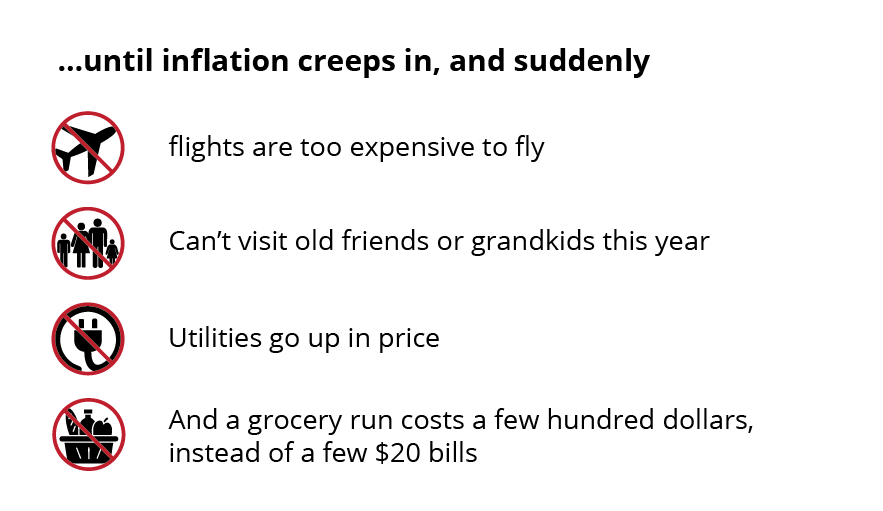
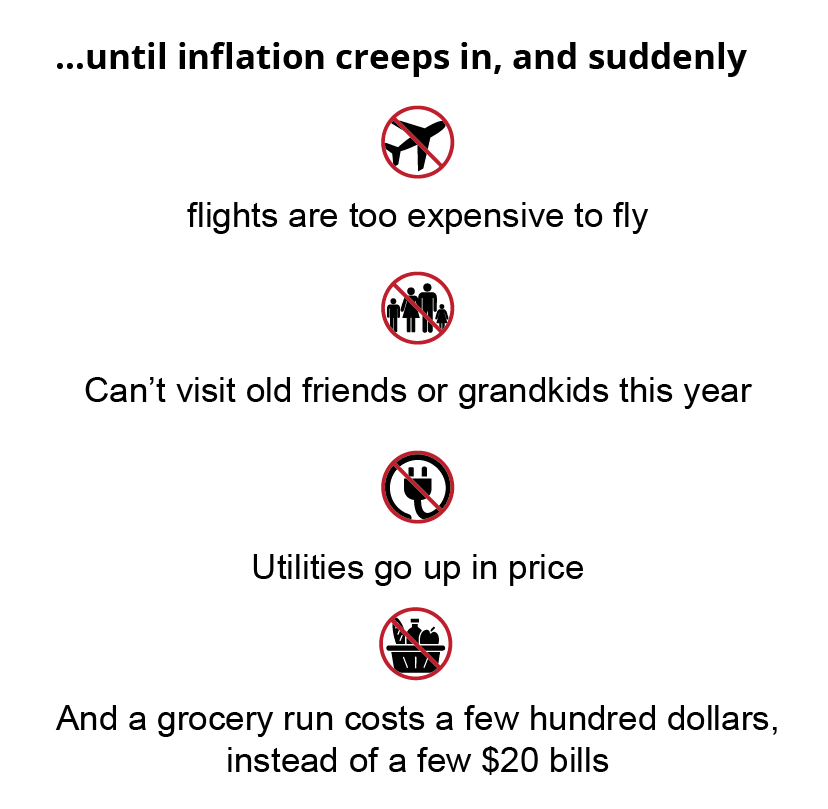
Then you expect that million to pay for your travel, gifts, visits to family and grandkids…
For the rest of your life. Literally! And that’s a great plan.
So how do you tackle the problem?
You could hope the stock market rockets up again, and grows your retirement…
Or you could look at assets that help defend against inflation.
Except the problem is, many IRAs and 401(k)s can be locked out of inflation-defending assets.
But it doesn’t have to be that way.
Because right now, thousands of Americans have figured out how to UNLOCK their IRA/401(k) so they can diversify a portion of their retirement savings into assets that help defend against inflation.
That’s why we put together this free guide.
It’s a brief, to-the-point handbook that shows you:
- The IRS Rule That Lets You Access Locked Retirement Funds
- Who Really Controls Your Retirement Savings
- How To Transition To An Unlocked IRA

And it’s completely free to get a copy.
So what you do with your retirement savings is your business, but at the very least, you should be educated about your options.
But of course, the choice is yours.
Mercedes-Benz’s 31% China Drop Has a Quiet Platinum Problem Attached

Volvo Cars fell almost 30% on Friday after reporting a SEK 5.6 billion operating loss and announcing 2,500 job cuts. Revenue in China roughly halved from a year earlier, as Volvo Cars and other legacy premium brands were squeezed by upstart Chinese competitors and steep price-cutting across the market. The question hanging over the German luxury segment going into this week is how much of that was a Volvo-specific collapse and how much is a sector-wide statement.
Mercedes-Benz answers on Wednesday. On 28 October 2026, Mercedes-Benz Group AG will publish the Q3 results for 2026. The sales picture is already in hand: sales in China dropped 31% to 86,800 units compared with the same period last year, dragging group sales, which include vans, down 6% to 491,700 vehicles. The Top-End segment, home to AMG and Maybach, saw the deepest cut: quarterly sales in that segment dropped 21% to 53,900 units, affected by the weaker market environment in China and ongoing model changeovers.
What investors don’t yet know is what that volume collapse did to margins. RBC warned that Mercedes’ Q3 car margin could dip below the company’s 3% to 5% full-year guidance range, while its top-end models were also soft. A 31% drop in China deliveries can hurt profits more than it hurts sales, because automaking has large fixed costs. When factories and supply chains run below capacity, each vehicle has to carry more of those costs, which can squeeze margins fast. The car division was already running at roughly 4% in the second quarter, posting adjusted EBIT of EUR 909 million and a 4.0% adjusted return on sales. Falling below the 3% floor on Wednesday would put the full-year guidance range under immediate pressure.
For precious metals investors, the relevance is indirect but real. Autocatalysts remain one of the largest single sources of platinum and palladium demand globally. German premium vehicles, sold at higher prices and built with more complex exhaust systems than mass-market cars, consume more platinum-group metals per unit than the segment averages suggest. A sustained collapse in high-end combustion and hybrid volumes in China is not neutral for PGM offtake. Volvo’s CEO said the China slump “came faster than we thought,” and described the environment as one of “de-globalisation, hypercompetition and climate change.” If that describes the structural condition rather than a temporary dislocation, the PGM demand assumptions built into most 2026 and 2027 forecasts deserve scrutiny.
The PGM demand picture is already shifting from a separate direction. Hybrids gaining share from EVs have quietly extended platinum and palladium demand beyond what most forecasts assumed.
RBC cut its Mercedes-Benz target from EUR 54 to EUR 44 on October 13, 2026, and the stock has spent most of October trading in the EUR 40 to EUR 42 range, roughly 35% below its 52-week high. RBC already reflected the risk by cutting its 2027 equity income estimate to EUR 200 million from EUR 300 million and lowering the EBITDA valuation multiple it uses from 1.5x to 1x. That is not a minor trim. It is a reassessment of the earnings trajectory.
Risks to Monitor
The bull case for Mercedes-Benz, such as it is, rests on geography. U.S. car sales rose 6% to 75,300 units and are up 12% this year. Europe added 5%. The electric GLC propelled Mercedes-Benz’s EV sales to an all-time quarterly high, with battery-electric passenger-car deliveries reaching 68,400 units, a 61% annual jump. Those offsets matter, but they don’t replace the margin profile that came with selling premium combustion vehicles in China at full price. The bear case is that Volvo’s report was not idiosyncratic. If Wednesday confirms that the Chinese premium market is in structural contraction rather than cyclical pause, the damage runs well beyond one quarter.
Bottom Line
Mercedes-Benz is the first German premium result since Volvo’s implosion. The market already expects a weak quarter. What it does not know is whether management confirms, or quietly signals, that the 3% to 5% margin band is still achievable for the full year. A guidance cut would shift the conversation from China sales to European earnings resilience, and would renew pressure on the downstream commodities, including platinum-group metals, that depend on premium combustion vehicles staying profitable enough to keep selling. Wednesday’s number matters beyond Stuttgart.