
October 22, 2026
Bonus Content: Tesla’s Cash Crunch Makes the SpaceX Merger Question Urgent
Dear Reader,
In 1998, a 27-year-old Elon Musk set out to replace the U.S. dollar.
Then his plans fell apart.
First, his PayPal co-founders staged a coup and fired him.
Then, he spent decades building Tesla… SpaceX… xAI…
Amassing more wealth and power than any man in history.
And he’s about to “reboot” the U.S. dollar, with the full blessing of the White House, Congress, and the U.S. Treasury.
If he’s successful, this technology will be bigger than Tesla and SpaceX combined.
And for investors, it could be one of the most explosive opportunities of the decade.
Regards,

Ian King
Chief Strategist, Strategic Fortunes
Tesla’s Cash Crunch Makes the SpaceX Merger Question Urgent
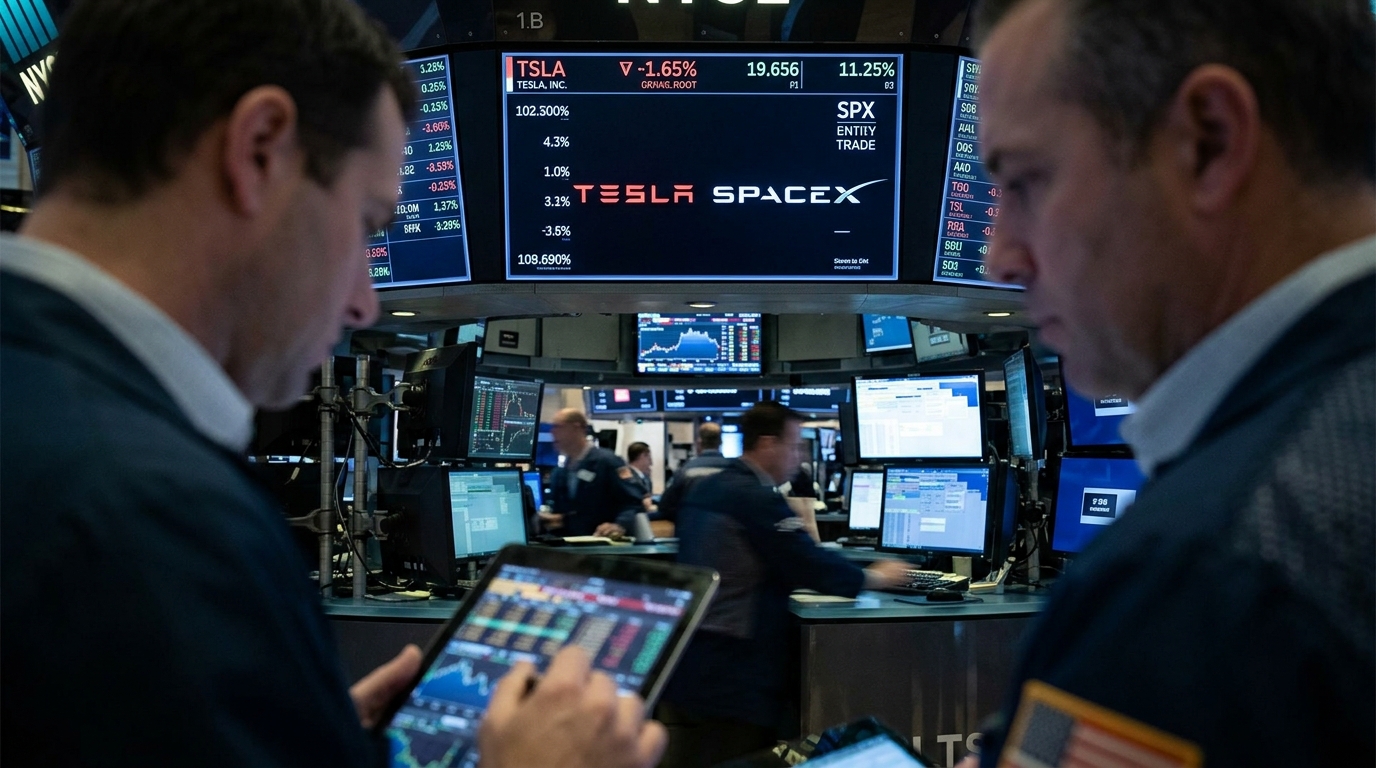
Before Tesla opens its books tonight, investors should spend a moment with the company on the other side of the proposed merger. SpaceX reported Q3 revenue of $14.6 billion, up 161% year over year, with net income of $4.4 billion. That is not a cyclical beat. AI, which SpaceX now calls Super Intelligence, has become its largest business by revenue, with revenue rising to $7.56 billion. When a rocket company generates that much AI revenue in one quarter, it rewrites the frame around any deal involving Tesla.
The boards of SpaceX and Tesla have each formed special committees to review a possible merger, at the request of shareholders. Musk said he cannot be in the discussions because he is a conflicted party. Musk also noted that a merger would require a 50% vote of all Tesla shares outstanding, not merely those who turn out to vote. That is an exceptionally high threshold, and it forces the question of what Tesla shareholders are actually being asked to exchange.
The answer to that question depends almost entirely on what Tesla reports tonight. Free cash flow is the number to watch, and the current consensus implies heavy cash burn, with capital expenditures climbing to about $7.77 billion for the quarter. Tesla’s own published analyst-consensus compilation also shows full-year 2026 capex of roughly $25.4 billion. That reversal from the prior year’s cash generation is the clearest argument merger proponents can make: Tesla’s standalone financial profile has deteriorated sharply while SpaceX’s has inflected upward.
Record-High Copper Fuels This Below – $2 Discovery Stock
Copper has blasted to all-time highs as global electrification, AI data centers, and grid expansion collide with tightening supply. One Canadian copper company trading below $2 has consolidated an entire historic copper belt in the Yukon for the first time. High-grade copper is already confirmed at the flagship, multiple opportunities are advancing, and drilling is accelerating with multiple rigs turning and more being added.
Get the full story now while this Yukon copper-gold story is still below $2.
Wall Street also expects revenue of about $28 billion and earnings per share of $0.45. Automotive gross margin excluding credits came in at 16.3% in Q2, down from 19.2% in Q1. If margin stabilizes tonight, the bull case for Tesla standalone is still intact. If it erodes further while the company is spending more than $25 billion in 2026 capital expenditures on Optimus, Cybercab, and AI chips, the argument for keeping TSLA independent becomes harder to make at any multiple.
That is where the merger math turns genuinely complicated. Dilution is the core risk for Tesla holders. Investor Gary Black has argued that a Tesla-SpaceX merger could fail the math for TSLA holders if SpaceX is valued far above Tesla, because a stock-for-stock deal could force substantial dilution. SpaceX’s valuation has moved considerably since earlier back-of-the-envelope analyses, which is exactly why this debate is heating up now. Wall Street is split: one camp believes a stock-for-stock merger would be significantly dilutive to Tesla’s retail shareholders; another argues that merger expectations will drive Tesla’s valuation upward ahead of any deal.
Musk was careful to note that the committees have not reached agreement on any transaction terms, and said: “I think some people out there assume that a SpaceX and Tesla merger is a certainty, and I think that would be overstating it.” That caveat matters. The committees have no mandate, no timeline, and no publicly disclosed advisers.
What tonight’s Tesla report actually determines is the negotiating position Tesla’s independent directors walk into those committee rooms with. Strong margins and positive free cash flow give them leverage to demand a premium exchange ratio. Continued cash consumption at $4 billion to $5 billion a quarter hands that leverage to the other side. SpaceX just showed what a profitable AI infrastructure business looks like at scale. Tesla’s job tonight is to show it still has something worth combining with it.
Free cash flow is the metric that separates negotiating leverage from desperation at the committee table. Among the largest AI infrastructure spenders, sustained positive free cash flow has become the rarest and most valued signal in the entire sector.