
October 21, 2026
Bonus Content: China’s Rare Earth Pause Expires Nov. 10. No Renewal Filed.
Washington Wants the Next Drone Boom Built in America
America wants to dominate the next great weapons market.
For generations, military strength was measured by the size of a nation’s ships, tanks and aircraft. But the next era may belong to something smaller, faster and more intelligent: Drones.
Drones can gather intelligence, move critical supplies and complete missions without putting pilots at risk.
And Washington is moving to bring that industry home. A new Executive Order calls for expanded domestic production, secure supply chains and greater military adoption of American-made drones.
The global drone market was valued at $83.8 billion in 2025 and is projected to reach $182.4 billion by 2033. A nearly 120% increase!
North America already accounts for more than 40% of that market. Yet one Chinese company still controls roughly 70% of the U.S. civilian drone market.
Washington wants to change that.
And with the Pentagon reportedly seeking around 300,000 drones, investors may want to know which American companies could benefit.
One little-known Nasdaq company has spent more than 25 years developing professional drone technology. It has patents, a broad product lineup and real-world deployments behind it.
If America leads the next drone revolution, this overlooked company may finally get Wall Street’s attention.
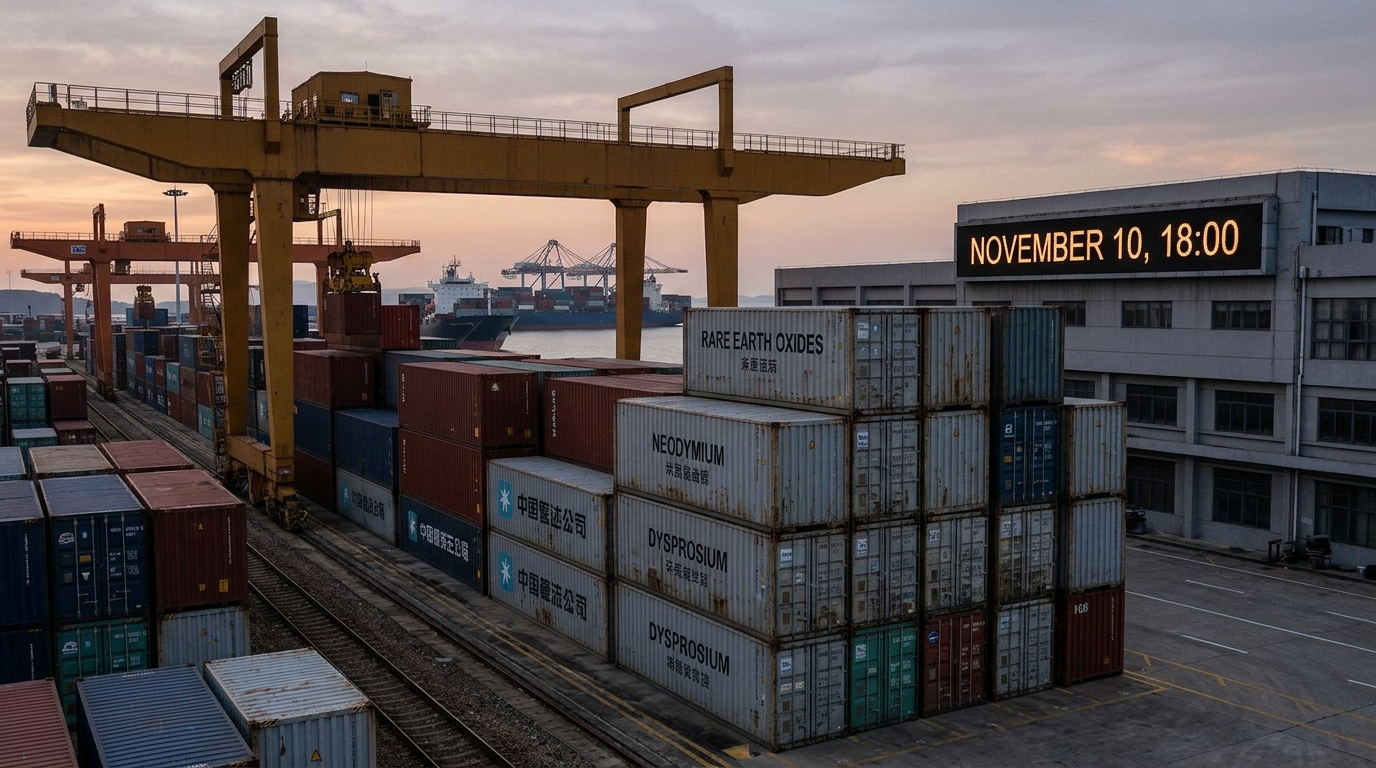
China’s Rare Earth Pause Expires Nov. 10. No Renewal Filed.
Mark November 10 on every portfolio calendar you keep. China’s one-year suspension of its October 2025 rare earth export controls runs until that date under MOFCOM and GACC Announcement No. 70 of 2025, and there has been no publicly posted extension as of October 16, 2026. That gap matters enormously, because Washington said in late September that the broader US-China trade truce now runs to January 10, 2027, but Beijing has not published matching legal text with that same date.
Washington and Beijing extended the broader truce to January 10, 2027 after talks between Trump and Xi, but the public readouts did not spell out the rare earth suspension by name, as Bloomberg Government reported. The truce’s main ceasefire keeps rolling. The rare earth piece, legally speaking, does not.
What Snaps Back If No Renewal Arrives
The controls first unveiled on October 9, 2025 expanded China’s licensing regime to additional rare earth-related items, including measures tied to elements such as erbium, holmium, europium, ytterbium and thulium. They reached further than any rule before: China’s October 9, 2025 package included a “foreign direct product rule”-style provision requiring Chinese approval for exports by foreign exporters when the products contain trace amounts of certain Chinese-origin rare earths. That extraterritorial clause is the one that sent shivers through every magnet-dependent manufacturer outside China a year ago.
The April 2025 controls on seven elements were never suspended at all. So the baseline going into November 10 is already restrictive. China’s rare earth exports fell 9.6% to 43,711 tonnes in January through September 2026, even as September alone rose 6.7% year on year, Reuters reported from China customs data. The trade data confirms Beijing has been gripping the valve well before any deadline.
The signal from shipment flows is equally direct. Rare earth magnet shipments to the United States fell 28.7% in September compared with August, even as exports to Vietnam jumped 57.5%, Reuters reported from customs data. Vietnam has become a routing point, not a destination.
Where MP Materials and Lynas Stand
The two companies most often cited as the West’s best answers to Chinese supply dominance face different but related pressures.
MP Materials was already operating under a targeted restriction before the November 10 deadline arrives. China added 10 US entities to its export control list in June 2026, prohibiting exports of dual-use items with immediate effect, naming rare earth and magnet developers MP Materials and USA Rare Earths, Reuters reported. For MP Materials, which operates the Mountain Pass mine in California, the ban complicates sourcing Chinese-origin dual-use inputs and materials. Even ramping up Stage 2 and Stage 3 processing, the inability to reliably and legally source Chinese-origin heavy rare earth inputs is a significant operational hurdle. MP’s domestic base is real, but the feedstock dependency is not a footnote.
Lynas, the largest rare earth producer outside China, enters November from a position of relative operational strength. The company reported a record average selling price of about A$98.2 a kilogram in the June quarter, helped by stronger pricing, product mix and tighter conditions, though NdPr production was affected by ore-quality variation at Mount Weld, as Lynas and Australian trade reporting described. Longer term, Lynas produced about 7,260 metric tons of NdPr in fiscal 2026, and investor presentations point to higher output over time. That growth runway is exactly what the November 10 situation is designed to accelerate, in terms of customer urgency if not mine output.
What the Pricing Already Tells You
Markets are not waiting for November 10 to move. As of October 2026 pricing snapshots, terbium is up about 131.6% year to date at roughly $4,594 per kilogram, based on widely circulated investor reference pricing. These are not speculative spikes. They reflect genuine scarcity for buyers who cannot rely on Chinese licensing approvals arriving on schedule.
Risks to Monitor
Three outcomes remain in play: extension, selective reinstatement, or full return of the October 2025 rules, including the extraterritorial foreign-exporter provision. A full return is the tail risk, but even selective reinstatement on holmium, erbium and thulium would reset ex-China material sharply. The IEA estimates full implementation of these rare earth export controls could put $6.5 trillion a year of downstream production outside China at risk, and that even with planned expansions, expected magnet capacity outside China still meets only a fraction of projected 2035 needs.
The bullish case for Western producers is straightforward: every day Beijing does not publish a renewal notice, the strategic argument for MP Materials and Lynas grows louder in boardrooms from Detroit to Tokyo. The bearish case is equally plain. A last-minute renewal would relieve pressure, cap the price move, and remind investors that diplomatic timelines, not legal ones, have so far governed this market. The legal text says November 10. Until Beijing says otherwise in writing, that is the date that counts.