
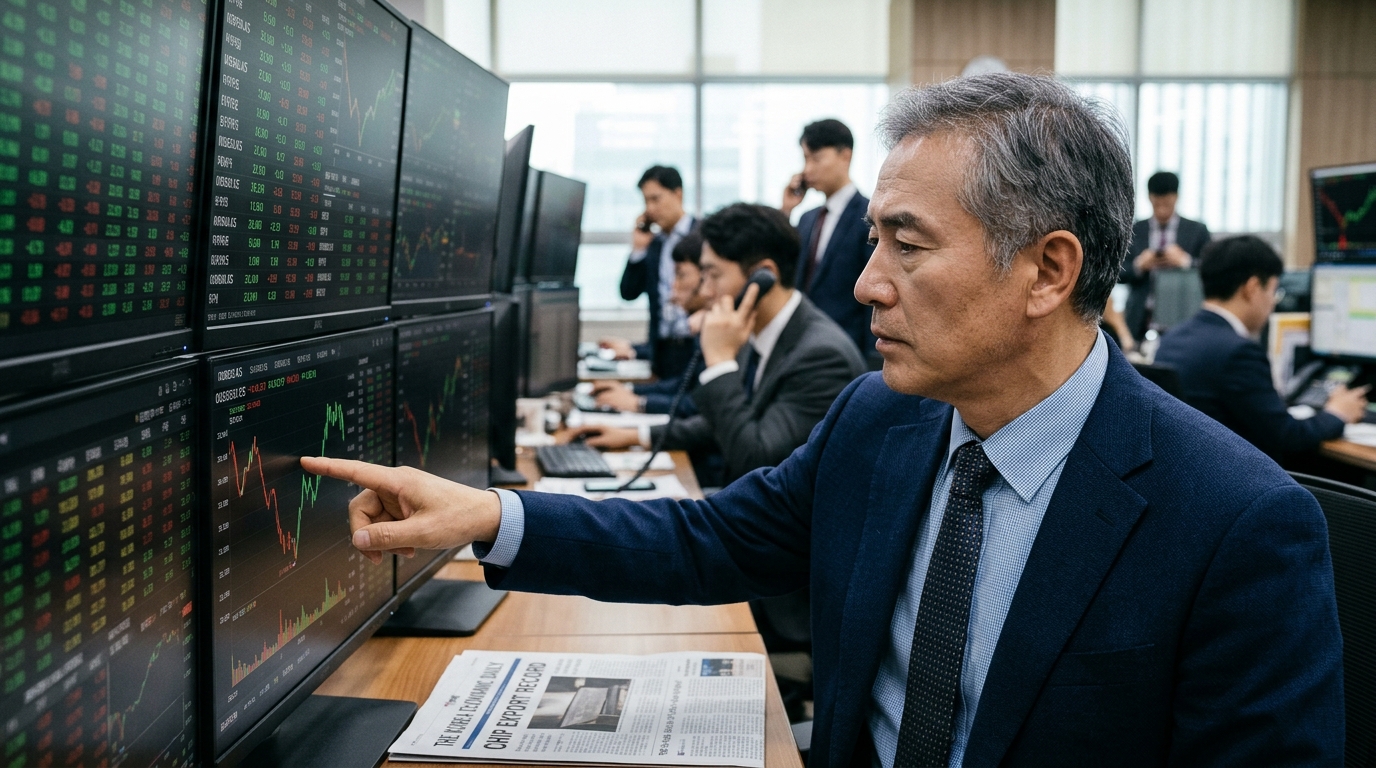
The most honest thing the Korean market did this week was lose nearly 4 percent on Tuesday and gain more than 3 percent on Wednesday. Not because sentiment shifted, but because data arrived.
The Kospi dropped 3.73% on October 20 to 5,552.74, with SK Hynix and Samsung Electronics falling 4.23% and 2.98% respectively. The driver was familiar: concerns about returns on artificial intelligence investments, political and fiscal instability in Europe, and rising U.S. Treasury yields. Foreign and institutional investors did not wait for proof. Foreign investors sold a net 530.3 billion won and institutions a net 1.005 trillion won, for combined net selling of 1.5355 trillion won.
Then the Korea Customs Service published its October 1-20 trade figures Wednesday morning, and the short case ran into hard numbers.
Export value during the period reached $61.6 billion, up 105.4% from the same period last year, the highest export performance ever recorded for the October 1-20 window. Semiconductor exports surged 222.5% year-on-year to $27.5 billion, also an all-time high for mid-October, with chips accounting for 44.7% of total exports, a 16.2 percentage point increase from a year earlier. That share figure matters as much as the growth rate. Nearly half of everything Korea ships abroad is now a chip.
The reversal was immediate. The Kospi closed at 5,735.66, up 182.92 points, or 3.29%. Samsung Electronics closed at 223,500 won, up 5.67%, while SK Hynix rose 5.81% to 1,294,000 won. The rally was forceful enough that the Korea Exchange activated a buy-side sidecar at 10:51:56 a.m., temporarily suspending program buying for five minutes after Kospi 200 futures rose more than 5%, the first such activation in two months.
The customs data did not arrive alone. The night before, Super Micro Computer jumped in late trading after reporting preliminary quarterly results that topped analyst estimates, with the server maker saying sales will be $18.5 billion to $19.5 billion in the quarter ended September 30, versus the analyst consensus of about $15 billion. That update undercut the central premise of the prior session’s selling: that hyperscaler spending was softening. Korean stocks rebounded sharply after those strong results from the U.S. AI server maker revived sentiment toward semiconductor shares.
The whipsaw between Tuesday and Wednesday is what makes this week instructive rather than merely dramatic. The Kospi had already plunged around 21% over seven trading sessions from October 6 through October 15 on AI-related investment concerns. Bears have a genuine case: AI infrastructure debt is rising, CoreWeave debt was trading at distressed levels, and Reuters reported Monday that S&P Global estimates the biggest tech firms likely carry more AI-linked liabilities than currently known. Those risks have not disappeared.
What changed is the demand side of the ledger. South Korea’s exports surged 105.4% in the first 20 days of October, led by record chip sales driven by global AI investment, with semiconductors rising 222.5% and accounting for 44.7% of the total. This is not a sentiment survey or a guidance range. It is physical product loaded onto cargo planes at Incheon and shipped to customers across Asia and the United States. Exports rose to China by 154.4%, the United States by 154.9%, Singapore by 121.1%, and Malaysia by 363.2%.
For precious metals investors tracking the macro regime, the two-day Kospi move reinforces something worth watching: AI capex is not slowing in any measurable way. That sustains the industrial demand floor for copper and the broader risk appetite that has kept gold’s safe-haven bid in check even as real yields climb. If the AI spending cycle extends, the dollar and Treasury yields remain the primary variables governing gold’s next move, not a collapse in chip demand. The data, for now, has spoken.
The copper connection runs deeper than a macro footnote. AI data centers consume copper at a scale that is reshaping the refined supply deficit and the structural demand floor for industrial metals.