
October 20, 2026
Bonus Content: FedEx Is Locking Up Land Next to Top Air Cargo Hubs
Dear Reader,
You lock your doors. You shred your mail. You watch what you post online.
But on June 18th, five federal agencies, including the Federal Reserve, proposed a rule that reaches somewhere most people never think to protect…
Your money.
Private companies now issue their own digital dollars, used for payments and transfers online.
The new rule would require those companies to identify every customer the same way a bank does.
Your name, attached to every digital dollar you buy.
Most people missed it.
They were busy celebrating the July 11th ban on the Fed’s digital dollar, which does nothing to stop the private versions.
Now you might be thinking…
“I don’t use digital dollars. Why should I care?”
Because Bank of America, Wells Fargo, Citi and Capital One are among 21 financial institutions planning a joint one, targeting launch next year.
A digital dollar backed by Visa and Mastercard went live September 30th.
PayPal’s is already in Venmo.
Zelle has announced one too.
Sooner or later, the dollars in your accounts will likely move through these systems.
And any privacy-minded person should read this twice…
Right now, the rule only covers buying digital dollars from the company.
But the agencies are considering going further.
Tracking your name every time those dollars change hands.
Person to person. Payment to payment.
Public comments closed August 21st. Now the decision is up to them.
It’s being framed as crime prevention.
It always is… isn’t it?
What’s in your safe is yours. What’s in the bank is a promise.
Digital dollars work like the bank.
A company stands behind every one, and by law that company must be able to freeze them.
But some digital assets have no company or bank behind them at all. You hold them directly, like what’s in your safe.
That’s why I recorded a free presentation on our “Digital Dollar Immunity” System.
It shows how we hold a portion of our assets outside that system.
4,500+ members are already doing this.
If you have $50k+ saved for retirement and want to protect your family from whatever comes next, watch it now:
Click Here To Reveal The “Digital Dollar Immunity” System →
To your wealth,
Tan Gera, CFA®
Decentralized Masters
P.S. The public comment window closed August 21st. The final rule is still coming.
FedEx Is Locking Up Land Next to Top Air Cargo Hubs
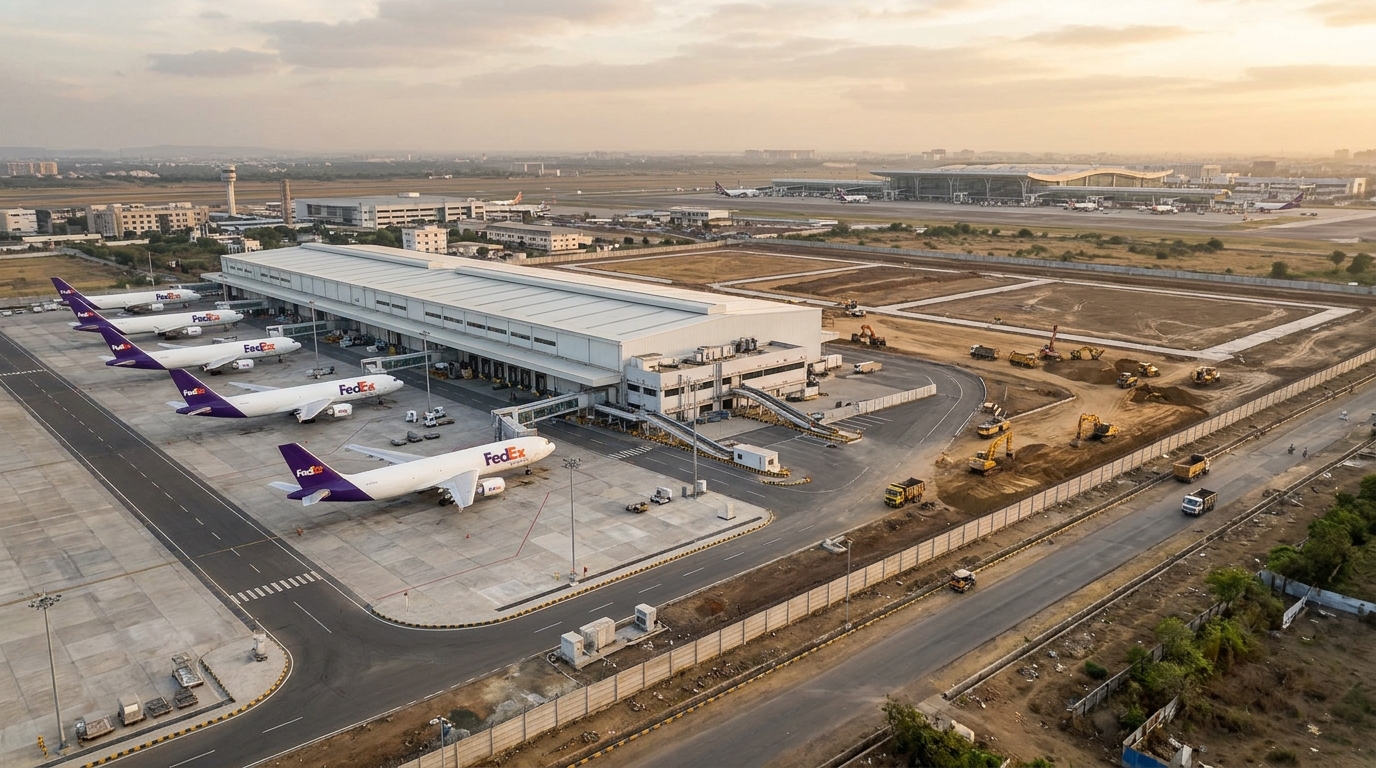
The most consequential logistics story of 2026 is not happening in a boardroom. It is happening on the tarmac perimeter, where FedEx is quietly securing control of the industrial land that sits closest to major air cargo hubs, before anyone else can.
In February, FedEx broke ground on a fully automated air cargo hub at Navi Mumbai International Airport, partnering with Adani Airport Holdings on a proposed 300,000 square foot facility backed by a long-term investment exceeding ₹2,500 crore (roughly $300 million at recent exchange rates). Six months later, the company announced a further US$150 million investment in a 230,000 square foot integrated hub at GMR Cargo City inside Delhi’s Indira Gandhi International Airport, designed to bring international gateway and pickup-and-delivery operations under one roof. That is roughly $450 million in airport-embedded real estate commitments in a single country, in a single year.
The Delhi hub is one part of a three-gateway network, with Delhi covering North and East India, Bengaluru the South, and Navi Mumbai the West. The architecture of this buildout is deliberate. Each node sits inside or directly adjacent to a major airport, not in a distant industrial park connected by highway.
The economics behind the land grab are stark. Industrial rents within five miles of major cargo airports like LAX and DFW can command up to 24% higher rates than the surrounding market. Near JFK, industrial triple-net asking rents reached $30.08 per square foot at the end of 2025, an all-time high. Transportation accounts for 45% to 70% of overall supply chain costs, compared with just 3% to 6% for occupancy. Locating next to an airport is expensive on rent but highly cost-effective on total logistics spend.
FedEx’s internal transformation reinforces the move. Network 2.0 is on track to close a little over 475 facilities and reduce the company’s overall footprint by about 30% by the end of 2027, while covering around 65% of average daily volume through the consolidated system during the 2026 peak season. Closing redundant stations frees capital, and that capital is going directly into high-value, airport-adjacent positions. The Delhi hub alone is expected to increase FedEx’s processing capacity from 600 to 5,000 packages per hour, with scope to scale further.
Then there is the European dimension. Reuters reported on September 18, 2026 that 89.81% of InPost shares had been tendered in the consortium offer agreed in February that valued InPost at about €7.8 billion, at €15.60 per share in cash. InPost operates more than 61,000 automated parcel lockers across Europe. Together with the India hub push, FedEx is constructing a physical infrastructure ring around air cargo hubs on two continents simultaneously.
The risk is real. Miami International Airport’s long-range modernization program has been described publicly as a $9 billion plan by the airport itself, and as a larger figure in some local reporting, and airport expansion projects worldwide are crowding out the same land FedEx wants. Scarcity works both ways. But for investors watching FDX, the relevant question is whether a competitor can replicate this footprint once the gates close.
The land scarcity argument rests on a demand floor that is itself in motion. Freight volumes have posted back-to-back months of meaningful year-over-year gains, the kind of data that historically marks a cycle turn.
They probably cannot. That is the point.