
October 20, 2026
Bonus Content: Aramco’s Export Lifeline Is Now a Target. Here Is What That Means for Gold.
Dear Reader,
Bank of America revealed your expiration date.
In their Bloomberg interview, said the digital dollar was inevitable.
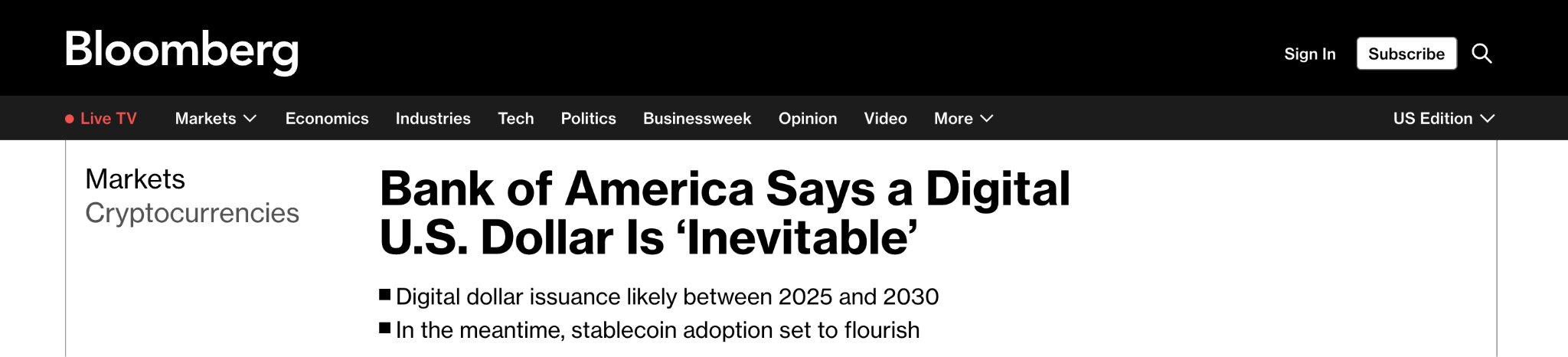
Their exact words: CBDCs are an “inevitable evolution of today’s electronic currencies.”
The Federal Reserve has already asked for public comment. The infrastructure is being built as you read this.
Once the digital dollar launches, every transaction you make can be tracked. Your spending could be controlled. Your accounts could be frozen.
China already did this. Nigeria already did this.
But there’s still a way to preserve your privacy.
I’m Tan Gera, ex-Wall Street banker and CFA© Charterholder.
I left the system when I saw what was coming.
Over 4,500 investors have already used this method to hold assets the government can’t freeze and generate yields the Federal Reserve can’t touch.
Watch how to access this escape hatch before it closes →
The window is closing.
To your freedom,
Tan Gera, CFA©
Decentralized Masters
P.S. Bank of America called the digital dollar “inevitable.” Discover the easy method investors are using to escape →
Aramco’s Export Lifeline Is Now a Target. Here Is What That Means for Gold.
Saudi Arabia did not simply postpone a conference this week. It cancelled the visible symbol of its own confidence in Riyadh’s security. The Future Investment Initiative, originally scheduled for October 26 to 29 in Riyadh, was pushed to 2027 after Houthi missile and drone attacks, including strikes on Riyadh’s King Khalid International Airport, prompted security concerns among international executives and investors. Among those no longer traveling to Riyadh: JPMorgan’s Jamie Dimon, Goldman Sachs’ David Solomon, Blackstone’s Stephen Schwarzman, BlackRock’s Larry Fink and Citigroup’s Jane Fraser.
The FII postponement matters as a signal, not a supply event. The supply event is Yanbu.
Why Yanbu Changes Everything
The Houthis said Monday they carried out operations targeting King Khalid International Airport in Riyadh, Abha International Airport, Saudi Aramco facilities in Yanbu on the Red Sea coast, the Shaybah oilfield and Saudi naval forces. Saudi officials said they intercepted drones and missiles, including projectiles aimed toward the wider Yanbu region and cruise missiles over the Red Sea.
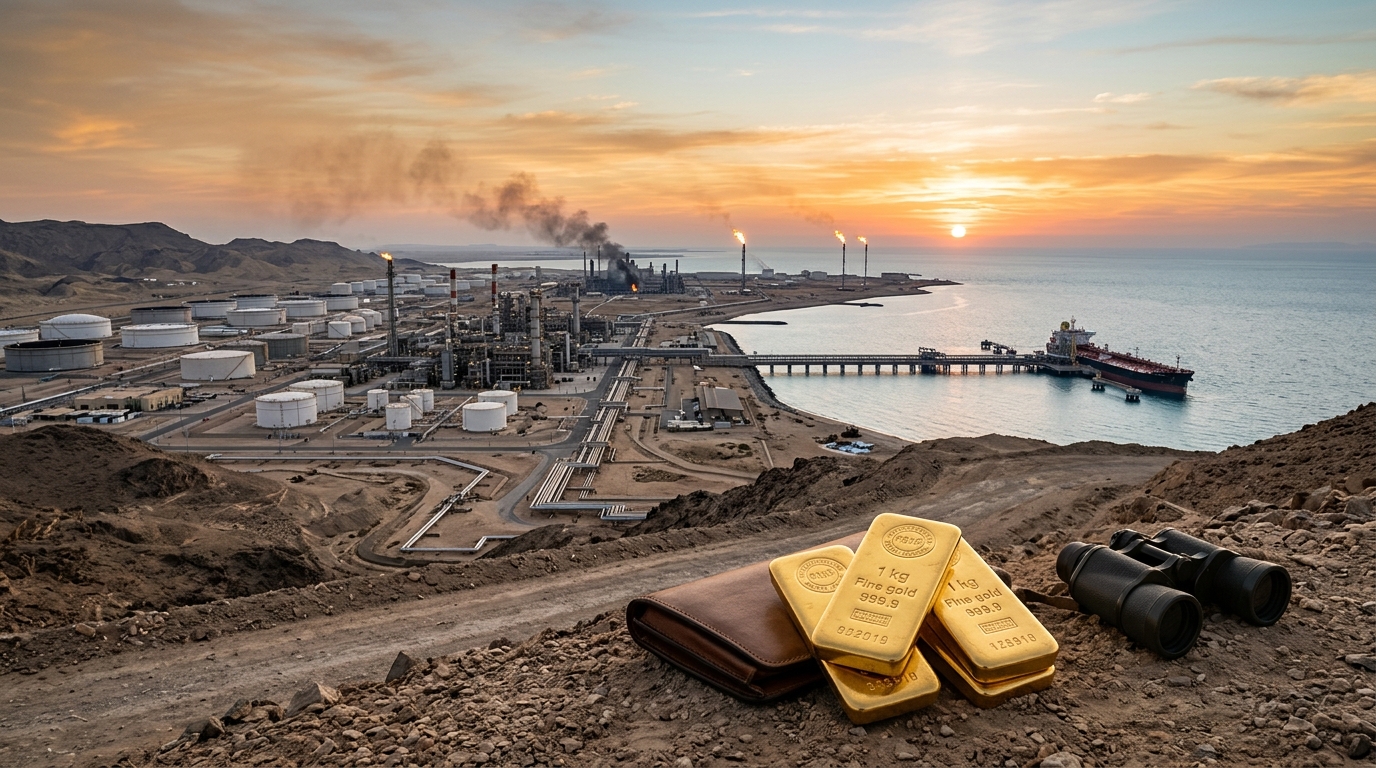
Yanbu is not one of several Aramco facilities. It has become the central artery of Saudi oil exports since the Strait of Hormuz was effectively restricted earlier this year. Saudi Aramco has said its East-West pipeline has a nameplate capacity of 7 million barrels per day, and it moved to run the line at full capacity after Gulf shipping was disrupted. Separate industry estimates and tanker-tracking snapshots have varied widely through 2026, so treat any single-day loading figure as directional, not definitive.
Shaybah tells a different story. The oilfield sits deep in the Rub’ al-Khali desert in southeastern Saudi Arabia, far from Houthi-held territory in northwestern Yemen. A confirmed strike at that range would represent a significant escalation in demonstrated Houthi reach. Whether the claim holds up matters less than what it signals: the Houthis are now explicitly targeting both ends of Saudi Arabia’s energy export infrastructure.
What This Does to Gold, Silver and the Dollar
Gold’s reaction so far has been counterintuitive. On Monday, spot gold fell about 0.4% to around $4,148 per ounce in afternoon trade, weighed down by a firmer U.S. dollar and elevated U.S. Treasury yields. Normally, attacks on Saudi oil sites would send buyers into gold. This time the energy shock is the bigger force.
Here is the key distinction investors need to make. The current yield pressure on gold comes from fiscal-driven term premiums, not from a Fed that is about to tighten aggressively. The Federal Reserve last raised its target range to 3.75%-4.00% in September, and markets are focused on what long-end yields are saying about inflation and sovereign risk rather than imminent policy tightening. That kind of yield environment has historically been one where gold holds ground, and sometimes gains, because both variables, rising inflation expectations and sovereign credit stress, are bullish for hard assets simultaneously.
Silver around $57 is catching a separate bid. Spot silver was up about 0.6% to roughly $57.37 on Monday. Oil at $110 raises industrial input costs broadly, which can suppress industrial silver demand. But the same oil shock that squeezes manufacturers accelerates the energy transition rationale for solar and electric vehicles, two of silver’s largest and fastest-growing end markets.
The dollar has absorbed some of the safe-haven flow, which is the headwind for metals right now. But the dollar’s safe-haven status in a Gulf energy shock is more fragile than it looks. Recent Saudi Exchange data show foreign institutions have been meaningful net sellers in several September reporting windows. That capital is looking for a home, and not all of it is landing in Treasuries with a 10-year yield that already carries fiscal credibility questions.
Risks to Monitor
No Saudi, Aramco or independent source has confirmed any strike on the Yanbu facility during the October 17 to 19 window, and no satellite imagery or damage reports have surfaced. Unconfirmed claims have historically produced a risk premium that fades once loadings are shown to be intact. Analysts expect oil prices to remain sensitive to supply disruptions, although the risk premium could decline if shipments continue without interruption. If Yanbu loadings run normally through next week, Brent pulls back and the current headwind on gold from oil-driven yield pressure eases.
The bullish case requires something more: confirmation of physical damage at Yanbu. The attacks matter less for the damage inflicted than for what they reveal: the vulnerability of the kingdom’s oil export safety valve. While there is no evidence of shipment disruption, experts say the attacks have left exposed what has become Saudi Arabia’s most strategically important oil export corridor.
Bottom Line
The Houthis crossing from shipping lanes to Saudi export infrastructure is a structural shift in risk, not a one-day headline. Gold’s subdued response reflects a specific yield dynamic, not a dismissal of the threat. If Yanbu damage is confirmed, the inflation channel for gold reopens forcefully and the dollar’s hold on safe-haven flows will be tested. Watch satellite data on Yanbu loadings and the 10-year yield’s next move with more discipline than any Houthi press statement.