
Hi,
If you’ve been waiting to get revenge on your bank…
For low interest rates… high fees… and rude customer service…
NOW is the time.
An alternative “AI Bank” is now available.
It pays 6% per year…
Charges you 0% fees…
And, crucially, gives you control of your money like never before.
This isn’t a crypto play, or anything to do with the blockchain…
It’s a revolution against traditional banking.
And the banks are terrified…
JPMorgan Chase and other major banks have been trying to stop it from happening behind the scenes…
But they’re failing.
And now more and more of these “AI banks” are popping up.
Regards,
Jeff Remsburg
Editor, InvestorPlace Digest
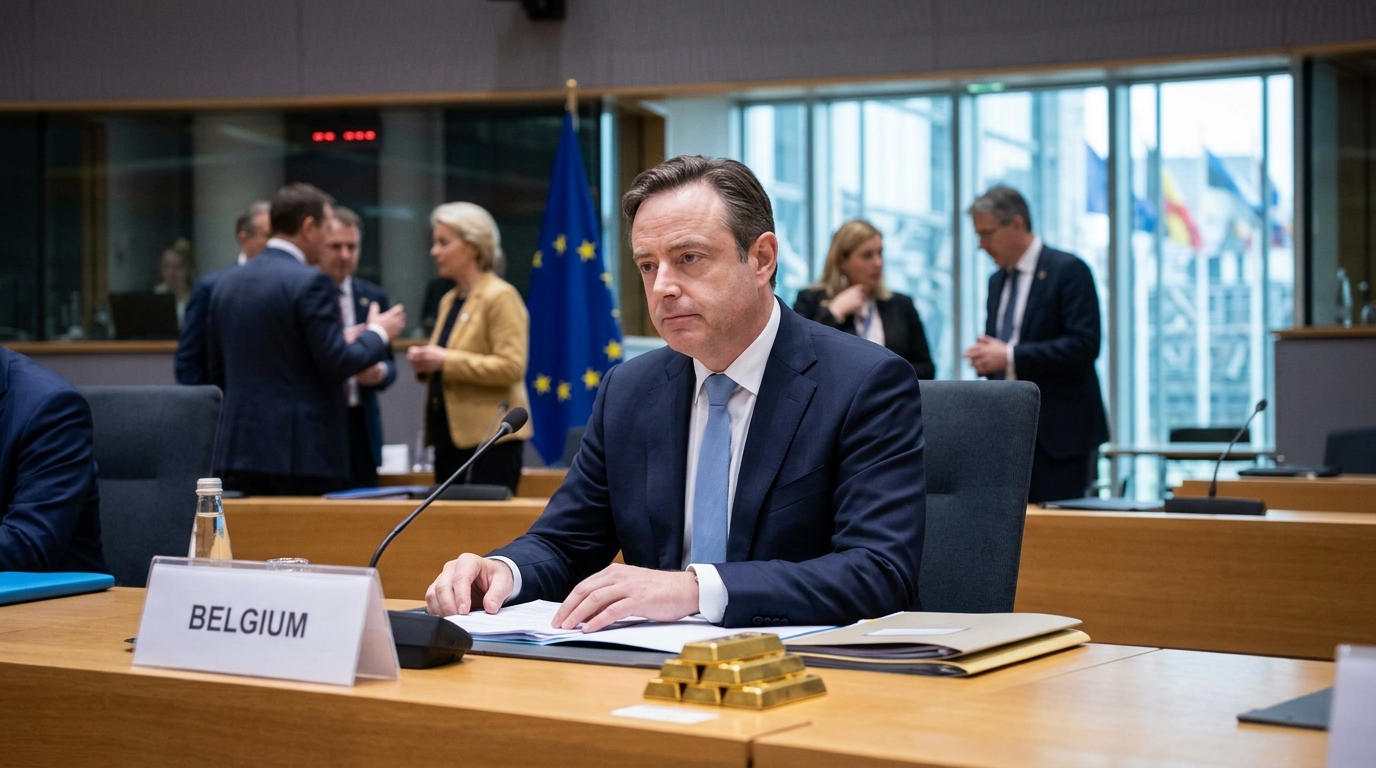
Belgium Just Proved Why Central Banks Keep Buying Gold
The October 15-16 EU summit in Brussels ended Friday without a word of progress on Ukraine’s funding crisis. Belgian Prime Minister Bart De Wever held firm, blocking any agreement to deploy the roughly €185 billion in Russian central bank assets held at Euroclear toward Ukraine’s war effort. Same position, same result, same excuse about legal exposure. The summit moved on.
What didn’t move is a $78 billion problem that is now firmly a market issue rather than a diplomatic one. Ukraine faces an unresolved $78 billion external financing gap for 2027: $45 billion for military operations and $32.6 billion to keep civilian government functions running, even as the European Commission has said 2026 needs are fully covered. The burden falls back onto EU joint borrowing and national defense budgets that were already stretched before any of this started.
Belgium’s core objection has never changed. De Wever has rejected EU proposals to use immobilised Russian central bank assets to support Ukraine, warning that tapping the assets could leave Belgium and Euroclear exposed to Russian legal retaliation. Most of the assets are held at Euroclear in Belgium. Meanwhile, Russia’s central bank has sued Euroclear in Moscow and Russian courts have ruled in the central bank’s favour, though enforcement outside Russia remains uncertain. Brussels has a clearing house sitting at the center of a geopolitical legal war, and no EU member state has offered Belgium the full indemnity it demands.
That impasse is the point. Not just for Ukraine, but for every reserve manager watching this play out.
The 2022 freezing of roughly $300 billion in Russian central bank assets was described at the time as a financial instrument of war. What it has actually become is a multi-year demonstration that sovereign reserves held in someone else’s jurisdiction can be immobilized, litigated, and rendered functionally inaccessible for a long time.
That shift shows up directly in the buying data. Central banks bought a reported 289 tonnes of gold in the second quarter of 2026, which the World Gold Council described as a record high for a second quarter. The World Gold Council’s 2026 Central Bank Gold Reserves Survey found that central banks have accumulated an average of 1,000 tonnes of gold annually over the past four years, and a record 45% expect to increase their holdings over the coming year. These are not momentum traders. They are institutions with 50-year investment horizons that do not sell because of a Fed meeting or a ceasefire headline.
Gold near $4,150 an ounce is not cheap by any historical measure. But the claim that gold reached an all-time high of $5,608 in January 2026 does not hold up, so I am not going to anchor this argument to a number that cannot be verified. Every central bank buying at current levels knows the metal is historically expensive. They are buying anyway, because the alternative is holding a claim on another government’s financial system that can be frozen, litigated, and blocked by a single dissenting vote at an EU summit.
The Euroclear situation keeps that lesson fresh. Defense contractors like Rheinmetall are filling some of the gap Belgium leaves open: Ukraine signed a contract with Rheinmetall for 155mm artillery ammunition and propellant charges, with Rheinmetall describing the deal as worth a high double-digit million euro amount. But contracts funded through improvised joint borrowing are a workaround, not a solution. The underlying funding architecture for 2027 remains broken.
Rheinmetall is one node in a much larger rearmament wave. European defense budgets rose roughly 20% in a single year, and NATO’s new 5% GDP spending target has locked in multi-year procurement backlogs across the primes.
For gold investors, the relevant question is not whether Belgium eventually relents. It probably does, eventually, under enough pressure. The relevant question is what the past four years of watching this process have taught reserve managers about the risk of holding foreign currency reserves versus holding a physical asset with no counterparty. The short answer is reserve diversification driven by geopolitical risk, not a bet on next quarter’s gold price. Every failed summit reinforces that calculation. Friday was another one.