
October 8, 2026
Bonus Content: The Dutch Government Is Selling Half Its ABN Amro Stake
TODAY’S GOLD ALERT(AD)
Dear Reader,
At Daily Gold Alerts, we have a saying: the price of gold is an outcome, not the story.
The real story is what drives it: energy, policy, geopolitics, and the scramble for strategic resources. That’s why today’s development caught our attention.
Trump just threatened a country.
No… not Iran.
Not Canada… Mexico… or even China.
None of the usual suspects.
One of the ten most powerful economies in the world passed a new law that would hit one massively profitable American company.
Trump went to bat for them, warning that hurting this company would be a “big mistake.”
So why would a sitting president pressure a major economy over a single publicly traded stock?
What’s Driving This
Follow the resources.
With the Iran War looking like it will stretch well past the midterms, energy security has become a front-line national issue.
And this company sits at the epicenter of the two forces Trump sees as essential to his second term:
Precious metals investors know this pattern well. When governments start defending strategic assets, markets begin pricing in security, not just earnings. Those shifts don’t stay small for long.
The Opportunity
According to veteran strategist Karim Rahemtulla of Monument Traders Alliance, this shift is creating what he calls “unicorn” opportunities.
They’re rare. But they can have the potential to rise 1,000% or more, sometimes in months, sometimes in days.
Karim screened 23,281 publicly traded stocks.
Right now, only ONE meets his criteria.
See the only unicorn stock Karim has found in today’s market →
Risks to Monitor
Speculative opportunities carry real risk. Policy fights can de-escalate, and timelines can slip. That’s exactly why Karim lays out his full case, including what could go wrong, before you decide anything.
Bottom Line
When a president personally defends one company on the world stage, smart investors ask why.
Karim believes he has the answer, and the stock.
To your prosperity,
The Daily Gold Alerts Editorial Team
P.S. The last time Karim found an opportunity like this, his readers had the chance to get a stock at $2 in 2022. It’s now nearly $20. This window won’t stay open long.
The Dutch Government Is Selling Half Its ABN Amro Stake
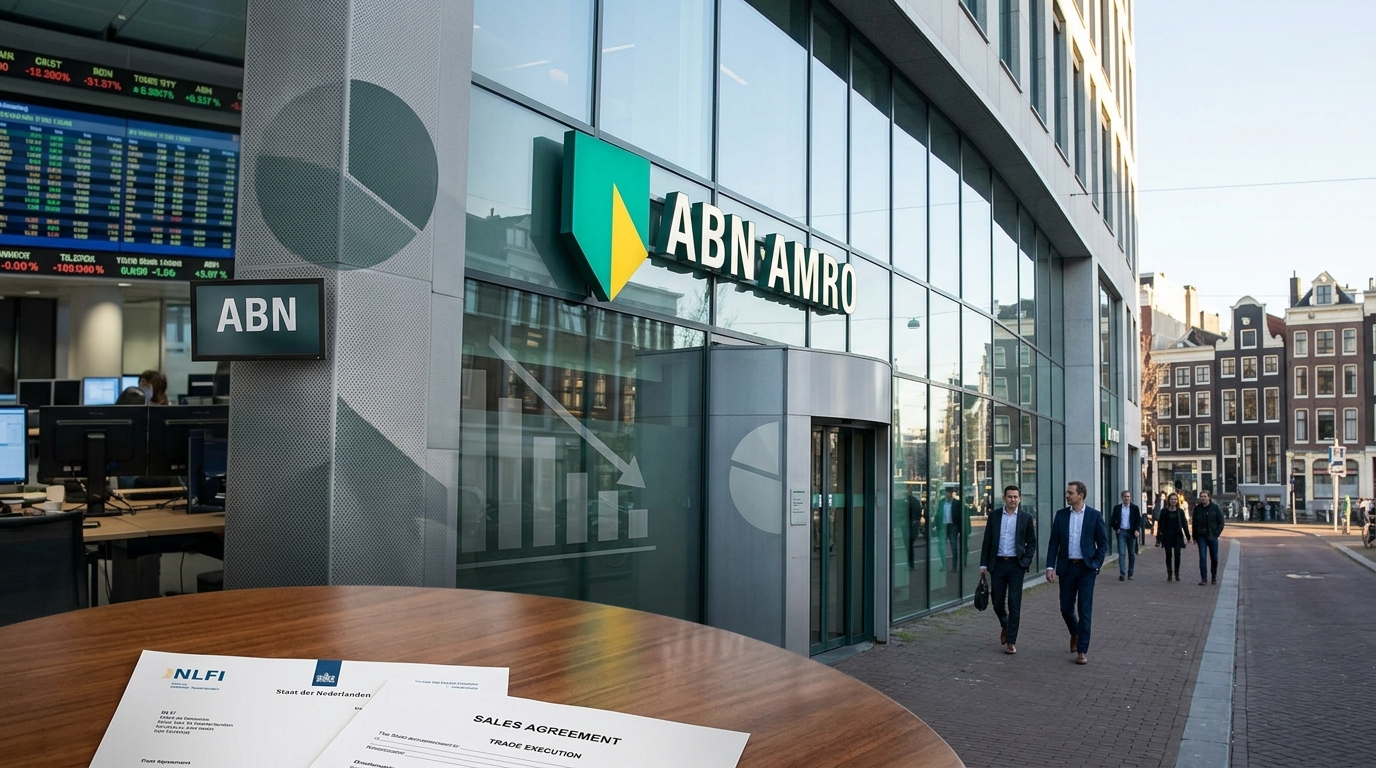
The story of the Dutch government and ABN Amro has always moved in one direction: toward the exit. On October 7, that journey accelerated sharply. NLFI, the foundation that manages the state’s interest in financial institutions, announced it would reduce its stake in ABN Amro from 20.7% to 10.5%. That is not a trim. It is essentially halving what remains of an 18-year-old rescue position.
The new plan is the fifth consecutive trading plan since ABN Amro’s initial public offering, with first trading expected to commence on November 20, 2015, following earlier sell-downs through accelerated book builds. The sale of shares will happen via a pre-agreed trading plan executed by BofA Securities Europe. There is no fire sale, no block discount, no panic. This is an orderly wind-down of a public ownership experiment that was never meant to be permanent.
Mandates like this one — orderly, high-profile government sell-downs executed through a single bookrunner — are exactly the kind of fee-generating work that has been refilling investment bank pipelines across the Atlantic. The same dealmaking environment powering European privatizations is driving Wall Street revenues to multi-year highs. how the M&A supercycle is pushing Goldman Sachs above a thousand dollars explains the broader capital markets backdrop.
The mechanics matter beyond the share count. NLFI and ABN Amro have agreed that NLFI will keep its current information rights for as long as it holds 10% or more of the bank. The Relationship Agreement will end as soon as NLFI’s stake falls below 10%. That is the real clock ticking here. The current plan targets 10.5%, which keeps the agreement alive by just half a percentage point. A further trading plan, buyback, or even modest market activity could push the stake through that floor, ending the state’s formal governance footprint altogether.
CEO Marguerite Bérard told Bloomberg Television: “The state has always made very clear that its intention was to fully return ABN Amro to the market, and we welcome that direction.” The choreography is polished, but the direction is unambiguous. Management wants the government off the shareholder register.
ABN Amro stock closed at €40.47 on Euronext Amsterdam on October 7, down 4.39% from a previous close of €42.33. The dip is a familiar artifact of supply overhang rather than any fundamental deterioration. ABN Amro reported net profit of €781 million for the second quarter of 2026, and a broader analyst consensus lists a Buy mean rating from 20 analysts with an average target of €43.31.
For European banking investors, this matters beyond the Netherlands. The Dutch government nationalized ABN Amro in October 2008 during the financial crisis, and the lender returned to the stock market on November 20, 2015, after which the state has steadily reduced its holding. That arc, now nearing completion, is the same arc playing out across the continent. ING, Deutsche Bank, and UniCredit have each undergone their own post-crisis ownership normalization, and each successive exit by a European government has generally been read as a confidence signal by the broader market.
That confidence signal is part of a wider re-rating story for the financial sector. As government stakes shrink and deal pipelines refill, the investment case for banks has quietly shifted from recovery to compounding — a dynamic worth understanding before the next leg higher. why the return of boring banking is actually the trade of the year lays out the structural argument in full.
The question for investors watching ABN Amro specifically is what a fully privatized governance structure does to strategic optionality. Without the Relationship Agreement, the bank operates without a state information partner watching over material decisions. That removes one layer of constraint, but it also removes one layer of implicit sovereign backstop.
It is a question that applies more broadly to every major bank navigating the post-crisis transition from constrained institution to fully commercial operator. The contrast between banks that have used that freedom to build durable revenue engines and those still finding their footing is sharper than it has been in years. how Goldman Sachs and Morgan Stanley have built fundamentally different strategies for the same environment is the clearest illustration of what strategic optionality actually looks like in practice.
The key question going forward is whether the remaining state holding is flagged for further disposal on a set timetable, which caps the overhang debate, or left open-ended. Until that answer arrives, the 10.5% floor is not a destination. It is a waypoint.