
October 7, 2026
Bonus Content: AI Chip Startup Etched Is Seeing $40–50B Bids. Nvidia Should Watch.
Dear Reader,
Every single day a new drug sits waiting for FDA approval can cost the company behind it approximately $500,000.
Miss by a month and the meter can run to $15 million. Miss by a quarter and it can reach $45 million.
Now you understand why this hidden AI company may have big pharma trapped in the best possible way for investors.
See why this $500,000-a-day problem has my full attention.
I am Alexander Green, Chief Investment Strategist of The Oxford Club for more than two decades. I bought Apple in 1996, and Amazon and Netflix below $3 split-adjusted.
Those wins taught me to look beyond the loudest hardware story and ask a more important question: Which company becomes so embedded in an industry that removing it feels reckless?
I believe I have found one.
Nineteen of the top 20 biopharma companies run regulatory operations through its platform. Their clinical data, submissions, and compliance records live inside the system.
Now comes the pressure point: customers are being moved from a legacy product to the company’s newer AI-powered platform. More than 125 customers are already live, and Clinical Data AI applications are scheduled to go live in December 2026.
When one lost day can carry a six-figure cost, switching to an unproven rival could be an executive-level gamble.
Discover why big pharma may be unable to walk away from this platform.
This is Phase 2 of the AI boom: not building chips, but using AI to take control of an essential, expensive workflow. The deeper the platform goes, the harder it may become to replace.
That December rollout gives investors a concrete reason to pay attention now, while the company is still hiding in plain sight.
The December rollout is on the calendar. The stock is still hiding in plain sight.
See the complete biopharma AI case before the December rollout.
Good investing,
Alexander Green
Chief Investment Strategist, The Oxford Club
P.S. One day of FDA delay can cost roughly $500,000. This platform already sits inside 19 of the top 20 biopharma giants, and its Clinical Data AI rollout is scheduled for December. See the stock behind the rollout here.
AI Chip Startup Etched Is Seeing $40–50B Bids. Nvidia Should Watch.
Something strange is happening in the inference-chip market. Etched is fielding investment offers at valuations between $40 billion and $50 billion, roughly double the $21 billion mark the company set in August when it announced a $700 million round led by Jane Street. That August financing itself came only weeks after the company disclosed a $300 million round in July at a $10.3 billion valuation.
Etched’s valuation has climbed from $10.3 billion in July to $21 billion in August to $40 billion-plus in reported talks, three marks in under three months, among the fastest-compounding valuation curves of 2026’s AI infrastructure cycle. No deal has closed. The talks remain at an early stage, and terms could change or no deal may ultimately be completed. Still, the fact that credible term sheets exist at these levels says something meaningful about where capital thinks this market is going.
What Etched Is Actually Selling
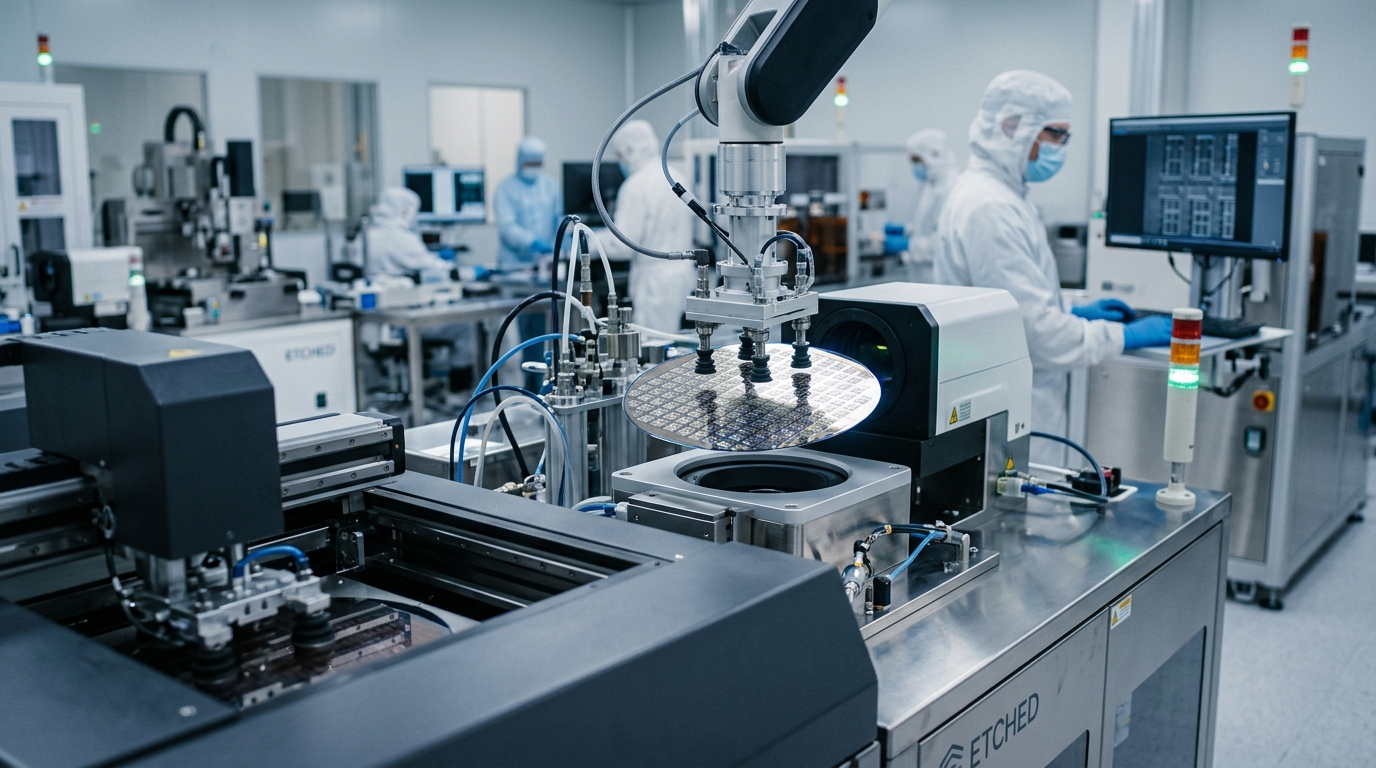
Etched designs specialized chips built to run transformer models, the architecture behind today’s large language models. By narrowing its focus to a single workload, the company is betting it can outperform general-purpose processors on AI inference. The company claims its chips can process more tokens faster and at a lower cost than Nvidia’s.
The pitch has traction in the market. The startup builds full AI inference systems powered by its own chips, and the company has said it has secured more than $1 billion in customer contracts. That places it well past the slide-deck stage.
Etched has also impressed investors with its ability to attract engineers from Nvidia, with around 15% of its roughly 400 employees having previously worked at the chip giant, according to The Wall Street Journal. Hiring Nvidia alumni is a signal of intent. It is also, implicitly, a referendum on Nvidia’s ability to retain the people who understand its weaknesses best.
What This Means for Nvidia and Broadcom
Nvidia is not standing still. The Information reported in June 2026 that Nvidia increased its share of the AI inference chip market to 74%, and that its estimates assume about 55% of Nvidia’s revenue in the April 2026 quarter came from inference workloads, or about $41 billion. That is a dominant position, but dominance in a fast-moving market is rented, not owned.
Broadcom is the more nuanced story. Inference is a more vulnerable part of Nvidia’s stack than training because repetitive production workloads reward specialization. Once the same model is serving enormous traffic, even a modest reduction in cost, power, or latency can justify the engineering effort required to move away from a general-purpose GPU. Broadcom is becoming a serious threat in hyperscale custom silicon and networking, co-designing chips for the world’s largest buyers. Etched is targeting a different layer: companies that want purpose-built inference systems but do not have the engineering scale of Google or Meta to design their own.
Risks to Monitor
The honest read here carries caveats. Jane Street being both Etched’s biggest investor and its most visible customer is the diligence flag. That’s not fraud; it’s a demand signal that needs an independent reference customer before anyone treats $1 billion in contracts as proof of market pull. That’s a narrower bet than Nvidia’s, Groq’s, or Cerebras’s broader AI-accelerator plays, and it only pays off if transformer-style inference stays the dominant workload. Architecture shifts in AI have happened before, and a startup optimized for one paradigm carries real concentration risk.
Even so, the compression of Etched’s valuation timeline is the story worth watching. Private markets are pricing inference silicon at a pace the public equity market has not fully absorbed. Whether or not Etched ultimately closes at $40 billion or $50 billion, the offers themselves confirm that the market for Nvidia alternatives is moving from aspiration to capital formation. For investors watching Nvidia and Broadcom from the outside, the private-market reset is an early indicator worth tracking.