
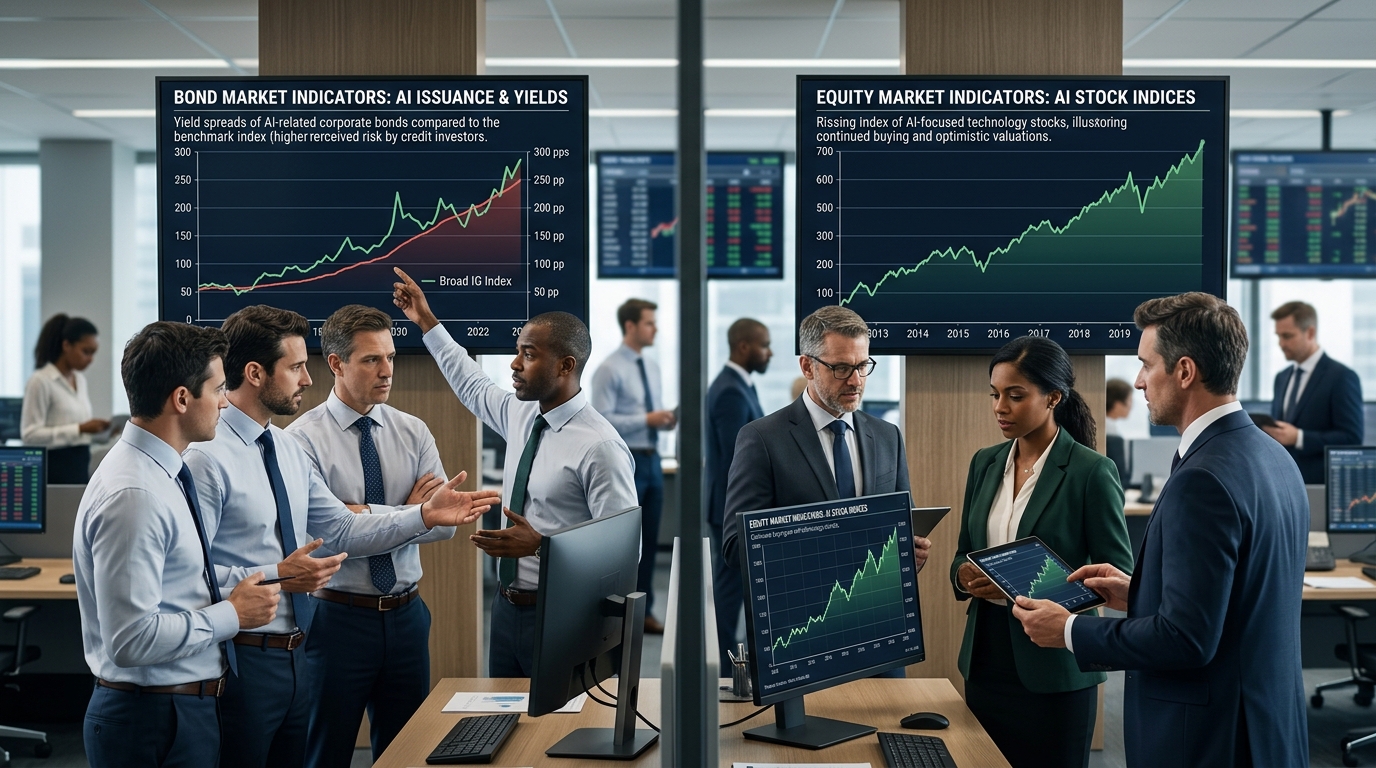
Two markets are staring at the same AI buildout and reaching opposite conclusions. Credit investors are charging a 115-basis-point spread on AI-related bonds against roughly 78 for the broad corporate index, a gap that has widened materially as long-term government bond yields have climbed to their highest levels since 2007. Equity investors, at least in some corners, keep buying. Figuring out which market has the better read is the most important question in institutional portfolios right now.
The bond market’s verdict is blunt. New-issue AI bond issuers have averaged premiums of approximately 12 basis points above secondary market levels to get deals done, compared with roughly 2.5 basis points for the broader investment-grade market. That concession exists for a reason: Goldman Sachs expects gross debt issuance from hyperscalers to hit a record $420 billion next year, up 60% from its 2026 estimate, while overall U.S. corporate issuance through August was already up 30% year over year to $1.9 trillion, according to the Securities Industry and Financial Markets Association. Supply at that scale forces price discovery whether the market wants it or not.
With the 10-year Treasury yield near 5.17% as of September 25, 2026, up about one percentage point from early 2026, companies issuing debt are having to offer more attractive rates of return to lure investors. The result: bond buyers are getting selective. Brown Advisory’s head of fixed income, Colby Stilson, said the firm is being “very selective” within hyperscaler debt, citing “the coming supply and the lack of visibility into that return on invested capital.”
The equity market’s split reaction to all this is telling. CoreWeave has held up fine this month, while Oracle, which has counted on the debt market for its AI expansion, has struggled. That divergence maps almost exactly onto balance-sheet risk. S&P Global Ratings downgraded Oracle in July. The company’s fiscal 2026 free cash flow came in at negative $23.7 billion, the direct consequence of pouring cash into data centers, chips, and leases faster than the cloud business generates it. Oracle’s stock slid further after Bloomberg reported that the company sent a force majeure notice tied to its New Mexico data center project, seeking to delay payment on the campus if it fails to come online as expected in 2028.
Meta and Microsoft sit in a different position. Meta’s shares rallied sharply in September and approached a $2 trillion market cap. Analysts pointed to improving confidence in Microsoft’s AI investments. Both companies are issuing debt in volume, but their cash generation gives bondholders a margin of safety that Oracle’s does not.
The hidden implication most equity investors are underweighting: the financing structure itself is becoming a competitive moat. CoreWeave closed an $8.5 billion delayed draw term loan rated A3 by Moody’s and A (low) by Morningstar DBRS, a rare example of investment-grade rated financing secured by GPU infrastructure and an associated customer contract, backed in part by contracted cash flows from Meta. Blue Owl, PIMCO, and other private credit firms have committed over $40 billion to preleased data centers through Rule 144A private placements since late 2025, accessing a market that public-market buyers structurally cannot reach. Firms that can tap private credit at scale are insulated from the public bond repricing. Those that cannot are exposed to it every time they return to market.
BlackRock’s credit team has argued the widening in AI-related spreads reflects supply-and-demand dynamics rather than credit-quality concerns, and that companies remain willing to fund themselves at wider spreads because they believe AI investments will generate returns well above their borrowing costs. That may be true. But the bond market’s roughly 37-basis-point premium over the broad investment-grade index is the market demanding proof, not assuming it.
Stocks to Watch
Oracle (ORCL): The most exposed name. Junk-adjacent credit ratings, negative free cash flow, and a force majeure notice on a flagship data center project have combined with rising yields into a genuine cost-of-capital crisis. The equity has already absorbed a steep decline in 2026; the bond market suggests the re-rating is not finished.
CoreWeave (CRWV): The counterintuitive beneficiary among the debt-heavy names. CoreWeave warns about rising rates in its SEC filings, noting that every 100-basis-point increase in rates could increase interest expense by about $30 million on its floating-rate debt. But GPU-backed, investment-grade rated financing and a contracted revenue backlog give it a structural advantage over unsecured borrowers. Watch whether that premium holds as rates stay elevated.
Meta (META): The clearest example of a company that gets to be on both sides of the trade, issuing debt to fund capex while simultaneously providing the contracted cash flows that back other companies’ debt. That circularity is a strength, not a risk, as long as its own revenue keeps growing.
Microsoft (MSFT): A strong balance sheet insulates it from the worst of the repricing. Barclays has estimated that the six largest technology companies now account for approximately 8.6% of duration-times-spread in the U.S. investment-grade bond market, exceeding the six largest banks. Microsoft’s size within that cohort means its bonds move markets, but its earnings power means it can absorb the cost.
Blue Owl (OWL): The private credit channel that public bond markets cannot easily replicate. Blue Owl has been involved in financing large, preleased data center projects linked to marquee partners. As public bond spreads widen, the premium on private credit access grows with them.