
September 27, 2026
Bonus Content: Distressed Offices Are Becoming Data Centers. Silver and Copper Pay Attention.
A message from America’s Gold Company
URGENT ALERT
Your Retirement Has a $40 Trillion Problem
America’s debt just reached a level no nation has ever seen, and paper savings sit directly downstream.

If you have a 401(k), IRA, or TSP, and it sits entirely in paper assets, then every dollar of it depends on the strength of a currency now backed by nearly $40 trillion in debt.
According to U.S. Treasury data, the national debt is closing in on $40 trillion. More than any nation has ever owed. And with long term borrowing costs at some of their highest levels in years, Washington is paying real money just to service what it already owes.
But here is what most people are not being told: a government this deep in debt rarely defaults loudly. History suggests it quietly pays its bills with dollars that buy less, year after year. And the savings built on those dollars feel it first.
One bad year. One shock. One crisis of confidence.
History shows how quickly paper savings can give back years of gains, and how long rebuilding can take.
There is a way savers have historically prepared, and it is available to you right now.
Long standing IRS rules generally allow you to move a portion of your retirement savings into physical gold and silver, a time tested store of value, and you may be eligible to do it without triggering taxes or penalties.
Everything you need to know is laid out in the FREE Precious Metals Retirement Guide from America’s Gold Company. Download your free copy here!
Inside, you will learn how the process generally works, who may qualify, and the specific questions to ask before moving a single dollar. The guide is free, with no obligation of any kind.
Yes, Send Me the FREE Precious Metals Retirement Guide!

Free to Claim. Includes Retirement Rollover Basics, Step by Step.
100% free. No credit card. Delivered straight to your inbox.
Or speak with a precious metals specialist at 1-888-691-8238.
Distressed Offices Are Becoming Data Centers. Silver and Copper Pay Attention.
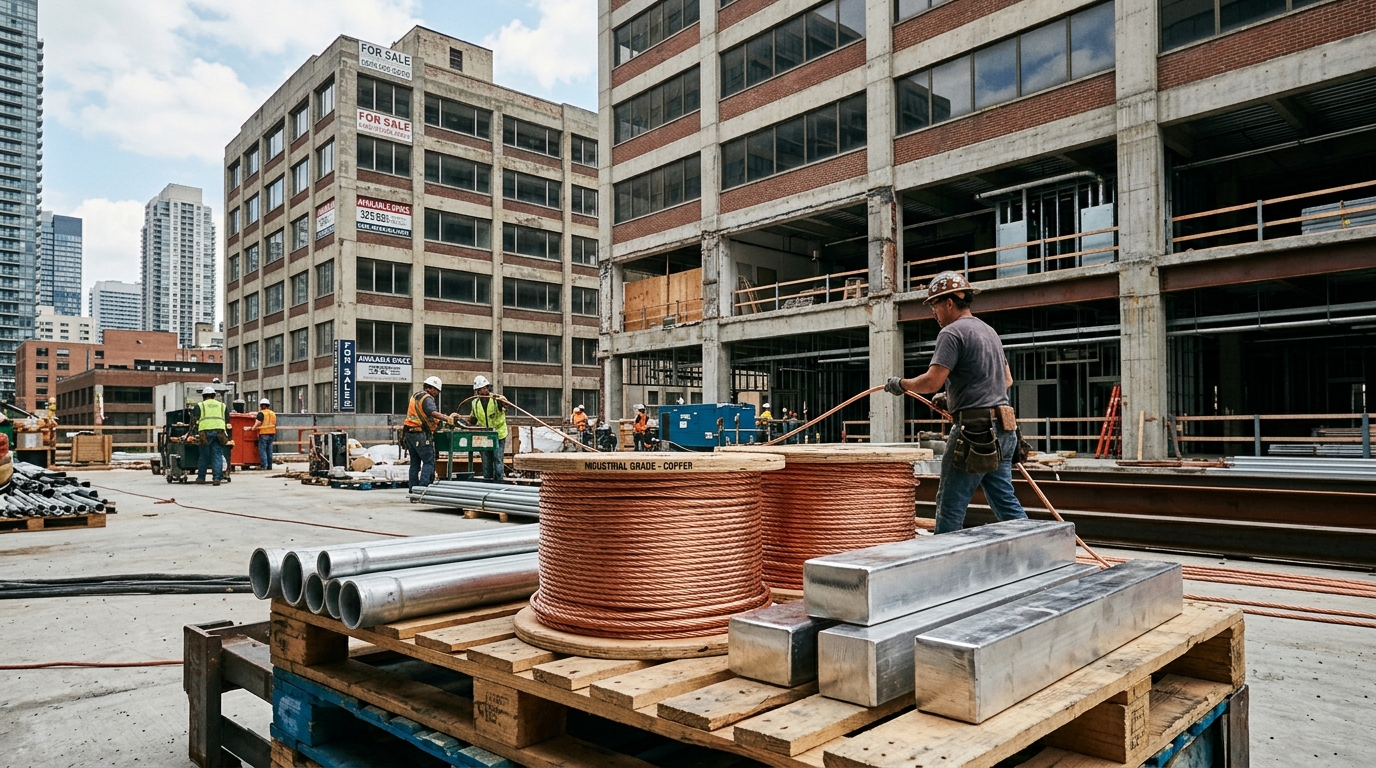
The story most investors are telling about the commercial real estate collapse is about losses. The more useful story is about what replaces those buildings, and what that replacement consumes.
The CMBS office delinquency rate climbed to a record 12.34% in January 2026, the highest since Trepp began tracking the metric in 2000. That is not a cyclical soft patch. The end of “extend and pretend” is forcing lenders and borrowers toward workouts or foreclosures. Roughly $875 billion to $936 billion in commercial real estate loans are scheduled to mature in 2026. Class B and C office towers in secondary markets are the most exposed, and they are landing in the hands of opportunistic buyers at prices that would have seemed absurd three years ago.
A growing number of those buyers are not housing developers. They are edge data center operators. Firms such as EdgeNebula are converting underutilized or vacant urban real estate, including empty offices, into data centers designed to handle AI-era power demands on the existing city grid. The conversion can take as little as two months, using modular deployments with liquid cooling and waste heat recovery for the host building or local district heating networks. The economics are compelling: in top North American colocation markets, vacancy has been near zero, with Northern Virginia at 0.2% in the first half of 2026, keeping utilization extremely tight for available capacity.
This is where the precious metals angle sharpens. Every repurposed office tower that goes live as an edge facility is a new consumer of silver and copper, in volumes that dwarf anything typical office tenants required. The World Silver Survey 2026 says Metals Focus and the Silver Institute expect silver offtake from data centers alone to exceed 10% of electrical and electronics demand next year. Silver is used in AI and data centers primarily as an electrical and electronic material, with key applications including electrical contacts, connectors, switches, relays, circuit boards, semiconductor packaging, and power-management equipment. This lands on top of a silver market that has been running a supply deficit for multiple consecutive years, with industrial use accounting for roughly half of all annual silver demand.
Copper’s exposure is just as direct. Wood Mackenzie finds that base metals demand from data centers extends beyond the servers and cooling units inside the facility to grid reinforcement and transmission networks, with that additional layer significantly expanding the metals demand created by each data center. Trafigura estimates AI could add up to 1.0 million tonnes of additional copper demand by 2030. Edge conversions are small individually, but they are multiplying across hundreds of mid-tier markets simultaneously, each one connecting to existing urban substations rather than greenfield grid extensions.
Where the Opportunity Sits
Class B and C office collateral remains a conversion, or rescue-capital problem for traditional real estate lenders. For metals investors, it is something else: a structural demand driver arriving through an unexpected channel. The distressed office cycle and the AI infrastructure buildout are two separate stories that are quietly merging into one metals demand event.
Silver miners with low all-in costs and exposure to growing industrial off-take, and copper producers positioned for tight refined balances in 2026, are the clearest beneficiaries. The fire sale in commercial real estate is, in a roundabout way, a purchase order for both metals.