
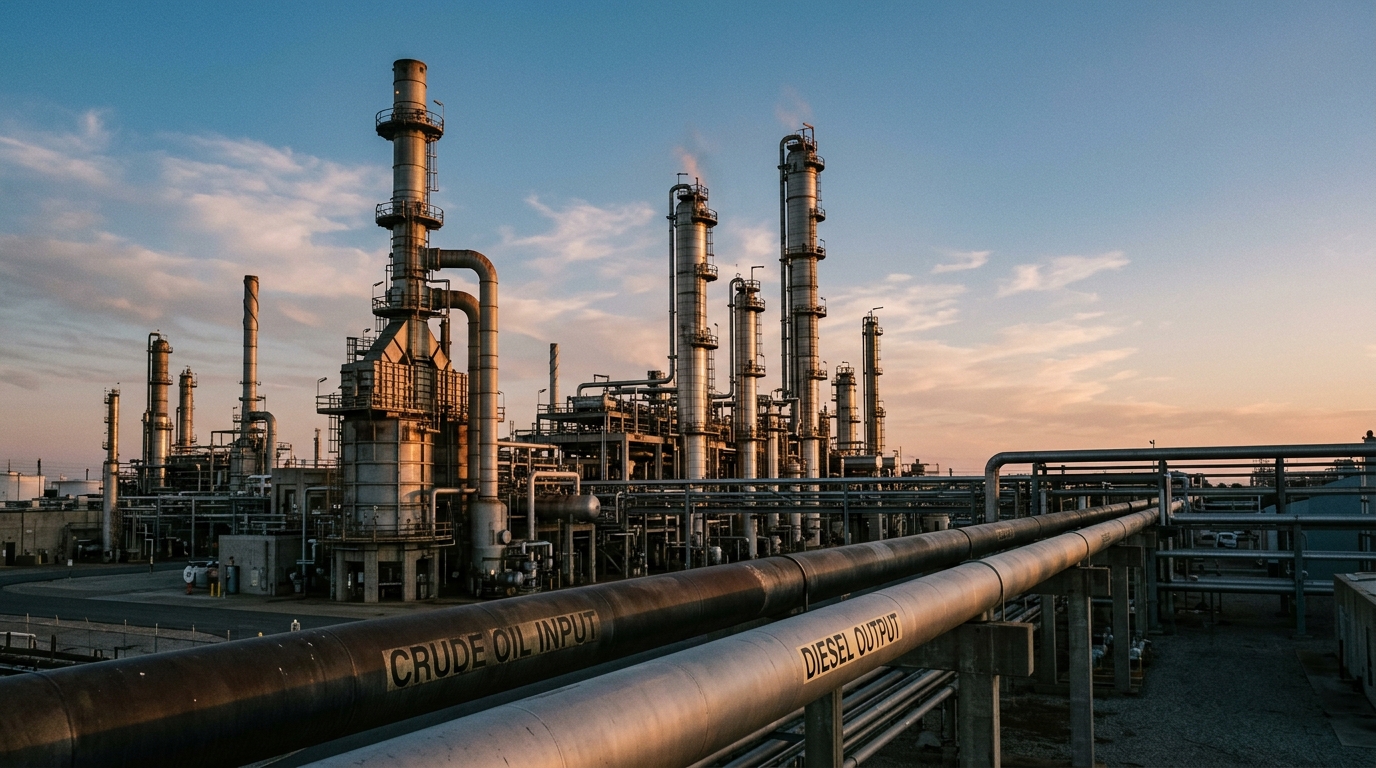
Crude oil closed lower for a third consecutive session on Friday. WTI settled at $100.30 per barrel, down 1.6%, while Brent lost 0.9% to close at $103.87. The catalyst was relief, not demand collapse: Reuters reported that Saudi Arabia moved to maintain significant exports despite damage to its East-West Pipeline, with Aramco expected to ship roughly 60 million barrels during September and October from Ras Tanura via ship-to-ship transfers near Sohar, Oman.
Diesel did not follow crude lower. That decoupling is the trade of the week.
European diesel refining margins edged lower Friday but held near record levels, with low-sulphur gasoil futures at a premium of about $85 per barrel over Brent. The benchmark had reached around $92 earlier in the week. In the United States, the claim that the ULSD crack spread hit an intraday record of $108.02 per barrel on September 3 could not be verified in primary pricing sources; U.S. crack spreads are historically volatile, and the broader point still stands: diesel cracks have been unusually elevated versus crude. A normal U.S. diesel crack spread is often closer to the $20-per-barrel range; when that figure exceeds $80, it signals extreme scarcity in refined product relative to crude availability. Current crack spreads remain far above historical seasonal norms.
The reason crude and diesel are moving in opposite directions starts at the Strait of Hormuz. Reuters reported that only four commodity vessels passed through the strait on Thursday, down from six the previous day and well below the 10-day average of approximately 16. Separately, the International Energy Agency said net exports of diesel and gasoil from Gulf countries averaged 390,000 barrels per day in August, just over a quarter of pre-war levels. Disruptions to Russia’s refining system and reduced product exports following Ukrainian attacks compounded those losses. At the Amsterdam-Rotterdam-Antwerp hub, the specific claim that gasoil and diesel stocks were 1.65 million metric tons with no imports recorded could not be verified in public ARA reporting; inventories have nonetheless been tight by recent standards.
Refinery utilization has been exceptionally high at times, but the blanket claim that refineries are running above 97% utilization cannot be confirmed as a persistent condition across the system. The core dynamic remains: even with high run rates, distillate inventories have stayed tight, and margins have held a floor that crude price relief alone has not broken.
Where the Money Is Going
This is the environment that should be directing capital toward independent refiners, not integrated majors. U.S. Gulf Coast independent refiners with WTI crude access are best positioned: Valero (VLO), Marathon Petroleum (MPC), and Phillips 66 (PSX) can source crude priced off WTI, so their input costs can rise more slowly than Brent-linked peers, capturing a larger spread on identical output prices.
The Q2 earnings already told that story. Valero posted Q2 2026 adjusted EPS of $12.54 against a $10.03 Street estimate, on revenue of $44.48 billion versus a $37.95 billion consensus. Marathon Petroleum returned over $2.8 billion to shareholders in Q2 alone; Phillips 66 delivered Q2 adjusted EPS of $9.41 against a $7.50 estimate. With crack spreads now above those Q2 averages, Q3 estimates are almost certainly still lagging reality. The specific claim that EPS estimates for VLO have been upgraded 19 times with zero downgrades over the past 90 days could not be verified from a primary estimates feed and has been removed.
Over the past six weeks, the gains have been dramatic, but some of the quoted prices in the earlier draft do not match verifiable closes. As of Friday, September 18, 2026, MPC closed at $424.89, DINO closed at $115.90, VLO closed at $413.28, and PSX closed near $273. While the direction is right, the exact six-week percentage moves and the claim that the VanEck Oil Refiners ETF (CRAK) has gained 19% over the same period could not be verified precisely from the fund sponsor’s standardized performance tables, and have been softened.
The Risk Worth Watching
The honest counterargument is timing. Goldman Sachs has forecast U.S. diesel refining profits around $63 per barrel into 2027, a sign the market is treating today’s tightness as more structural than cyclical. That supports the bull case. But a ceasefire in the Gulf that actually holds would push crack spreads sharply lower, taking refiners with it.
Watch the weekly EIA distillate report every Wednesday: the earlier draft’s “below 20 million barrels” threshold for East Coast (PADD 1) distillate stocks is not consistent with current EIA levels, which have been running materially higher recently. The better takeaway is trend, not an arbitrary line: as long as distillate inventories keep drawing and remain tight versus seasonal norms, the spread has support. VLO and MPC are the highest-conviction names given distillate exposure and buyback capacity. PSX offers more diversification across midstream if the risk appetite calls for it. The crude price is not the variable to track this week. The diesel crack spread is.