
September 19, 2026
Bonus Content: Darden Reports Thursday Into a Tough Cost Quarter
Hi,
Take a look at this…

It’s smaller than a fingertip…
It’s made of glass…
And it’s about to unlock the next wave of AI growth.
Jensen Huang, Nvidia’s CEO, says this “light-speed” device is shattering the limitations of AI… and without it, AI can’t scale.
Google Ventures says it’s the future of AI compute…
And Sequoia Capital – the firm that backed Anthropic and OpenAI – calls it a “holy grail.”
Already, Elon Musk, Mark Zuckerberg, Cathie Wood, and Bill Gates are moving money to prepare for what’s coming…
Yet most Americans have never heard of it.
Wall Street insider Jason Bodner – the same man who called Nvidia at $4.50 – says this device is about to launch a whole new wave of AI winners…
And to prove it, he’s giving away his #1 stock involved with it – for free.
Click here to learn more. (No purchase necessary.)
We have so much to look forward to,
Jeff Brown
Founder & CEO, Brownstone Research
P.S. Stocks tied to this “light-speed” device already surged 133%, 217%, and even 320% – in a few short months. But it’s just getting started. Click here before the mainstream catches on.
Darden Reports Thursday Into a Tough Cost Quarter
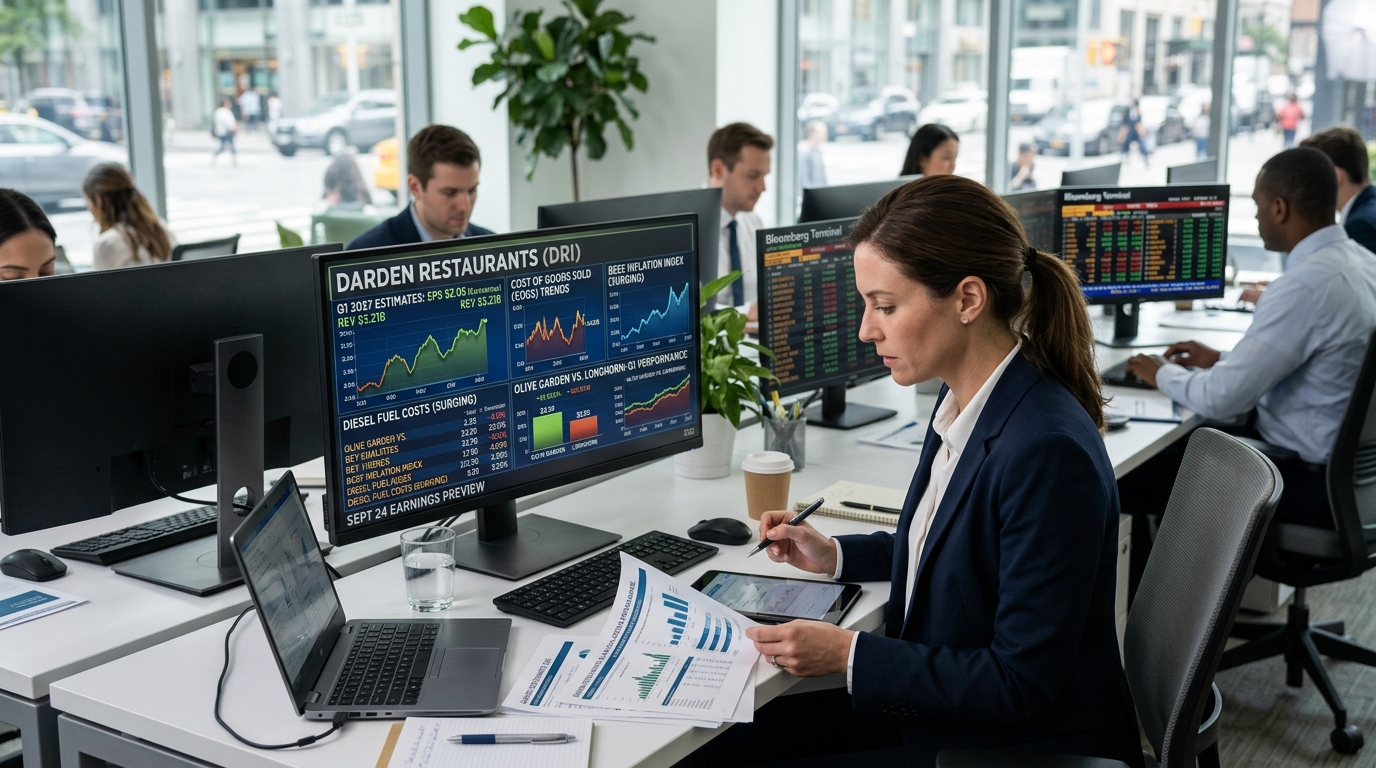
Darden Restaurants drops its fiscal 2027 first-quarter results before the open on Thursday, September 24, and the setup is harder than the consensus suggests. Analysts expect $2.05 per share on revenue of $3.21 billion, compared to $1.97 per share and $3.04 billion in the year-ago quarter. That is tidy growth on paper. The problem is the cost environment surrounding those numbers.
The EIA’s weekly update shows U.S. on-highway diesel averaged $6.285 per gallon for the week of September 14, 2026, with regional averages ranging from about $6.03 in the Gulf Coast to more than $8.04 in California. That is a roughly 68% increase from the year-ago level of $3.739 a gallon. Restaurants source food across hundreds of distribution routes. Every truck hauling produce, dairy, or protein to an Olive Garden or LongHorn Steakhouse is now burning record-cost fuel, and those freight surcharges land on the food and beverage line.
Darden itself entered the year expecting total inflation of about 3% in fiscal 2027, with beef inflation likely highest in the first quarter before easing later in the year. That forecast predates the September diesel surge. Beef inflation ran close to 12% in fiscal 2026, and management expected first-quarter beef prices to be higher year over year by mid-to-high-single digits. Squeeze both inputs simultaneously and restaurant-level margins have nowhere to hide.
The Brand Divergence That Actually Matters
The headline number will move the stock, but the line item worth watching is the Olive Garden-versus-LongHorn split. In the fourth quarter of fiscal 2026, Olive Garden same-store sales grew just 2.4% while LongHorn grew 9.5%. That gap did not appear in one quarter. It has been widening. LongHorn Steakhouse is one of Darden’s clearest growth drivers, with same-restaurant sales rising 7.2% across fiscal 2026 and accelerating to 9.5% in the fourth quarter, supported by food quality, service execution, and a value proposition not built mainly on promotions.
Olive Garden’s situation is more complicated. It is the most-loved, most-considered brand in casual dining, carrying the highest mental penetration and the strongest purchase intent of any brand in the category. But brand affinity and comp momentum are separate things. Oppenheimer’s current model assumes overall company same-store sales up 2.8% rather than 3.1%, and Olive Garden up just 0.9% versus 1.8%. Morgan Stanley, by contrast, expects Darden to exceed Wall Street’s first-quarter estimates despite a continuing drag from Olive Garden and forecasts the company will reiterate its fiscal 2027 outlook.
The Dave & Buster’s Warning
Darden does not operate in a vacuum. The most recent big casual-dining data point came from Dave & Buster’s, which is a rougher read on the same consumer. Dave & Buster’s swung to a $12.5 million net loss in its second quarter as revenue fell to $544.1 million from $557.4 million a year earlier. Comparable store sales declined 2.9%, reflecting softer consumer demand at established locations. Darden’s customer skews older and slightly more affluent, which has historically provided a buffer, but $6-plus diesel and persistent goods inflation compress discretionary budgets across income bands.
Risks to Monitor
Darden’s stock has moved more than its own priced-in options move in five of its last eight earnings reports, including an 8.9% actual decline against a 5.2% implied move last September. Options traders are again pricing in roughly an 8% move around the September 24 release, signaling elevated event risk rather than a clear directional prediction. On the bullish side, easing beef inflation could lift restaurant-level margins and help longer-term profit targets hold, while Darden’s smaller brands add another source of growth. On the bearish side, management’s choice to price below inflation protects value perception and traffic, but the trade-off is that margin expansion could stay constrained if commodity or labor costs remain elevated.
Darden’s full-year fiscal 2027 guidance calls for total sales of $13.60 billion to $13.75 billion, same-restaurant sales growth of 2.5% to 3.5%, and diluted net earnings per share of $11.10 to $11.35. Oppenheimer notes that Darden has reiterated its fiscal 2027 guidance after first-quarter results in each of the past four years and expects another repeat. Whether that guidance holds credibility with investors on Thursday depends almost entirely on what Olive Garden’s comp looks like and how candidly CEO Rick Cardenas addresses the freight and beef cost picture on the 8:30 a.m. call.