
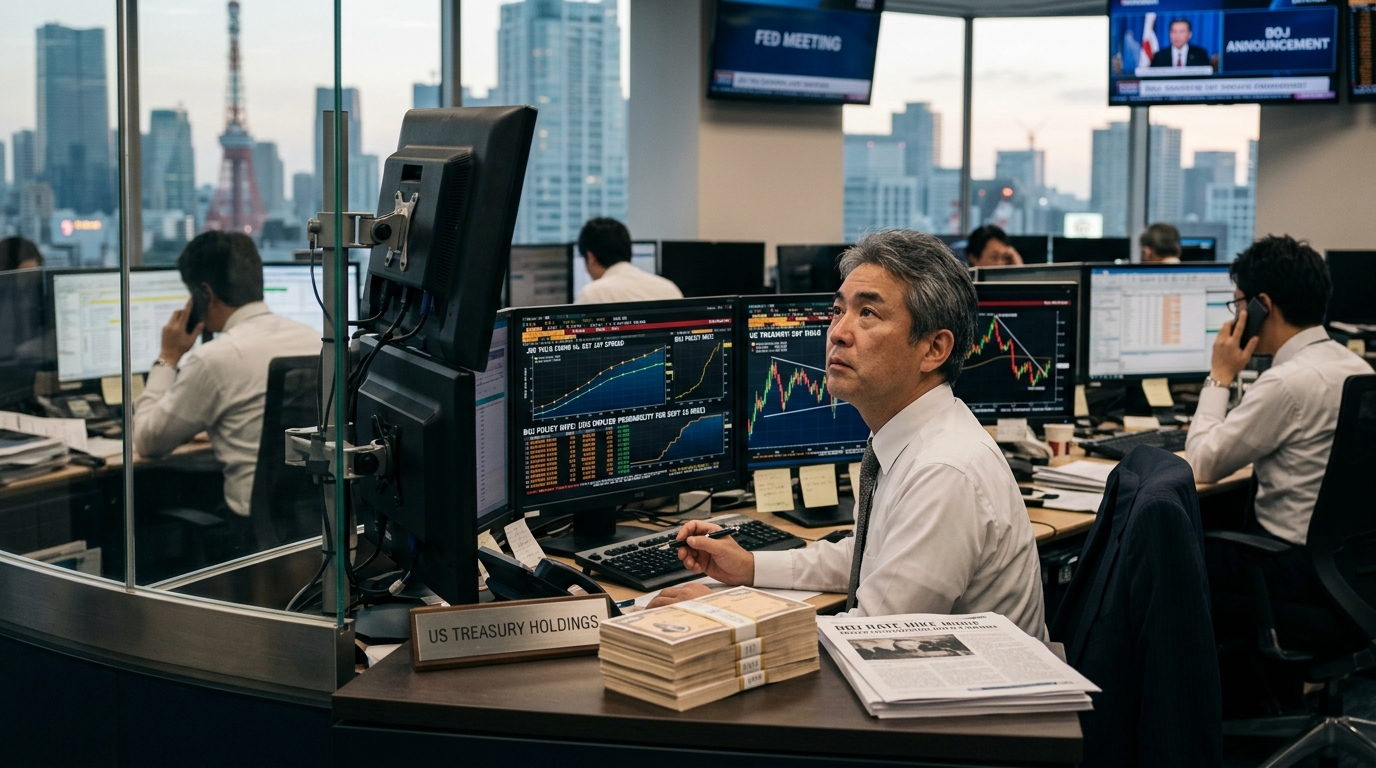
The yen is not the main concern on macro desks this week. The real question is what a Bank of Japan rate increase does to Japan’s roughly $1.1 trillion position in US Treasuries.
The Fed announces on Wednesday, September 16. The Bank of Japan concludes a two-day meeting on September 18, and economists have increasingly leaned toward another hike at that meeting, though it is not unanimous. OIS markets currently price roughly an 80% to 90% probability of a hike, with the overnight call rate sitting around 1.00%. The Fed lands first, changes the rate differential, and then the BOJ walks in and reacts to a number that didn’t exist 48 hours earlier. That sequencing is not an abstraction. It is a live problem for anyone running a global rates book.
Why the Bond Market Is the Story
As of 2026, Japan has remained the largest foreign holder of US Treasuries, with holdings fluctuating around $1.1 trillion in recent months. That position was built over decades when JGB yields were effectively zero and domestic investors had nowhere else to park capital. The logic is now reversing.
Japan’s 10-year government bond yield has touched 3% for the first time since 1996, while its 30-year yield has reached around 4.18%. Japan is one of the largest holders of foreign assets, particularly US Treasuries, and if Japanese yields rise, domestic investors, banks, insurers and pension funds have less incentive to invest abroad. That potential repatriation of capital could ripple across global markets, tightening financial conditions far beyond Japan’s borders.
The mechanism does not require panic selling. State Street Investment Management strategist Masahiko Loo has argued that the more important risk is Japan gradually ceasing to be the marginal buyer of foreign bonds. That distinction matters enormously. A buyer going quiet is far harder to see in daily price action than an outright seller, but the cumulative effect on Treasury demand can look similar.
The Bull and Bear Cases
The bull case for Treasuries rests on the pace of any rotation being manageable. Some major banks have argued that carry trades can prove more resilient than feared, with limited signs so far of large-scale, forced repatriation by Japanese investors. Flow data has not yet confirmed the rotation, and institutional Japanese investors tend to move slowly.
The bear case is structural, not tactical. Rising short-term Japanese rates combined with a strengthening yen could reduce the yield pick-up from owning US Treasuries while simultaneously cutting the yen value of existing holdings. BlackRock has used a hypothetical 5% shift to illustrate the scale, which would be on the order of $55 billion. A 5% shift from a roughly $1.1 trillion base is not a tail scenario. It is a plausible reallocation decision at an annual investment committee meeting.
Compounding the pressure: Reuters reported in early September that Japan’s foreign reserves fell by a record $79.6 billion in August, a 6.18% drop, the biggest since comparable ministry data began in 2000. That drawdown was the cost of buying time until the BOJ could act. The BOJ is now about to act, but a Fed hike on Wednesday would widen the rate differential again before the BOJ even votes, complicating the yen’s path.
What Investors Are Missing
Most commentary focuses on the yen’s direction. Less attention has gone to the JGB yield curve itself. Benchmark JGB yields have now hit 3%. Japan’s debt-to-GDP is widely cited as very high by developed-market standards, but recent IMF estimates put general government gross debt closer to a bit above 200% of GDP rather than above 250%. Every 25 basis points the BOJ adds raises government funding costs on a debt stock that dwarfs any other developed economy’s in relative terms. If the BOJ hikes and JGB yields rise further, Japanese institutions face pressure from two directions: domestic funding costs climb while the carry advantage of holding foreign paper shrinks.
Stocks to Watch
iShares MSCI Japan ETF (EWJ) is the most direct equity expression. A yen-strengthening BOJ hike hurts export earnings across the Nikkei’s largest components.
Mitsubishi UFJ Financial Group (MUFG) and Sumitomo Mitsui Financial Group (SMFG) are the two institutions whose foreign bond portfolios represent the largest repatriation risk. Both hold significant Treasury exposure built during the zero-rate era. Japan’s 10-year yield has often moved with global rates, including US Treasury yields, but a divergence following an asymmetric week of central bank decisions could break that correlation in a way that is painful for institutions running matched-book assumptions.
iShares 20+ Year Treasury Bond ETF (TLT) captures the long-duration Treasury risk most exposed to any reduction in Japanese demand. If the marginal buyer steps back, long-end yields do the adjusting.