
August 24, 2026
Bessent’s buyback boost faded fast. The 30-year is back near 5.3%. Warsh speaks Friday. Gold is already pricing the outcome.
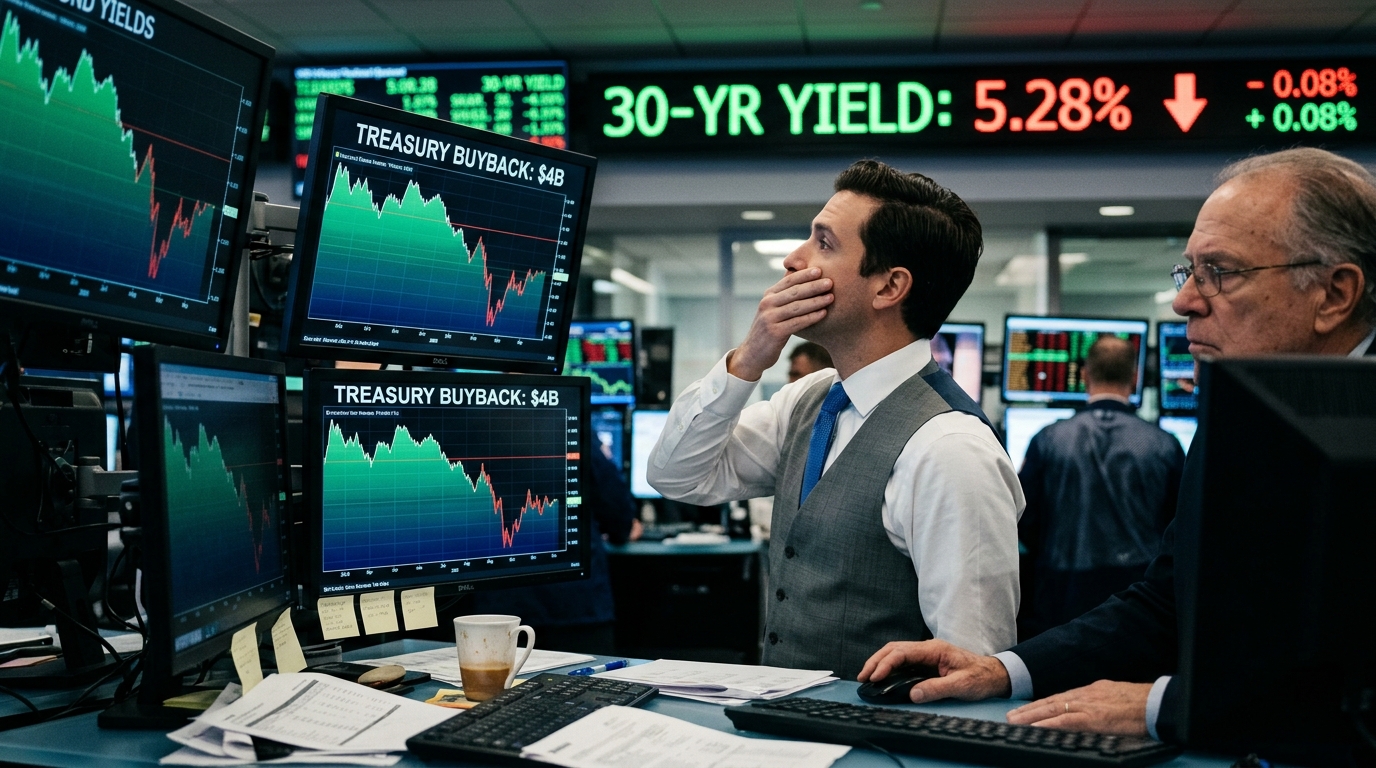
The Treasury tried to calm the bond market on August 19. By the following morning, the calm was gone.
Scott Bessent announced that the department would at least double its long-dated bond buyback operations, raising the maximum per-operation amount for 10- to 20-year and 20- to 30-year repurchases from $2 billion to at least $4 billion. The 30-year yield fell about 10 basis points on the day. Then it reversed. Within about 24 hours, yields at the long end erased essentially all of Wednesday’s decline and moved back toward where they were before the announcement. Bessent was back in front of cameras by Thursday, saying the $4 billion ceiling was a minimum and that buybacks could be larger still.
The bond market’s verdict was unambiguous. A $2 billion increase in per-operation buyback size is, as multiple outlets noted this week, barely material against a Treasury market measured in the tens of trillions of dollars. The 30-year yield is currently hovering near 5.27%, just below the roughly 5.337% intraday peak reached on August 18, the highest level since 2007. That is not a market that is impressed by fiscal signaling. It is a market demanding compensation for a problem it does not believe is being solved.
61% of Americans Worry America Could be on the Verge of Another Civil War
Today, more than half of America thinks a civil war is likely.
Former CIA Advisor Jim Rickards agrees.
He just uncovered a fascinating plot by Trump to keep the Democrats out of the White House until 2033.
And while he believes it could be successful, it could also trigger America’s Second Civil War.
What the Long End Is Actually Pricing
The confusion is worth clearing up, because it matters directly for gold. The Federal Reserve holds the front of the curve at 3.50% to 3.75%. The 30-year is not a Fed instrument. It prices inflation, fiscal trajectory, and the term premium investors demand for lending to the government across three decades. The primary driver is not inflation expectations, which are not sitting at 2.2% right now. The five-year TIPS breakeven has been closer to the mid-2% range in late August, around 2.34% on August 20. The driver is deficit concern and the sheer volume of long-dated supply the market must absorb.
The Congressional Budget Office projects net interest outlays of about $1.0 trillion in fiscal year 2026. Every quarter-point rate increase compounds that cost. The market understands this, which is precisely why a $4 billion intervention bought less than a session of relief.
Gold Is Not Reading the Rally. It’s Reading the Failure.
Gold closed last week up roughly 5%, touching its highest level since mid-May near $4,600. That is not a response to falling yields. The 30-year yield remains near 5.27% and the 10-year is trading near 4.7%, a rate environment that would historically suppress a non-yielding metal. Instead, gold is responding to what the buyback intervention revealed: that managing the cost of U.S. debt has become an active policy priority, and that the tools available are not keeping pace with the problem.
Several major banks, including Goldman Sachs, Citi, and JPMorgan, have leaned on currency debasement framing in their 2026 research, reflecting record debt levels and persistent fiscal deficits. MKS PAMP metals strategist Nicky Shiels has also argued in recent 2026 materials that precious metals are increasingly behaving as strategic monetary assets in a debasement-driven regime. Gold has decoupled from the conventional real-yield framework. In early August, long-dated yields held roughly flat while the metal continued rising, a combination analysts read as evidence that fiscal sustainability concerns are now a larger driver than short-term rate differentials.
Friday: Every Scenario Has a Price
Kevin Warsh delivers his first Jackson Hole keynote on August 28, three weeks before the September 15 to 16 FOMC decision. Markets are pricing meaningful odds of a September hike. When a large share of surveyed fund managers expect a neutral tone, neutral is already priced in. The surprise is what moves markets.
Dr. Skousen: “Only 500 copies of my report today”
I’ve worked for the CIA. Met four US presidents.
But watching Peter Thiel’s playbook changed everything.
He just bet $1 BILLION on one private company. And my research leads me to believe the IPO announcement could come soon.
I’m sharing my free pre-IPO ticker… and releasing my “secret partner” report to only the first 500 people today.
Warsh has said he wants to focus on bigger questions rather than offer near-term guidance, and has emphasized that the Fed is not constrained by market pricing. His communications approach since taking office in May has been deliberately opaque: shortened statements, evasive press conferences, no forward guidance. Three regional Fed presidents dissented in favor of immediate tightening at the July meeting, an unusually hawkish internal fracture.
For gold investors, the two scenarios at Jackson Hole produce different near-term paths but the same medium-term destination. A hawkish signal from Warsh pushes real yields higher and pressures gold in the short run. A neutral or dovish lean validates the debasement trade and sends gold toward the $4,800 resistance shelf that capped every rally in May. Either way, the structural case does not depend on the podium. It depends on a 30-year yield at 2007 highs and a Treasury department that just demonstrated it cannot talk the long end down for even 24 consecutive hours. That is the story gold is trading. Warsh Friday is the next data point, not the thesis itself.