
The Bottleneck Nobody Fixed
Memory was supposed to be a commodity again by now. It is not. The market that spent 2022 and 2023 drowning in supply gluts has flipped into what multiple analysts are calling the most severe structural shortage in 15 years. The cause is not cyclical. It is architectural.
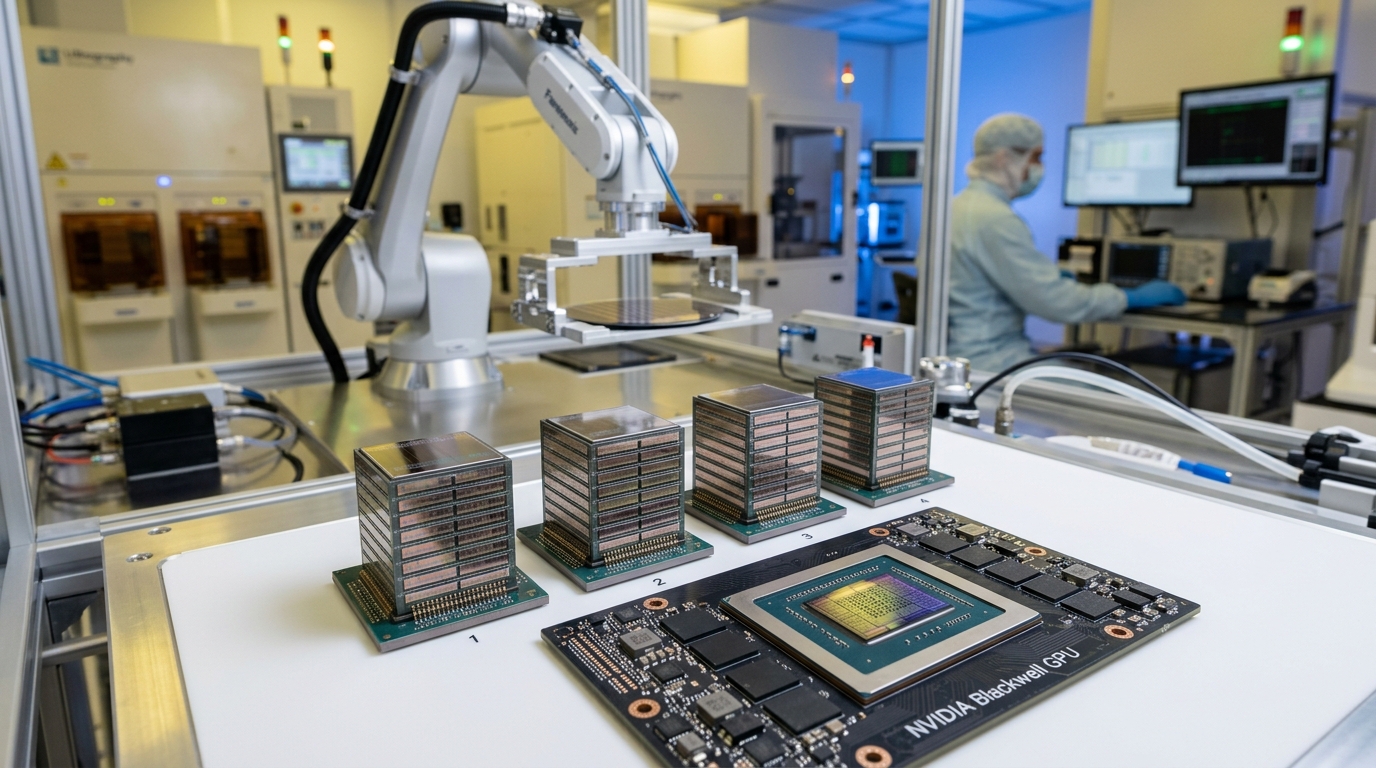
A single AI server consumes 8 to 10 times the DRAM of a traditional server. NVIDIA’s B300 GPU uses eight HBM stacks. Global AI server shipments are forecast to reach 1.5 million units in 2026, up 180% year over year. No fab schedule in the industry can absorb that math cleanly, and the three companies that control over 90% of global DRAM production have made their choice: convert capacity to high-margin HBM, and let conventional DRAM tighten.
That decision is running earnings across the sector to levels that look more like software than cyclicals. The investment question is which of the four primary plays in this ecosystem are priced correctly for what remains ahead.
Analyst Targets
- Micron (MU): Analyst consensus and price targets vary by data provider and date; the specific figures cited here could not be verified.
- SK Hynix (000660.KS / HXSCL): Shares near the bottom of their 52-week range of $128.38 to $194.80 after a post-earnings selloff; KB Securities and Meritz Securities raised full-year 2026 operating profit estimates to the 320-330 trillion won range
- Samsung Electronics (005930.KS): Consensus full-year 2026 operating profit forecast near 86 trillion won; HBM4 sales expected to rise more than 3x quarter over quarter in Q3
- Marvell Technology (MRVL): Analyst target figures vary by data provider and date; August 27, 2026 earnings report is the next catalyst
Micron: The Quarter That Rewrote the Debate
Micron’s fiscal Q3 2026 results, reported June 24, were not a beat. They were a rerating event.
Q3 FY2026 Key Metrics:
- Revenue: $41.46 billion vs. $35.84 billion estimated, a 346% increase from $9.3 billion a year earlier
- EPS: $25.11 vs. $20.20 estimated, a 24% beat; year-ago EPS was $1.91
- Net income: $28.24 billion vs. $1.89 billion in the same quarter last year
- Core data center revenue: $11.5 billion, up more than sevenfold year over year
- Cloud memory revenue: $13.77 billion, up over 300%
- Data center SSD revenue: over $5 billion
- Mobile and client revenue: $11.52 billion, up 254%
- Automotive and embedded revenue: $4.63 billion, up 311%
- Q4 guidance: revenue of $33.5 billion ± $750 million; EPS of $18.90 ± $0.40
- Next earnings: expected around September 22, 2026; the company had not confirmed the date at the time of review
The stock has risen sharply over the past year, pushing its market cap to roughly the high-$900 billions in early August 2026. Analyst consensus and price targets vary by source and date.
What changed the investment calculus is not just the revenue scale. It is that all four of Micron’s business units grew simultaneously, and by multiples rather than percentages. That is not a cyclical pop. That is demand that has structurally outpaced supply, and Micron is one of only three companies on Earth positioned to serve it at scale.
The core debate is whether Micron is showing peak-cycle earnings that the market should not capitalize aggressively, or whether AI has permanently redrawn the memory cycle.
SK Hynix: The Leader Nobody Is Paying For Right Now
SK Hynix is widely viewed as the HBM market leader, though precise share estimates vary by research firm and quarter. The company’s Q2 2026 results confirmed what its product roadmap already implied: HBM3E is in the maturity stage, HBM4 mass shipments began in Q2, and HBM4E samples have been delivered to major customers.
Q2 2026 Key Metrics:
- Revenue: KRW 79.32 trillion, up 257% year over year; a new quarterly record
- Operating profit: KRW 60.54 trillion, up 557% year over year; operating margin of 76%, an all-time high
- EBITDA: KRW 64.6 trillion; EBITDA margin of 81%
- Net profit: KRW 93.92 trillion, more than a 13-fold increase
- First-half cumulative revenue crossed 100 trillion won for the first time in company history
- Stock reaction: shares fell 9.6% on the day of results
The miss against analyst expectations was attributed primarily to HBM4 shipments that came in below projections, pushing some revenue recognition into the second half. Management confirmed HBM4 production ramp in H2 2026 and said yields and quality are nearing the levels HBM3E reached in its maturity stage.
The disconnect between SK Hynix’s operational reality and its stock behavior is the most interesting trade in the memory sector right now. A 76% operating margin, 557% operating profit growth, and a confirmed HBM4 ramp did not hold the stock. The U.S.-listed shares are near the bottom of their 52-week range. The market is pricing in the miss and the valuation concern. It is not pricing in HBM5 development, a multi-year demand outlook management says persists through 2028, or the fact that 81% EBITDA margins at this revenue scale represent a cash generation machine of historic proportions.
Samsung: The Catch-Up Trade With the Most Moving Parts
Samsung’s memory story in 2026 is a comeback execution test layered over the same structural demand that is powering Micron and SK Hynix. The company has highlighted HBM4 progress in 2026 disclosures and reported that its memory business set an all-time high for quarterly revenue and operating profit in Q2.
Samsung also signed an MOU with AMD to align HBM4 as the primary memory for AMD’s next Instinct MI455X AI accelerators and sixth-generation EPYC CPUs.
Several brokerages have raised their 2026 full-year operating profit estimates for Samsung into the 320 to 330 trillion won range. The consensus full-year forecast of 86 trillion won was cut slightly from earlier projections, but the reduction was driven by one-time employee compensation costs from May labor negotiations rather than a deterioration in the underlying business.
The central question for Samsung investors is whether its HBM ramp is moving fast enough to close the gap with SK Hynix. Samsung’s Device Solutions semiconductor division is the engine of current profitability, and HBM qualification progress is the key marker to watch in Q3 results. The stock has rallied sharply over the past year but remains well below its record high, making the risk-reward more balanced than either Micron or SK Hynix at current multiples.
Marvell: The Memory Infrastructure Play That Doesn’t Make DRAM
Marvell is the fourth name in this group, and it belongs here for a different reason. The company does not produce a single DRAM die. What it does is build the infrastructure that moves memory data at AI scale: custom ASICs, optical interconnects, PCIe 6.0 SSD controllers, CXL memory expansion, and rack-scale memory architecture. Every constraint in the HBM supply chain increases the premium on moving memory more efficiently, and that is Marvell’s operating terrain.
Recent Metrics and Catalysts:
- Q1 FY2027 revenue: $2.42 billion, up about 28% year over year
- Q2 FY2027 earnings report: August 27, 2026
- Analyst consensus and price targets vary by source and date
At FMS 2026 in Santa Clara, Marvell unveiled the Bravera SC6 PCIe 6.0 SSD controller, rack-scale CXL memory expansion, and pod-level optical shared memory solutions targeted at hyperscalers. The products are specifically designed to let cloud customers scale memory capacity and bandwidth independently of compute, which directly addresses the bottleneck that makes HBM so constrained: the inability to decouple memory scaling from GPU scaling.
The August 27 earnings report will be the first serious test of whether the AI memory infrastructure product cycle is converting into revenue at the pace implied by recent analyst target raises.
The Structural Case That Changes the Cyclical Framework
The memory sector has historically been analyzed through a cyclical lens. Analysts tracked inventory weeks, spot prices, and production capacity additions to predict the next correction. That framework still applies at the margin, but the dominant force in 2026 is structural reallocation of supply.
Data centers will absorb an estimated 70% of all memory chips manufactured worldwide through the rest of 2026 and into 2027. Supply-demand gaps for DRAM, NAND, and HBM in 2026 are tracking at levels not seen since 2011. The shortage is driven by three factors that compound each other: exponential AI demand growth, rigid supply constraints from HBM’s manufacturing complexity, and historically depleted inventory buffers.
HBM production displaces conventional DRAM at roughly a 3-to-1 wafer conversion ratio. Every HBM wafer a fab commits to means two or more conventional DRAM wafers that will not be produced. That displacement is creating price pressure across the entire memory stack simultaneously, which is why all four companies in this analysis are benefiting from different angles of the same underlying constraint.
Bull / Base / Bear Scenarios
Micron (MU)
- Bull: Continued upside to earnings power, HBM3E design wins at next-generation hyperscaler GPU platforms confirmed, stock approaches $2,000 range. AI has permanently altered the memory TAM, and Micron’s U.S. manufacturing footprint commands a strategic premium.
- Base: Guidance delivered in line, stock consolidates in the $1,200 to $1,600 range through the September earnings cycle, valuation normalizes toward 20x forward earnings.
- Bear: Hyperscaler capex cycles rotate or pause, HBM oversupply emerges in 2027 as Micron and Samsung ramp simultaneously, stock adjusts toward the $700 range as peak-cycle earnings compress.
SK Hynix (HXSCL)
- Bull: HBM4 ramp in H2 2026 closes the revenue gap against Q2 expectations, 76% operating margins prove durable through 2027, stock recovers to its 52-week high near $195.
- Base: HBM4 shipments normalize in Q3, stock stabilizes near current levels, long-term contracts provide earnings visibility that gradually brings institutional buyers back.
- Bear: HBM4 yield issues or further shipment deferrals push another quarter of revenue recognition into 2027, shares retest the 52-week low near $128.
Samsung (005930.KS)
- Bull: HBM qualification accelerates alongside the AMD partnership, full-year operating profit reaches the 320 to 330 trillion won range cited by KB Securities and Meritz, stock closes the gap to its record high.
- Base: HBM ramp delivers the guided 3x quarter-over-quarter revenue increase in Q3, consensus 86 trillion won annual operating profit is met, stock grinds higher with moderate multiple expansion.
- Bear: HBM qualification lags, SK Hynix and Micron lock up the key Nvidia and AMD sockets for the next generation, Samsung cedes market share and margins compress.
Marvell (MRVL)
- Bull: August 27 results deliver a beat-and-raise, Bravera SC6 sampling timeline pulled forward, data center revenue growth accelerates. Stock moves toward $300 to $360.
- Base: Q2 is in line with guidance, AI memory infrastructure bookings ramp gradually through H2 2026, stock consolidates near $220 to $250 ahead of clearer revenue confirmation.
- Bear: Q2 misses guidance, custom ASIC timelines slip, and elevated valuation compresses on any demand uncertainty. Stock retreats toward $150 to $175.
Technical Overlay
Micron has extended sharply from every major moving average after its June 24 earnings gap. The near-term level to watch is the post-earnings open, which now functions as the first line of support. A pullback toward the $900 range would represent the first meaningful retest of the breakout and would be the cleaner entry for investors who missed the initial move.
SK Hynix U.S.-listed shares are at the low end of their 52-week range. The $128 to $130 zone is the structural support area. A breach would signal institutional capitulation and would likely require confirmation of an HBM4 ramp delay to hold. Conversely, any H2 beat that exceeds depressed expectations carries significant upside from this base.
Marvell surged roughly 14% on its FMS 2026 product announcements and has since pulled back into the $210 to $220 zone. The August 27 earnings report is the binary event. A confirmed revenue acceleration would validate the breakout. A miss sends the stock back toward the $170 to $185 pre-announcement range.
What Investors Should Watch
- Micron Q4 FY2026 earnings, expected around late September 2026: The next report is expected around September 22, 2026, but had not been formally confirmed by the company at the time of review. A beat maintains the supercycle case. A guide toward flat or down sequentially reopens the peak-earnings debate.
- SK Hynix H2 2026 HBM4 shipment data: Management said HBM4 production is ramping. The Q3 results will be the first hard evidence of whether that ramp met internal targets or deferred again.
- Samsung HBM qualification progress: Confirmation that shipments are qualifying in next-generation accelerators is a key catalyst for the stock.
- Marvell August 27 earnings: The first test of whether AI memory infrastructure product launches at FMS are converting into booked revenue.
- Global wafer fab equipment spending: Lam Research posted full fiscal-year 2026 revenue of $23.23 billion, guided its next quarter revenue to about $8.1 billion, and on its earnings call pointed to calendar 2026 wafer fab equipment spending in the low $150 billion range. Any downward revision to that figure would signal that memory makers are pulling back on capacity investment, which would be the earliest warning signal for the entire group.
Bottom Line
Memory has become the rate-limiting input of the AI infrastructure buildout. That is not a promotional claim. It is the operational reality that Micron, SK Hynix, and Samsung are each reporting in real-time, and that Marvell is building an entire product portfolio around. The differences between the four names are about timing, positioning, and valuation, not about the underlying demand thesis.
Micron has the clearest earnings momentum and the most coverage, which means it is also the most priced for good news. SK Hynix is operationally dominant in HBM but is near a 52-week low, pricing in a significant amount of disappointment after its Q2 miss against elevated expectations. Samsung is the catch-up trade with the most execution risk and the highest potential multiple re-rating if HBM qualification accelerates. Marvell is the only one of the four that does not face a wafer capacity constraint, because its bet is on moving and organizing memory rather than producing it.
The trade that requires the least execution faith, given current prices, is SK Hynix. The one requiring the most confidence in future earnings delivery is Micron. August 27 at Marvell and late September at Micron are the next two dates that clarify which of those judgments is correct.
For informational purposes only.