
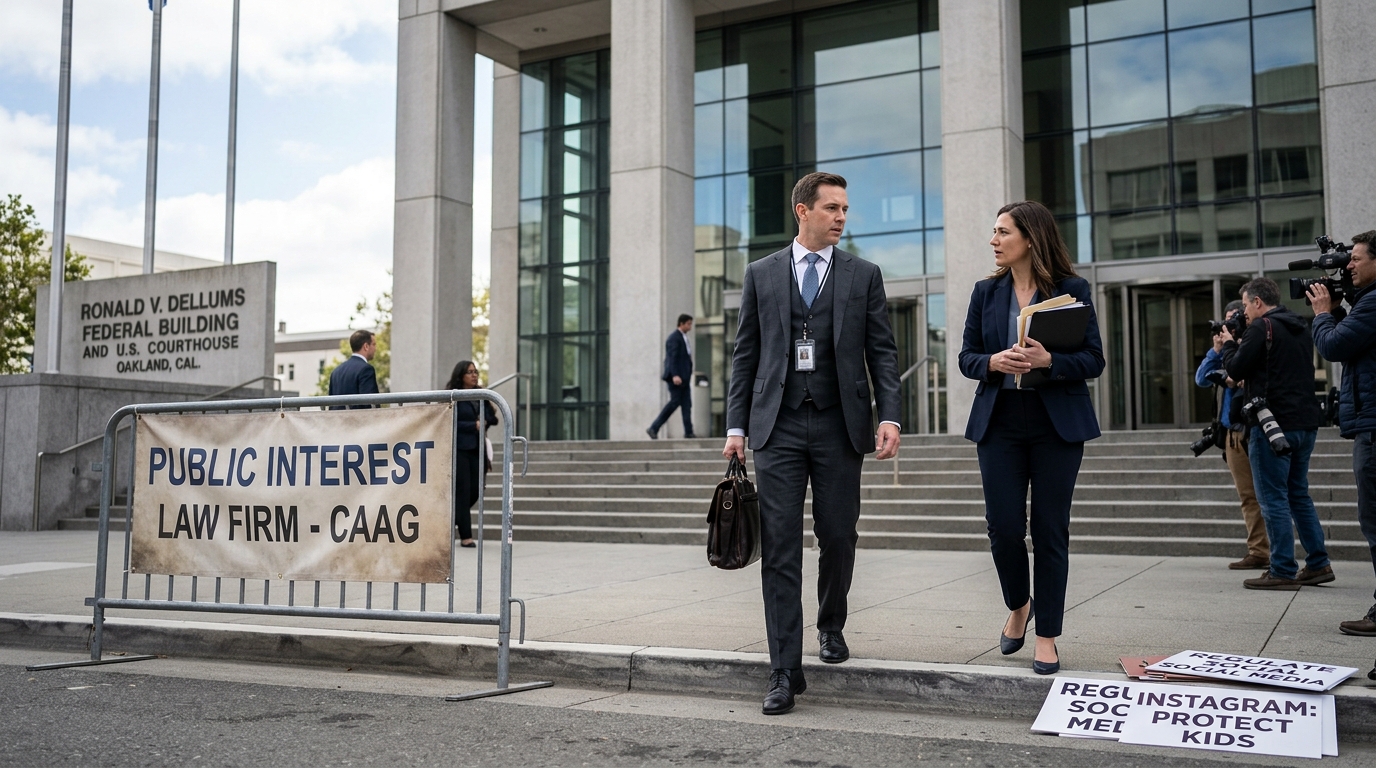
Forget the $1.4 trillion headline for a moment. A fine hurts once. Rules that weaken engagement could keep hurting. That is the distinction Wall Street keeps underpricing as Meta’s trial opened in Oakland this morning.
Meta Platforms is headed to court for a high-stakes showdown with a coalition of state attorneys general over claims that the company deliberately designed Facebook and Instagram to encourage compulsive use among young users. Attorneys for Colorado, California, New Jersey and Kentucky are leading a bipartisan group of 29 states and will give their opening statements in Oakland in a federal trial overseen by U.S. District Judge Yvonne Gonzalez Rogers.
Why This Stock Now
Meta’s stock dropped 3.55% to $568.97 on August 17, 2026, the day before opening statements. That pricing left the stock about 28.6% below the $796.25 52-week high listed on Meta’s investor site. Recent published analyst consensus targets have clustered in the mid-$700s, but they vary by data provider and day. The gap between where the stock trades and where analysts think it belongs is not a buying opportunity yet. It is a question about what Meta’s platforms are legally permitted to be.
The Business
Meta makes money by keeping billions of users engaged and turning that attention into advertising dollars. Meta’s core advertising business posted a 28% year-over-year revenue increase in Q2 2026. The same quarter showed $31.08 billion of capex, and management lifted 2026 expense guidance to $165 billion to $169 billion while guiding capex to $130 billion to $145 billion.
The engine behind those numbers depends on specific design choices. One of the suit’s central arguments is that Meta designed and deployed features to capture young users’ attention and prolong their time on social media, including the like button, the infinite-scroll function and recommendation algorithms that encourage compulsive use. Those are not incidental features. They are the architecture of the attention economy Meta built.
Why Wall Street Is Paying Attention
At issue is the prospect of court-ordered changes that could reshape how teens experience Instagram and Facebook, including limits on notifications, infinite scroll and autoplay, and tighter controls around algorithmic recommendations and age assurance. That is not a fine. That is a product teardown.
The litigation is no longer only a financial liability. It is becoming a direct driver of mandatory platform redesign, with court-ordered changes potentially including more rigorous age assurance, tougher child safety protections, and constraints on how encrypted messaging works for minors.
The trial could also see testimony from some of Meta’s most visible executives, including CEO Mark Zuckerberg and Instagram chief Adam Mosseri. Zuckerberg on a witness stand, under oath, explaining infinite scroll design decisions to a federal judge, is a different category of legal risk than a regulatory settlement.
What’s Driving the Opportunity
The countercase for META is straightforward. Legal experts caution that a complete shutdown of core features or platforms is highly unlikely, even under an adverse ruling, but note that the case could lead to more stringent constraints on how Meta designs engagement mechanics for teens and children. The company has also been building its AI advertising stack aggressively enough that even a constrained Instagram could generate more revenue per impression than the current version does today.
Judge Yvonne Gonzalez Rogers will oversee the trial and is expected to decide the case after the trial concludes. The proceedings are expected to last roughly six to eight weeks.
What Could Go Wrong
The precedent trail is not encouraging. Earlier this month, a New Mexico state court ordered Meta to pay $567 million to address harms to young people from its platforms in the second phase of that case, on top of $375 million in civil penalties ordered by jurors in March. In March, a California jury found both Meta and YouTube negligent in a lawsuit accusing the companies of designing their products in a way that contributed to a young woman’s harmful dependency and resulting mental health impacts.
Legal experts compare this wave of litigation to landmark cases against tobacco and opioid manufacturers that changed those companies’ behaviors as well as the public discussion about the risks of cigarettes and prescription painkillers. Tobacco companies paid. They also changed their product, their marketing, and their addressable market permanently.
Court or regulatory mandated product redesign, combined with laws limiting minors’ access to social media, and growing reputational risk, may reduce engagement metrics and ad revenue, and impact AI development. Meta acknowledged as much on recent earnings calls.
The Bottom Line
META closed Monday at $568.97, with a trial expected to run for weeks. This suit is a bellwether trial in a federal multidistrict litigation consolidating many similar cases before Judge Gonzalez Rogers in the Northern District of California. Whatever Judge Gonzalez Rogers decides in Oakland will reverberate across that entire docket.
The dollar figure gets the coverage. The injunction is the trade. If the court mandates specific feature removals, Meta does not write a check and move on. It rebuilds a platform that billions of users currently choose because of the very mechanics under scrutiny. That is why this case deserves more attention than its headline number suggests, and why META’s discount to consensus is not automatically a gift.