
October 28, 2026
Bonus Content: Microsoft Is Cutting People While Spending $175 Billion. Azure Has to Justify Both Tonight.
Blane Markham here, with an alert!
If you still haven’t saved your copy of “How To Turn $100 Options Into $1,000 Gains”…
… do it right now before the download link expires.
We’ll be moving this book behind a paywall in the near future so grab it now while you still can.
You’ll thank me.
FREE: How To Turn $100 Options Into $1,000 Gains
To your success,
Blane Markham
Markham Trading Team
Reminder:
Grab your copy of How To Turn $100 Options Into $1,000 Gains before we move it behind a paywall.
Microsoft Is Cutting People While Spending $175 Billion. Azure Has to Justify Both Tonight.
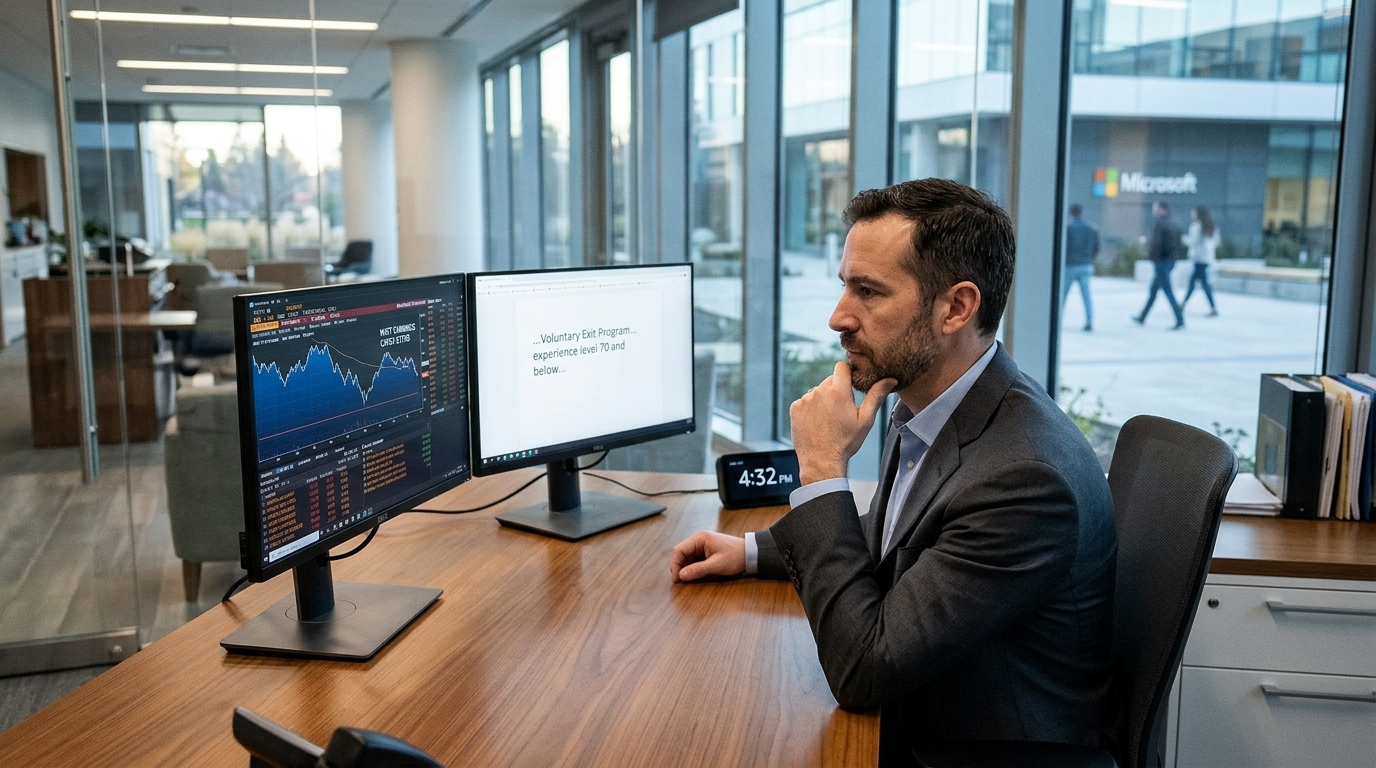
Two days before reporting quarterly earnings, Microsoft sent a memo to roughly 60,000 employees offering them the door. Chief People Officer Amy Coleman announced the voluntary exit program Monday, covering workers at experience level 70 and below across the US, Canada, India, and the United Kingdom. Employees have until early December to decide; those who accept leave December 31.
That is not a routine HR communication. It lands two business days before fiscal Q1 FY2027 results, with analysts expecting about $4.72 in adjusted EPS on roughly $90.6 billion in revenue. The sequence is worth examining on its own terms.
Microsoft is running approximately $175 billion in calendar-year capital expenditures, most of it pointed at AI data centers, GPUs, and power capacity. In the June quarter alone, capex including finance leases ran about $41 billion. The company simultaneously guided calendar-year 2026 capex spend over $50 billion including a lease reclassification impact tied to a useful life update, a figure that dwarfs what the company spent in the same period a year ago. So the question the buyout program raises is precise: if the AI machine is generating returns fast enough, why does the labor side of the ledger need to shrink?
The answer the company would give is efficiency, not distress. The April voluntary retirement program, the first in Microsoft’s 51-year history, saw more than 30% of eligible employees accept offers. Coleman’s memo cited that experience as the reason for expanding eligibility so broadly this time. Divisions including Copilot, finance, and Xbox are participating. Data center operations and certain sales teams are excluded, which is its own signal about where management sees irreplaceable headcount.
Azure is what tonight’s report has to deliver. Management guided 44% to 45% constant-currency growth for the quarter. That would be an acceleration from 43% in Q4. That Q4 figure was already Azure’s fastest growth since early 2022, and it sent the stock up 15.5% in a single session. The 45% guidance has since hardened into the baseline rather than an upside scenario. Analysts at BNP Paribas are modeling 46% growth; Bernstein projects revenue of $92.11 billion for the quarter, 1.6% above consensus. Microsoft has beaten consensus EPS estimates in each of its last four quarters, but the stock’s reaction to any single result depends less on the beat and more on whether Azure’s trajectory appears to be accelerating or plateauing.
The labor move and the capex move are not contradictory if Azure keeps compounding. Microsoft’s AI business crossed a $37 billion annual revenue run rate in an earlier quarter, up 123% year over year, and Azure surpassed $100 billion in annual revenue for the first time in fiscal 2026. Paid Microsoft 365 Copilot seats passed 30 million. Those are real numbers. The question is whether the rate of return on $175 billion in annual infrastructure spending is becoming visible fast enough to satisfy investors who need to see the denominator shrinking relative to the numerator.
If Azure comes in at 46% or better tonight and capex guidance holds without acceleration, Microsoft can present the buyout as a margin management tool inside a growth machine. If Azure comes in at or below 44% and capex guidance rises again, the buyout looks less like engineering and more like a company trying to manage two expensive problems at once.
That distinction matters more when the peer group is burning cash at scale. S&P Global projects all six major hyperscalers will generate negative free operating cash flow through 2027 — with Microsoft forecast as the sole exception.
For precious metals investors, this matters as a read on the broader technology sector’s confidence in AI monetization. Gold has benefited from uncertainty around stretched corporate valuations. Microsoft tonight is one of the clearest tests of whether those valuations are earned.