
Wall Street loves a new story.
But sometimes the more interesting opportunity is a company that has been waiting years for the market to catch up.
One little-known Nasdaq company has spent more than 25 years developing professional drone technology that is now a priority in Washington.
This is not a company trying to invent itself around D.C.’s latest push.
It was developing these technologies long before America’s current drone demand started.
That experience matters as the Pentagon looks for scale and Washington directs more attention toward domestic manufacturers.
Yet the company is still trading under $5… for now.
If America’s drone industry is entering a much bigger chapter, investors may want to know why this pioneer remains so overlooked.
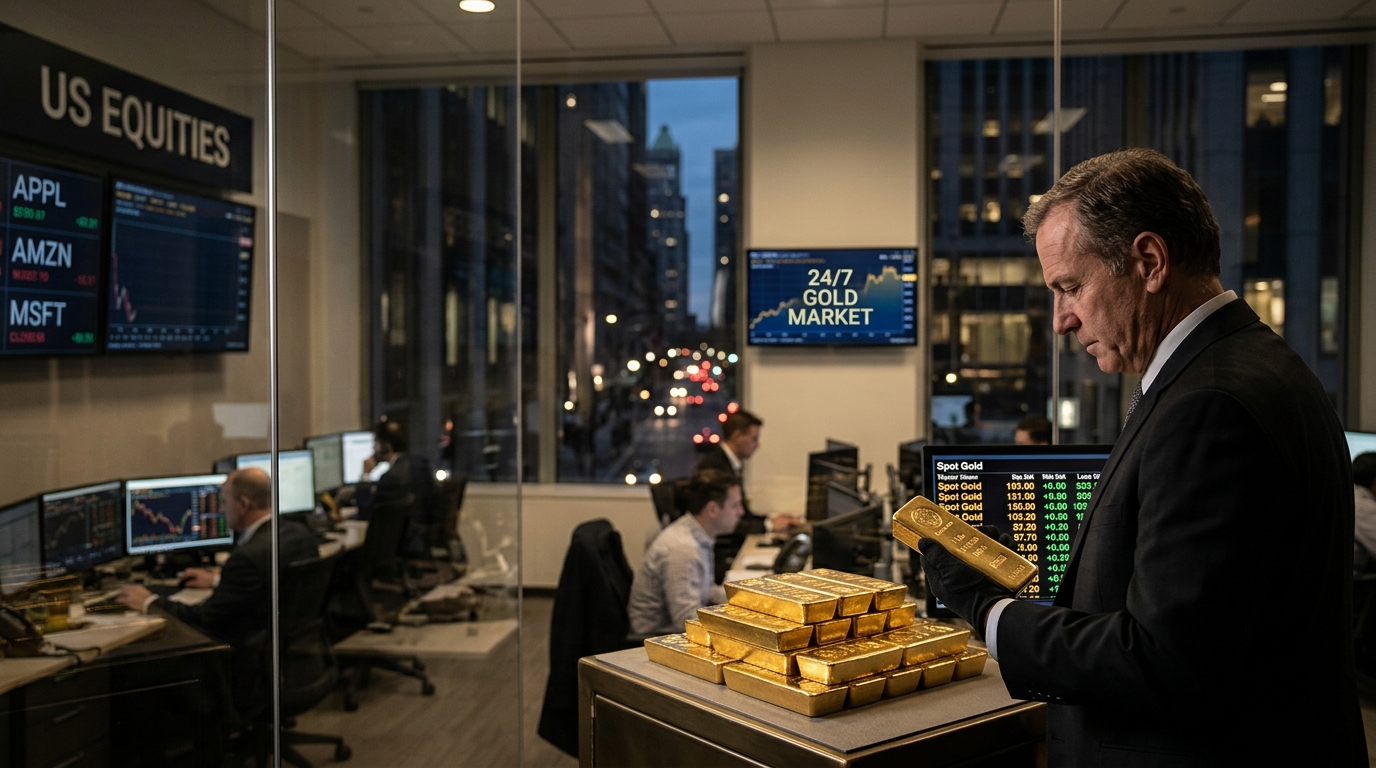
Wall Street Wants to Trade All Night. Gold Already Does.
Thursday’s SEC roundtable on 24-hour equity trading lands in the middle of quad witching and a Federal Reserve decision week, which is either terrible timing or a perfect stress test. Probably both.
The commission will host its Sept. 17 session to discuss moving toward 24-hour trading in U.S. equity markets, covering preparations for overnight trading, operations and resiliency, and the opportunities and challenges of expansion. The panelist list includes Citi, UBS, Cboe, NYSE, DTCC, Invesco, Nasdaq, Charles Schwab, BlackRock, Robinhood, Jane Street, State Street, BNP Paribas, BNY Pershing, Citadel Securities, and Interactive Brokers. That is an impressive room. The harder question is whether the room has studied the right market.
Gold has been trading continuously across Asian, London, and New York sessions for decades. It is not a model equity markets should copy uncritically. It is, however, a live demonstration of what round-the-clock price discovery actually looks like under stress, and some of what it shows is uncomfortable.
What the Gold Market Knows About Overnight Sessions
The London-New York overlap, running roughly 1:00 to 5:00 p.m. UTC, is the most liquid window in gold, with the tightest institutional spreads. Everything outside that window is thinner. The Asian session sets direction, but it does so with a fraction of the participation. Overnight gaps in gold, while less dramatic than equity gaps, remain a persistent feature precisely because liquidity does not distribute evenly across a 24-hour clock.
Gold’s volatility has risen in 2026, and bid-ask spreads can widen sharply in thinner, off-peak hours. That is the footnote equity investors should underline. Industry observers note that overnight sessions could enhance liquidity and price discovery but also present challenges, including thinner volumes during certain windows and potential impacts on market depth.
The SEC’s panel will dig into exactly these mechanics. Panel two addresses resiliency, covering systems capacity, Regulation SCI compliance, failover planning, and overnight trading rules around cybersecurity and staffing. Those are the right questions. The gold market’s experience suggests the staffing piece alone is chronically underestimated: liquidity in bullion dries most when human market-makers step away.
The Infrastructure Race Is Already Underway
The roundtable does not exist in a vacuum. The London Stock Exchange announced plans on July 21, 2026, to launch LSE 24, a new 24/5 trading venue designed for digital, algorithmic, and agentic trading. The DTCC’s subsidiary, the National Securities Clearing Corporation, went live with extended 24/5 clearing hours for U.S. equities on June 29, 2026. NYSE has announced plans to extend weekday U.S. equities trading on NYSE Arca to 22 hours a day, Nasdaq has said it anticipates a 24-hour trading timeline in the second half of 2026 pending regulatory approval, and Cboe has said it plans to launch 23×5 trading on its EDGX Equities Exchange in December 2026, subject to regulatory review and industry readiness.
That is a lot of concurrent construction. Clearance and settlement reform historically lags trading-hours expansion, and gold’s overnight experience shows the cost when it does: price dislocations that clear only when the main session opens and two-way flow returns.
Where Precious Metals Investors Should Focus
This roundtable matters to gold investors because the companies in that room, Nasdaq (NDAQ), ICE, Cboe (CBOE), Robinhood (HOOD), Charles Schwab (SCHW), and Interactive Brokers (IBKR), are simultaneously the infrastructure through which gold ETFs trade and the firms whose capital allocation will be consumed by extended-hours buildout. Any equity-market structural reform that diverts technology spending or changes settlement timing ripples into gold’s access channels.
The final panel will examine the potential effects of longer trading hours on liquidity and capital formation, and how market participation could evolve. For gold investors, the specific concern is whether thinner overnight equity sessions amplify cross-asset correlations. Gold’s behavior in 2026 has highlighted the distinction between its traditional safe-haven reputation and its actual price action during periods of market stress, with selling during liquidity crunches and rising correlation with risk assets leading some observers to describe it more as a liquidity-sensitive trade.
Extending equity trading hours could deepen that correlation during stress events, not reduce it. When equity markets are open around the clock and a shock hits at 2 a.m., the reflexive move to sell liquid assets for cash does not spare gold.
Bottom Line
Chairman Atkins framed Thursday’s session as moving toward a new day and night in U.S. equity markets, with the prospect of aligning with markets that already trade continuously. Bullion is precisely such a market. Its lesson is not that continuous trading creates continuous liquidity. It creates continuous price discovery, which is different and sometimes less comfortable. The SEC’s panel list is right. The preparation work is right. Investors in gold and gold equities should watch Thursday’s proceedings closely, because the market-structure decisions made in that room will eventually reshape the hours and the liquidity profile of every asset that trades through it.