
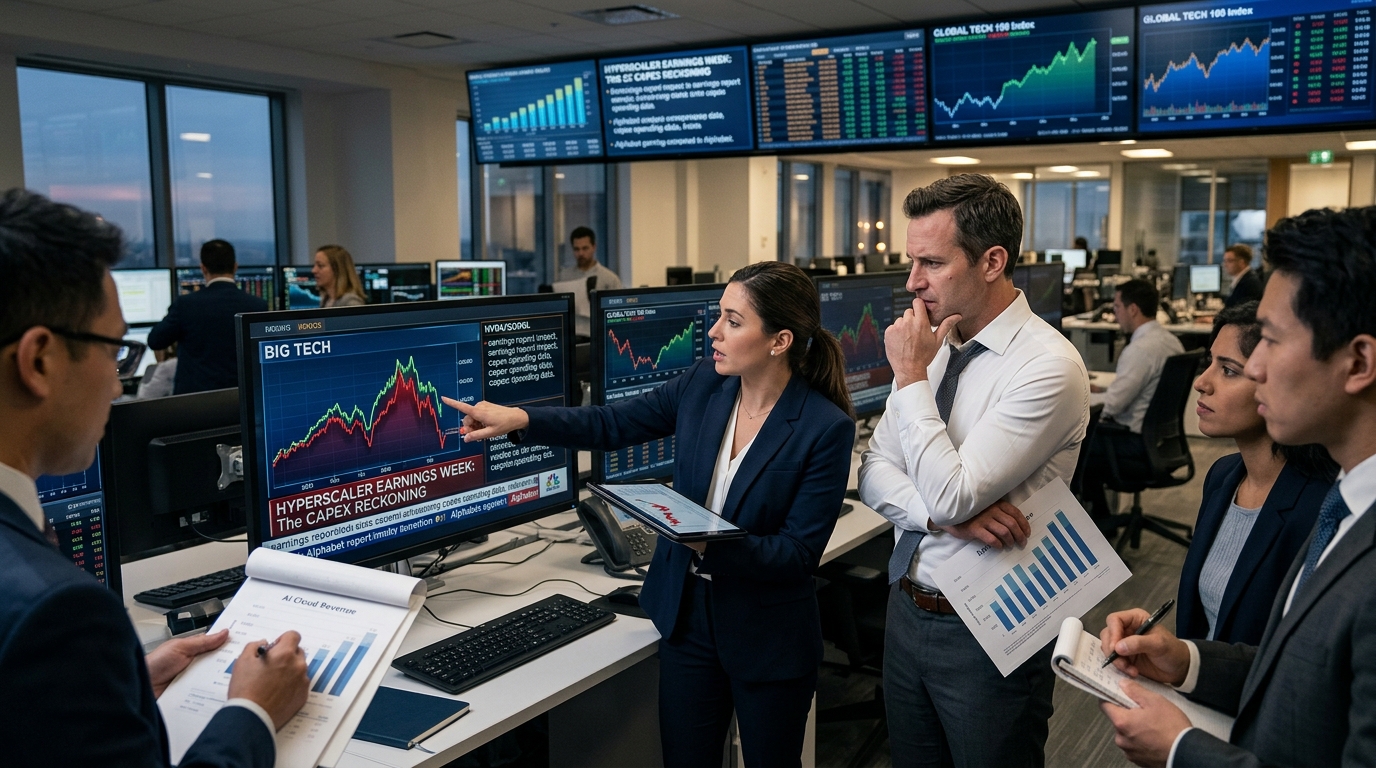
Something shifted last week. It wasn’t subtle.
Alphabet reported one of the strongest quarters in its history: revenue up 24% to $119.8 billion, Google Cloud surging 82% to $24.8 billion, and a 34% operating margin that most businesses would envy. Then the stock fell more than 7% the next day. The Mag 7 index dropped 4.8%, erasing roughly $797 billion in a single session.
The market didn’t punish Alphabet for its business. It punished the cash flow statement.
Alphabet posted negative free cash flow for the quarter. Capital expenditures hit $44.9 billion in a single quarter — roughly doubling year-over-year — against $39.1 billion in operating cash flow. The gap is not a business problem. It’s a trust problem. Investors who spent three years rewarding hyperscalers for spending more on AI just flipped the script. The question now isn’t whether demand is real. It’s whether the returns will justify the cost before the depreciation charges arrive.
And that question lands again this week. Three times.
The Queue
Microsoft and Meta report Wednesday. Amazon and Apple close the week Thursday. Together, these four companies are on track to spend well over $700 billion on capital expenditures in 2026. That figure, from combined consensus estimates, is not a rounding error. It is larger than the GDP of most countries.
Microsoft goes first among the hyperscalers. The setup is uncomfortable. Analysts expect $87.67 billion in Q4 FY2026 revenue and $4.24 in EPS — with Azure guided to grow 39% to 40% in constant currency. Those numbers are fine. The problem is that Microsoft has guided for roughly $190 billion in capex for calendar 2026, and this report will be the first time the company provides fiscal 2027 color on spending. If that number comes in above what Alphabet signaled, Microsoft is on the same trajectory that just punched Google’s stock down to below its 200-day moving average.
Slight tangent, but it matters: Microsoft’s Azure growth rate of 40% last quarter was ahead of guidance, and the stock still fell after that report because investors were focused on the capex line. That tells you what this market is weighing right now. It isn’t the revenue number.
What the Numbers Actually Show
Here’s the thing about the Alphabet reaction that most people glossed over. The company is not burning cash as a business model. It had an unusually large single-quarter capex surge. Alphabet reported GAAP earnings of $9.11 per share, well above the prior-year period, driven partly by a large unrealized investment gain. Google Cloud’s 82% growth was the fastest pace in years.
The bear case isn’t that the business is broken. It’s that the payoff timeline is uncertain and the depreciation math gets ugly. When you spend $44.9 billion in one quarter on data centers and chips, those assets start depreciating on day one. If customer commitments don’t accelerate proportionally, operating margins face a multiyear headwind even as revenue grows.
Barclays summed it up: “AI capex enthusiasm is beginning to cool.” UBS recommended staying invested but acknowledged the risks. The market is not running away from AI. It is repricing what it will pay for AI.
The Amazon Question Is Different
Amazon enters Thursday’s report with a structurally different profile than Alphabet or Microsoft. AWS grew 28% year-over-year in Q1 and delivered $37.6 billion in revenue with a 37.7% operating margin. The cloud division generated a large share of the company’s operating income on a much smaller share of its revenue.
Consensus for Q2 total revenue sits near $197 billion, up roughly 17% year-over-year, with AWS expected around $40.5 billion. KeyBanc has raised its AWS growth forecast to 31% for both 2026 and 2027. Goldman Sachs sees roughly 33% growth this year. Bank of America estimates that Anthropic-related workloads alone could contribute more than $1.5 billion in sequential AWS revenue growth this quarter.
The capex question here is whether Andy Jassy raises Amazon’s full-year 2026 guidance above its current approximately $200 billion commitment. Amazon has raised prices for certain EC2 Capacity Blocks for machine learning amid tight GPU supply. Options pricing is pointing to a roughly 6.3% move on results day — above the recent historical average of 5.4%. The market knows this report matters more than usual.
Sector Dynamics Right Now
The broader earnings season context adds pressure. S&P 500 blended earnings growth for Q2 has climbed to approximately 37.9%, which would mark the highest year-over-year growth rate since Q3 2021. Energy leads at 128.2% growth, Communication Services at 112.4%, and Information Technology at 64.6%.
But the Mag 7 as a group has underperformed the S&P 500 by more than 7% year-to-date through mid-July. The PHLX Semiconductor Index has outperformed the Mag 7 by nearly 80% year-to-date. JPMorgan analysts highlighted the rotation: while hyperscalers dominated S&P 500 earnings contributions in earlier quarters, semiconductors are now poised to deliver nearly half of year-over-year EPS growth. The AI money is still in the market. It just moved down the supply chain.
Healthcare and financials have also picked up rotational flows, with investors rewarding companies generating clean, cash-flow-supported earnings rather than those absorbing massive infrastructure bills with uncertain payback windows.
Three Scenarios for the Week Ahead
Bull Case
Microsoft delivers Azure growth at or above 40% and holds fiscal 2027 capex guidance flat or slightly below the $190 billion calendar 2026 level. Meta and Amazon both report strong cloud and AI monetization metrics that demonstrate revenue is accelerating faster than the capex build. Free cash flow trajectories improve sequentially. The Mag 7 index recovers 5% to 8% into early August as the Alphabet selloff is reframed as a single-quarter anomaly. The S&P 500 pushes toward 7,700 to 7,800.
Base Case
Microsoft and Amazon both beat revenue estimates with Azure and AWS growing at or above guidance. Capex guidance is raised modestly but paired with credible monetization data — Copilot seat growth above 25 million, AWS margin holding above 35%, Meta’s AI cloud business showing measurable progress. The market treats the reports as a mixed outcome, with initial volatility settling into range-bound trading between S&P 500 levels of 7,400 and 7,600. Semiconductors continue to outperform hyperscalers.
Bear Case
Microsoft raises fiscal 2027 capex guidance materially above 2026 levels without a proportional Azure acceleration. Amazon reports Q2 free cash flow below $1.5 billion and guides capex above $210 billion for the full year. Meta raises its own 2027 spending forecast to the $200 billion range flagged earlier in the year. The Alphabet selloff becomes a template. The Mag 7 index tests its year-to-date lows, the S&P 500 falls back toward 7,200, and capital rotation into semiconductors, healthcare, and financials accelerates further.
What Traders Are Watching
The price action this week will be driven less by whether these companies beat or miss revenue estimates and more by three specific variables on each call: the capital expenditure forward guide, the cloud growth rate trajectory, and any concrete evidence that AI infrastructure spending is translating into proportional revenue acceleration. The market’s new rule, established after Alphabet’s report, is that capex growth must correlate with revenue growth acceleration — not just management’s long-term thesis.
Key levels to monitor: the S&P 500’s 7,400 area has served as near-term support through the Alphabet-driven selloff. A break below that level on consecutive hyperscaler misses would change the technical picture materially. On the upside, a clean break above 7,550 on strong reports from Microsoft and Amazon would restore the bull case heading into Nvidia’s August 26 earnings date.
The Mag 7’s average pairwise correlation has fallen to 0.27 on a three-month basis, down from a peak of 0.78 in mid-2025. These stocks are no longer one trade. Each report this week will be judged on its own terms.
AI is still the biggest growth story in the market. The question the next four days answers is whether the companies spending the most on it can prove the returns are actually there — or whether the market keeps rotating toward the companies supplying the picks and shovels instead.
That answer arrives Wednesday night.
For informational and educational purposes only. Not investment advice. Trading involves risk, including loss of principal.