
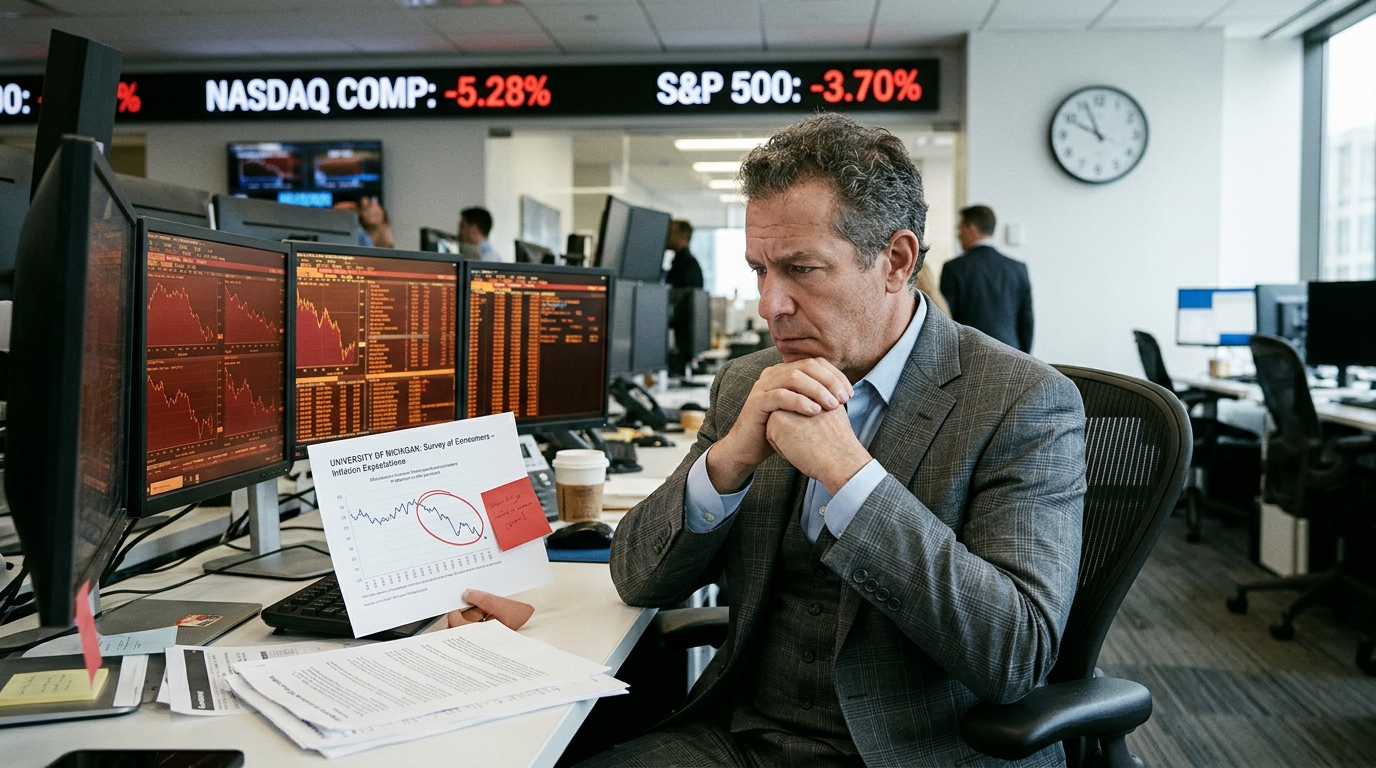
Friday, November 20 was the worst single day for U.S. equities in years. The session delivered the heaviest blow of an already brutal week: the Nasdaq plunged 5.28%, the S&P 500 declined 3.70%, and the Dow lost nearly 950 points. Into that wreckage, at 10 a.m., the University of Michigan dropped one of the more consequential data points of the month. Almost no one noticed.
Median year-ahead inflation expectations plunged from 4.7% last month to 3.7% in November, a full percentage point drop that overshot the preliminary reading of 4.3% by a wide margin. Five-year inflation expectations eased to 3.3% from 3.5%. The final sentiment index came in at 51.5, up from 48.0 in October. Year-ahead expectations at 3.7% remain above February’s 3.4% and all 2024 readings, so this is not a clean bill of health, but the direction is unmistakable.
The timing buried it. When the S&P 500 is falling 3.7% and Nvidia is shedding 14% after Reuters reported the SEC is probing the company’s accounting practices, a consumer survey rarely gets a close reading. That is precisely the problem.
Investing.com’s futures-based monitor put December hike odds at 93.6% on November 20, down from 99.6% in its previous-day snapshot. A six-point move in a near-fully-priced contract is meaningful. It reflects some acknowledgment that the inflation outlook shifted. But 93.6% is still close to certain, and the bond market’s reaction suggests the message has not been fully absorbed.
The 10-year Treasury yield closed at 4.92% on Friday, while the 2-year yield ended at 4.63%, leaving the curve upward sloping by 29 basis points. The 2-year dropped 13 basis points on the day, a meaningful flight-to-safety move. But that move was driven as much by equity panic as by any deliberate shift in the market’s Fed path. The 2-year at 4.63% still implies the market expects the Federal Reserve to stay higher for longer, well past December’s meeting.
That framing deserves a second look. Consumer sentiment rose about 7% this month, led by substantial post-election gains in both short- and long-run expected business conditions. Those with the largest stockholdings reported a decline in personal finances, consistent with continued AI-related agitation in stock markets, which means Friday’s equity losses could soften December’s sentiment reading further. If they do, they will arrive as a corroboration of what the final November survey already told us.
The question is not whether the Fed hikes in December. At the November 17 close, CME FedWatch put the odds of a quarter-point increase at the December 8-9 meeting at about 95%. A single consumer survey will not undo that. The question is what the survey means for the meetings that follow, and whether a Fed that has been leaning on sticky inflation expectations as justification for continued tightening will update its read.
One data point is not a trend. Sentiment remains 9% below February, prior to the start of the Iran conflict, reflecting continued uncertainty regarding cost-of-living factors. And some analysts have warned the improving mood could be a “sugar high from the election.” Those are legitimate cautions. But a full percentage point drop in one-year inflation expectations, in a survey the Fed watches closely, is not noise. It is a signal that arrived in the worst possible hour for anyone to be paying attention. The rate market has six basis points of acknowledgment to show for it. That gap is worth watching.
What to watch: Governor Waller speaks again before the December 9 decision. November CPI drops December 10, the day after. If that reading shows any softening, the gap between what the Michigan survey said Friday and what futures markets are pricing will become very hard to ignore.