

Hindsight is 20/20.
And in hindsight, these sorts of inflection points are always obvious.
Imagine, for example, if I’d told you in the mid-1850s that crude oil would be the foundation of the next century’s global economy.
Or that I told you in 1958 that Jack Kilby’s and Robert Noyce’s microchip would unleash the information age.
Or that Bill Joy’s 1981 graduate study program at Cal Berkeley would lead to the creation of the World Wide Web.
If you had known these things ahead of time and grasped how they would change the world… would you have had an edge as an investor?
Obviously.
Because the right idea, understood at the right time, by the right investor is what makes some people very rich.
Case in point: decades ago, a company called Schlumberger saw the insatiable demand for oil and pioneered tech to map underground reservoirs.
As the post-WWII energy boom hit its stride, Schlumberger’s stock exploded 50-fold.
Same with Intel…
If you understood the magnitude of what Robert Noyce created with the microchip, you didn’t need to be a Silicon Valley venture capitalist to get rich.
You could have simply bought shares of his company, Intel, and watched it surge from just $0.50 in the mid-1980s to $75 by the year 2000.
Same with Sun Microsystems…
In 1994, following the commercialization of the internet, Bill Joy’s company moved from $0.65 per share to over $125 per share in just six years – a 19,000% gain.
These enormous, historical gains didn’t require pre-IPO investing, early-stage funding, or any type of high-risk capital allocation.
All it took was a deep understanding of how a new technology, or a fusion of technologies, would impact certain companies and, of course, knowing what to buy.
Think back to the late 1990s, when the dawn of the net collided with the telecom boom.
A convergence that sent the companies building the infrastructure, like Cisco, up roughly 100,000%.
Or look back to January 2007… when microchips fused with 3G cellular networks to give birth to the smartphone, propelling Apple’s stock up 9,500%.
But mark my words: those events could be reduced to footnotes in history compared to what’s forming right now.
You see, the rate of disruption and transformation we’re seeing today has no precedent.
Right now, beneath the surface of the market, a number of immense forces are fusing together to create a potentially generational investment opportunity.
What I call an Ignition Point.
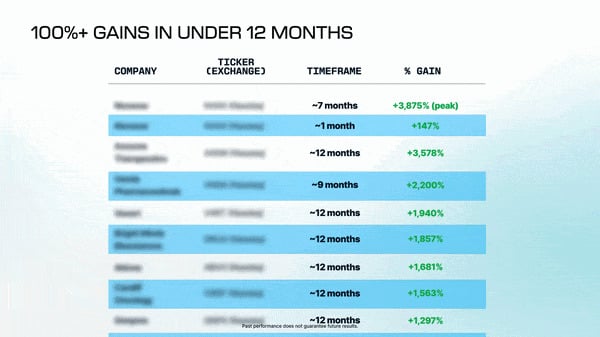
And even in the early stages of this event, we’re seeing certain stocks connected to the story rise sharply in a very short window of time.
Yet almost everyone is blind to it.
Everyone is too distracted by Nvidia, SpaceX, the IPOs of Anthropic and OpenAI, and the rest of the late-stage AI circus.
They’re missing the fact that the real wealth is being generated in a completely abandoned corner of the stock market.
I just released a video detailing exactly what is happening, and how to best capitalize on it regardless of your investing experience.
In it, I hand you a complete roadmap for playing this opportunity… I even give you the name and ticker symbol of the #1 stock sitting at the center of this Ignition Point.
Watch it here now while it’s still online.
Good investing,
Porter Stansberry
China’s October Numbers Put the Shenzhen Talks on a Knife Edge

The numbers that landed from Beijing this morning carry a weight that extends well beyond a single month’s data release. China’s economic momentum cooled in October, with retail sales, investment, and industrial output all coming in below expectations, a reminder that a growing reliance on external demand leaves growth more exposed to shocks abroad. Three days before Trump and Xi sit down together in Shenzhen, that is an uncomfortable set of facts.
Retail sales rose just 0.4% year on year in October, disappointing the 0.8% consensus forecast and slowing from a six-month high of 1.1% in September. The figures are more worrying given that October consumption should have received a boost from a seven-day holiday and the way Singles’ Day promotions now stretch beyond a single day into a longer selling season. Neither moved the dial. Fixed-asset investment fell 8.1% in January to October, worse than the expected 7.0% drop.
Strong demand for high-tech products masked the weaknesses in more traditional, domestically oriented industries, and may prolong or even deepen imbalances in China’s growth model as resilient manufacturing and exports lessen pressure on policymakers to shore up domestic consumption. Factories have been the main source of strength this year, helped by exports of AI-related technology, though the slowdown came despite a soft comparison with last October, pointing to cooling momentum rather than base effects.
What does Beijing plan to do about it? Not much, by design. China’s leaders have signaled they prefer to lean on faster deployment of already-budgeted fiscal spending and targeted measures rather than launch a major new stimulus push, with officials still wary of worsening industrial overcapacity. That posture predates today’s data, and there is no sign it will change before year-end.
For precious metals investors, the significance lies in the tension that posture creates ahead of Shenzhen. The U.S.-China trade truce runs to January 10, 2027, after both sides agreed to extend it beyond its earlier November 10, 2026 deadline. The agenda is expected to include the trade truce, which expires in January, and analysts largely expect it to be extended despite signs of growing friction. An economy leaning this heavily on export momentum has very little tolerance for a deal that goes wrong.
Property remains in a slump, and China’s 5-year government bond yield has been trading near record lows, pushing some Chinese savers toward gold as a safe haven. Chinese buyers have been shifting toward bars and coins and away from decorative jewelry in recent years, as China Gold Association figures have shown. Meanwhile, the People’s Bank of China reported about 40 tonnes of net additions to its gold holdings in the first half of 2026.
That dynamic deserves a clear reading. When domestic property, equities, and bonds all disappoint simultaneously, Chinese household savings rotate into gold. Weak October data reinforces each of those conditions rather than relieving any of them. Safe-haven motives, subdued local yields, weakness in the property sector, and concerns over the economic outlook have continued to support investment demand, with continued central bank buying also reinforcing confidence in gold among domestic investors.
The yuan’s role in this dynamic is easy to underestimate. Beijing’s fiscal expansion and PBoC reserve behavior have historically been the most reliable transmission channel from Chinese policy to gold prices.
The risk to this outlook is binary and timed. If the Shenzhen talks produce a credible extension of the trade truce, export momentum holds and Beijing’s calculation that it can run the economy on factories and foreign demand survives another quarter. If talks falter, the export pillar cracks, the pressure for genuine domestic stimulus grows, and uncertainty spikes. The investment slump has deepened and retail sales continue to lag the manufacturing side of the economy as consumer spending languishes with the property market downturn still weighing on household balance sheets. Neither outcome eliminates gold’s appeal in China; one simply accelerates it.
Investors watching the Shenzhen summit this week should understand that the October data has already narrowed Xi’s room for compromise. An economy carrying this much domestic weight cannot afford to lose its export engine. That constraint, more than any diplomatic pleasantry, will determine what gets agreed before January 10.