
Dear Reader,
Democrats have won both the House and the Senate.
That could make things a lot harder for President Trump.
Obviously, now comes the debate over what he can get done in the remainder of his term, and what it means for your money.
But before you make any changes to your investments, there’s something else worth thinking about.
What if the next big financial problem starts OUTSIDE Washington?
As you probably already know, companies are spending huge sums on AI data centers… counting on future revenue to justify the current expenditure.
But what happens if that revenue falls short?
The losses could hit not just AI stocks but also banks and retirement funds. And Washington could face pressure for another bailout.
Our new briefing explains all our concerns and also the steps you can take to prepare.
You’ll also find out how to get our reports on buying gold and silver in a crisis.
As Washington adjusts to the election results, take a moment to check how prepared your money is for what comes next.
Eliza Lasky
Weiss Advocate
China’s Rare-Earth Clock Is Running. Shenzhen Resets It or Not.
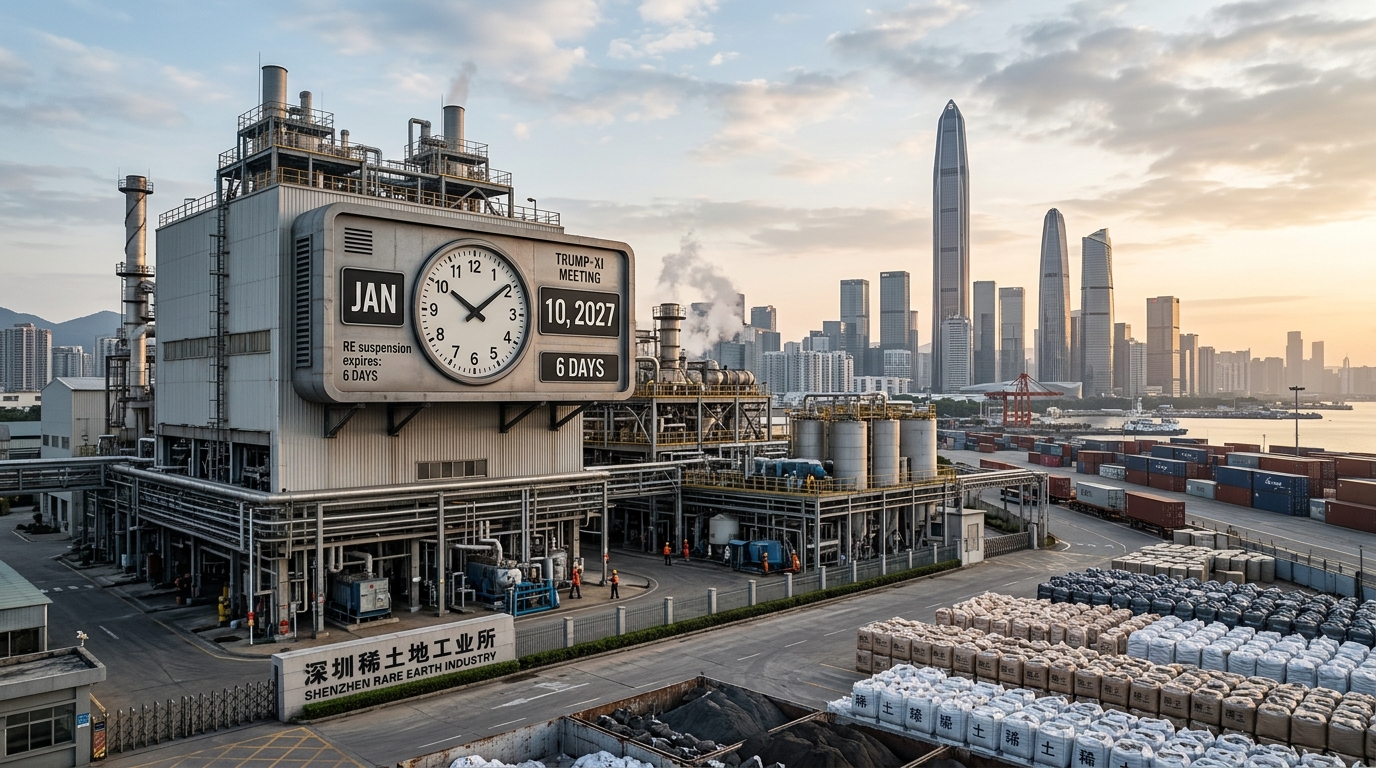
Six days from now, Donald Trump walks into Shenzhen for the APEC leaders’ summit. The diplomatic agenda is crowded: a possible three-way meeting with Vladimir Putin, ceasefire talks on Iran, the G20 warm-up. For precious metals and critical minerals investors, one number matters more than any of it: January 10, 2027.
That is the date China’s suspension of rare-earth export controls expires. China’s Ministry of Commerce extended the pause by two months until January 10, a move Beijing announced on November 9, 2026 as part of a broader package preserving the trade truce. The extension is real, but it is not reassuring. The extension runs only until January 10, 2027. No permanent deal. No binding mechanism. Just a two-month runway to Shenzhen and then Miami in December.
A Suspension Is Not a Supply Chain
The fundamental problem for U.S. manufacturers is that the paperwork exists but the material does not arrive in full. U.S. officials contend that China is fulfilling only about two-thirds of its pledged rare earth exports, with volumes failing to rise despite direct talks in New York two months ago. Beijing disputes that assessment. The data, however, is harder to argue with: between November 2025 and September 2026, the United States imported an average of 19.3 metric tons of rare earth compounds and metals per month, a decrease of almost 75 percent.
April licensing requirements for seven medium and heavy rare earths, including dysprosium and terbium, remain in place and were not lifted by the extension. Some Chinese suppliers had already halted rare earth shipments to American customers, and certain U.S. companies waited over six months for export licenses. The suspension buys time; it does not fix the licensing bottleneck.
The price gap has become grotesque. Yttrium is a staggering 125 times more expensive in Europe than in China, with a ton of the oxide costing about $1.15 million compared with about $9,144 in China, where supplies remain ample.
What Shenzhen Could Move
China’s rare earth exports to the United States remain sharply below pre-restriction levels, even as shipments to other destinations have proven more resilient, raising the stakes for Trump-Xi meetings in Shenzhen and Miami. U.S. Trade Representative Jamieson Greer and Treasury Secretary Scott Bessent have both pressed Chinese Vice Premier He Lifeng publicly and privately.
That bureaucratic friction is precisely what a bilateral meeting in Shenzhen could break. If Trump and Xi agree to a concrete compliance mechanism, rare-earth flows to the U.S. could accelerate materially before January 10. If Shenzhen produces only another vague commitment, the January deadline becomes a cliff.
Where the Investment Case Sits
The uncertainty has a consistent beneficiary: non-Chinese producers. Lynas and MP Materials are widely seen as core pillars of non-Chinese supply, but the system remains brittle when magnet-grade material tightens.
The policy backstop beneath those valuations is not permanent, and the market has already repriced it once. MP Materials’ rapid run-up raised the question of whether its advantages are durable or entirely dependent on the suspension holding.
MP Materials describes itself as America’s only fully integrated rare earth producer, with supply agreements covering GM and Apple providing baseline revenue. In the first quarter of 2026, the company produced a record 917 metric tons of neodymium-praseodymium, up 63 percent year over year, while rare-earth oxide production reached a quarterly record of 12,983 metric tons. Lynas, meanwhile, has been building its own momentum: in the fiscal year to June 2026, the group produced 13,089 metric tons of rare earth oxides including 7,260 metric tons of NdPr, reporting revenue of A$977.9 million. In March 2026, Lynas signed a binding Letter of Intent to finalize a rare earth oxide supply agreement with the U.S. government, supporting the U.S. industrial base and supply-chain resilience efforts.
A successful Shenzhen summit that unlocks full Chinese compliance would compress the price premium outside China and reduce the near-term urgency that drives demand toward MP and Lynas. A failed or inconclusive summit, with the January 10 deadline looming, keeps that premium wide and strengthens the investment case for both. The backdrop is further complicated by the Nvidia governance crisis: revelations that U.S. officials are scrutinizing suspected diversion channels for Nvidia chips to China have set off a series of events, with lawmakers pushing for tighter curbs on chip exports to China. A harder line on chips tends to harden Beijing’s posture on minerals in return.
Risks to Monitor
A clean deal in Shenzhen would be bearish for rare-earth equities in the short run. Analysts warn that a realistic possibility of further extension of the current suspension exists, rather than a durable resolution. That is the central risk to any position built on supply scarcity: Beijing can extend, adjust licensing, and release just enough material to prevent a crisis while preserving its strategic leverage. The trade-flow data suggests Beijing has retained the ability to selectively constrain access to rare earths, even after agreeing to ease export restrictions, mirroring the dynamics that preceded the Busan Agreement itself.
What investors should understand today is that the January 10 date is not just a trade deadline. It is the moment Beijing decides whether rare-earth supply is a tool or a good-faith commitment. Everything in Shenzhen next week tells you which one it is.