
November 3, 2026
Bonus Content: South Africa Just Lost Duty-Free US Access. Gold and Platinum Investors Should Pay Attention.
Dear Investor,
Here’s a list worth reading slowly.
a16z crypto. The London Stock Exchange Group. Paxos. Marex. Shinhan Asset Management. TreasurySpring.
In a single quarter, all six signed on to help run one crypto network.
Not to invest in it. Not to “explore” it. To operate it, as validators securing the network.
And they’re not alone. The DTCC, the institution that settles the U.S. securities market, is running a pilot on this same network with more than 30 firms. Treasury repo. Securities lending. Collateral. Tokenized stock transfers.
Most crypto projects spend years trying to get one bank to return a phone call.
This one has Wall Street’s plumbing moving onto it.
That’s why it’s my #1 coin right now.
And here’s the part that matters for your timing: while all of this was happening, the token itself dropped about 14% in a single day this week, with no bad news behind it. It’s still roughly 30% below its all-time high.
The institutions are building. The price is wobbling. I know which one I’m paying attention to.
My full report is normally $97. Today, $3.
Discover my #1 coin for the market right now (before it surges again).
To your massive success,
Bryce Paul
Crypto 101
South Africa Just Lost Duty-Free US Access. Gold and Platinum Investors Should Pay Attention.
Washington confirmed Monday what Pretoria had been dreading for months. US Trade Representative Jamieson Greer said South Africa and Rwanda would be suspended from the African Growth and Opportunity Act from January 1, 2027, citing concerns about barriers to US trade and investment, corruption, and threats to US national security and foreign policy interests. The headlines focused on cars and wine. Precious metals investors should be reading between those lines.
What the AGOA Suspension Actually Means
South Africa has been the largest beneficiary of the US program, exporting about $1.7 billion worth of goods to the US under AGOA in 2025. Those exports include car parts, citrus fruit, and wine. The automotive exposure is the headline number, but its deterioration predates Monday’s announcement. South African vehicle exports to the United States had already fallen 83.2%, dropping from 24,682 units in 2024 to 4,136 in 2025. The reason: a 25% Section 232 national-security tariff had already neutralized AGOA’s preferential rates long before this week’s formal termination.
Mercedes-Benz is now weighing options for its South African operations after US tariffs and the impending AGOA suspension have hit the auto sector hard. The carmaker has exported the C-Class sedan from South Africa to the US since 1997, taking advantage of AGOA’s tariff elimination. The suspension has raised fresh concerns about the viability of South Africa’s export-driven auto sector, which counts Mercedes, BMW, and Volkswagen among its largest investors and employers.
Why the Rand Is the Real Variable
For gold and platinum investors, none of that automotive detail matters as much as one number: the rand. South Africa earns a lot of foreign currency from metals, so when prices for exports like gold and platinum fall, the rand often softens too. The same dynamic runs in reverse through costs: a weaker rand inflates every rand-denominated expense on a mine’s income statement, from wages to diesel to reagents.
At 0630 GMT on Tuesday the rand traded at 16.62 against the dollar, little changed from its previous close. The economic impact is likely to be less severe than headlines suggest, ETM Analytics said in a note, adding that markets had largely priced in the move, limiting the rand’s reaction. That calm is worth noting, but it does not mean the risk has been absorbed. Political uncertainty can still nudge the risk premium investors demand to hold South African assets higher, and that showed up more clearly in bonds: the benchmark 2035 government bond’s yield was around the mid-8% area in recent sessions.
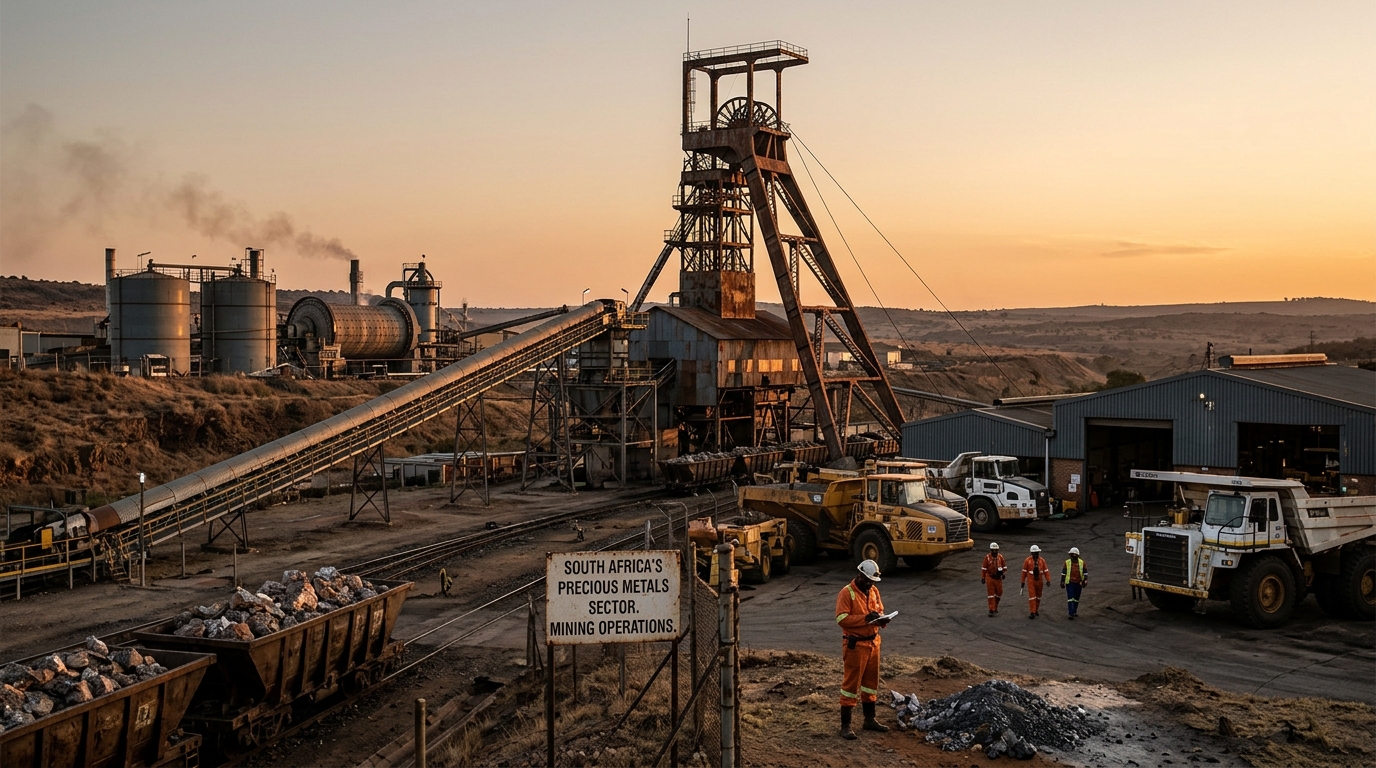
The deeper cost problem already existed before this week. Northam Platinum’s group unit cash cost rose 7.2% to R27,208 per 4E ounce in its interim period reporting for the half-year ended December 31, 2025. Its full-year guidance for group unit cash cost of R29,500 to R30,500 per 4E ounce implies a further step-up. South African supply is flat at best, costs are rising year after year in rand, and at least one major greenfield project remains subject to execution risk. Any meaningful rand depreciation from here compresses already-thin margins further for producers reporting in dollars.
Northam’s cost pressure does not exist in isolation from the demand side of the platinum equation. Hybrid vehicle sales taking share from EVs have quietly rebuilt the autocatalyst demand case for platinum-group metals.
The Investment Case
South Africa produces roughly 70% of global mined platinum. The USGS puts South Africa at roughly 70% of global mined platinum. That concentration is both the investment case and the risk. When South African political friction rises, platinum supply security becomes a real question, and that can support prices independently of demand fundamentals.
For gold, Harmony Gold (HMY) illustrates the cost-currency tension most clearly. Harmony’s all-in sustaining cost for FY2026 came in at R1,191,698 per kilogram, equivalent to US$2,195 per ounce, within guidance. For the financial year ended June 2026, group revenue increased 34% to R99.2 billion, while headline earnings per share rose 87% year on year. Those results were built on a strong gold price. A weaker rand would lift rand-denominated revenues, providing a natural hedge, but only if costs don’t accelerate faster.
Risks to Monitor
Washington cited barriers to US trade and investment, corruption, and threats to US national security and foreign policy interests as the grounds for South Africa’s removal. That language leaves the door open to further bilateral deterioration. The Trump administration has taken a series of measures against South Africa, accusing its government of anti-white discrimination, an allegation Pretoria rejects. A worsening political relationship raises the risk premium on South African assets broadly, including mining equities.
Political risk premium is only one variable compressing South African mining equities. Rising US real Treasury yields have already shown they can override geopolitical support and drive sharp precious metals selloffs.
The bullish read: rand weakness boosts rand-per-ounce revenue for South African gold producers, and supply-chain uncertainty around platinum has historically supported the metal’s price. The bearish read: cost inflation in South Africa is already running persistently higher year on year, and a deteriorating investment climate makes new capital allocation into the region harder to justify.
Bottom Line
The AGOA suspension is a political event with an economic tail. The auto sector took the visible hit, but the rand and South Africa’s mining cost base are where precious metals investors feel it. Producers like Harmony and Northam are already absorbing rising rand costs. If the currency breaks materially lower as bilateral tensions escalate, the revenue tailwind for gold miners gets louder while platinum’s supply-concentration argument becomes harder for the market to ignore. Watch the rand at 16.62 as the reference point. If it breaks toward 17.50 or beyond on sustained political pressure, South African mining equities shift in both directions: dollar revenues up, operating-cost risk up alongside them.