
Oil traders are selling the war premium. Gold investors should not follow them blindly.
Brent crude futures fell more than 3% in early Monday trading after hopes for diplomacy resurfaced. The catalyst was diplomatic, not fundamental. Iranian negotiators were in Doha for a third consecutive day of talks with Qatari mediators aimed at pushing for a deal to end the US-Israeli war on Iran, Reuters reported Sunday. Reports have also described President Trump alternating between public support for talks and threats of renewed strikes, with Washington widely expected to avoid major escalation before Tuesday’s US midterm elections.
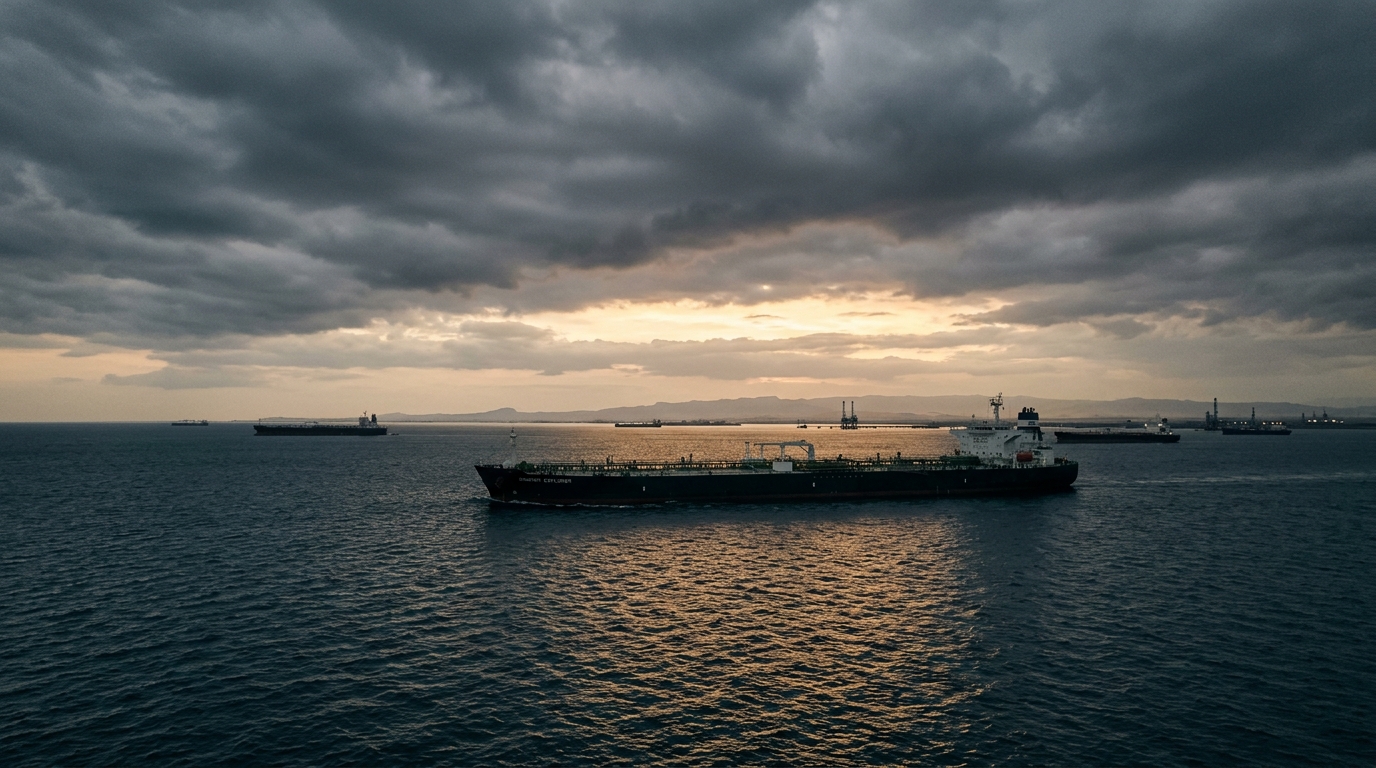
But here is what the oil market is choosing to ignore: effective yesterday, the Strait of Hormuz is a materially more dangerous place for the tanker fleet that moves most of its cargo.
Iran’s Persian Gulf Strait Authority said it will take “legal action” against all vessels belonging to South Korean shipping company Sinokor starting November 1, alleging that the tanker owner’s fleet has committed the most violations of its rules for transiting the Strait of Hormuz, Reuters reported on October 27. The action against Sinokor is the first time the authority has issued a blanket warning covering a shipowner’s entire fleet, rather than targeting individual vessels. Separate reporting has described the authority maintaining a non-compliance list that has reached 123 vessels.
The scale of what is threatened here is not modest. Bloomberg reported that ships owned by Sinokor carried 105.6 million barrels of crude through the Strait of Hormuz in September, more than any other owner and roughly 37% of the total, with the next three owners, Bahri, KOTC, and ADNOC’s shipping unit, moving a combined 97.3 million barrels. As for fleet size and buying spree, trade press has reported Sinokor’s 2026 acquisitions at roughly the low-70s vessels and total spending near $6 billion, depending on the dataset and definition used.
The Persian Gulf Strait Authority has not clarified what legal action will involve, and its published warning does not explicitly announce physical attacks on every Sinokor vessel. That ambiguity is precisely the problem. In this conflict, ambiguity has been the mechanism. In recent trade-press reporting, brokers have put the additional war-risk premium for a Hormuz transit at roughly 6% to 10% of a ship’s hull value at times, versus about 0.25% before the conflict. That can translate into a bill of up to about $20 million for a single supertanker voyage, depending on hull value and where rates are quoted.
Iran’s ambiguity strategy has a track record. Trump’s rejection of Iran’s Hormuz proposal sent VLCC earnings to record highs as the relief trade evaporated.
This is where the gold case sits. Gold was trading around $3,900 per ounce on November 2 after touching levels below $3,900 late last week, with market commentary attributing support to geopolitics even as higher-rate expectations continued to weigh on bullion.
But the Sinokor action introduces a specific risk that diplomacy headlines cannot resolve. Peace talks reduce the probability of new US airstrikes. They do not compel Iran’s strait authority to lift its fleet-wide warning on a short timeline. After the November 3 vote, Washington’s political reason to avoid visible escalation may loosen. Recent reporting has said Israeli officials have urged the White House to resume strikes immediately after the midterms, while Trump has publicly alternated between diplomacy and threats. The window in which Iran has the most to gain from disrupting commercial shipping, without triggering an immediate military response, may be precisely the next 48 to 72 hours.
Investors remain cautious regarding potential volatility in the Strait of Hormuz even as crude prices fall. They are right to be. The oil market is pricing hope of a settlement. The insurance market, the war-risk bands, and Iran’s own escalation ladder suggest the underlying risk has not moved. Gold, bouncing from late-October lows with geopolitics cited as a support, may have more floor than this morning’s Brent decline implies.
Risks to Monitor
The bull case for gold’s geopolitical bid breaks down if US-Iran talks in Doha produce a concrete ceasefire framework before the midterms. A genuine deal that reopens Hormuz to all commercial traffic would remove the structural argument here. KCM Trade’s chief market analyst told Reuters that Brent could be pushed toward $120 if rhetoric hardens after the midterms, which would compound inflation expectations and press the Fed’s hand, keeping real yields elevated and capping gold’s recovery room. That is the dual risk: gold needs the geopolitical floor to hold without the inflationary consequences of a full oil spike accelerating above it.
The Fed adds a second variable to that dual risk. Real yields and the December rate decision are the mechanism that caps how far geopolitical support can lift gold even when the floor holds.
Bottom Line
Brent fell more than 3% this morning. Iran’s most consequential shipping action of the entire conflict took effect yesterday. Those two facts coexist, and the oil market has chosen to pay attention only to the first. Precious metals investors understand that the geopolitical premium does not evaporate with a press conference. The Sinokor fleet-wide warning is live, war-risk insurance remains at wartime levels, and the midterm constraint on US escalation expires Tuesday night. Gold around $3,900, bouncing from late-October lows, may be the better place to hold that unresolved risk than Brent around $110 falling on a deal that has not yet been signed.