
September 26, 2026
Bonus Content: Defense Backlogs Hit $1.36 Trillion. The Bottleneck Is the Story.
Do this before November 3

For the last 78 years, one thing has predicted a bull market…
With 100% accuracy…
The midterm election.
It doesn’t matter which party wins.
Or what the economic conditions are.
In war and in peace…
The 12 months following a midterm election are the most profitable.
This midterm will be no different.
And I just caught Wall Street sneaking money into two stocks – ahead of the Nov. 3 election.
Defense Backlogs Hit $1.36 Trillion. The Bottleneck Is the Story.
The money is not the constraint anymore. That is the single most important shift in the defense investment story right now, and most investors have not fully priced what it means.
Global defense outlays are expected to climb to $2.6 trillion by the end of 2026, with momentum pointing toward $2.9 trillion by the decade’s end, according to Forecast International.
On the allied side of the Atlantic, the acceleration has been relentless. The International Institute for Strategic Studies estimates real growth in European NATO defense spending surged to 12.9% in 2024 and 12.3% in 2025, and that collective spending is on track to increase by almost 10% again in 2026. These are not one-year budget spikes. European rearmament and U.S. defense funding are extending revenue visibility through 2029 and beyond.
That demand has flowed directly into contractor order books. PwC’s mid-year 2026 aerospace and defense outlook put the five largest U.S. primes at $1.36 trillion in combined backlog at the close of fiscal 2025, up 23.7% year over year, with individual order books ranging from flat to growth of more than 30%.
Lockheed Martin’s backlog reached $193.6 billion at year-end 2025. RTX ended 2025 with a record backlog of $268 billion. The numbers are so large they obscure the real investment question: can these companies turn contracted paper into delivered ships and planes?
Huntington Ingalls, the only U.S. shipyard that designs and builds nuclear-powered aircraft carriers, is the clearest case study. The company reported Q2 2026 revenue of $3.4 billion, up 10.9%, and the submarine industrial base finalized contract modifications for Virginia-class Block VI and Columbia-class Build II submarine construction valued at a combined $76.6 billion. Total backlog as of June 30, 2026, stood at $57.3 billion, up from $53.1 billion at year-end 2025. That backlog converts to years of contracted revenue. The question is the conversion rate.
CEO Chris Kastner pointed to a fourth consecutive quarter of double-digit shipbuilding growth, with throughput improved 12% year to date against a 15% full-year target and more than 3,500 shipbuilders hired. The labor build is real, but the margin line reflects the strain. Free cash flow turned negative $150 million in Q2, versus $730 million a year earlier.
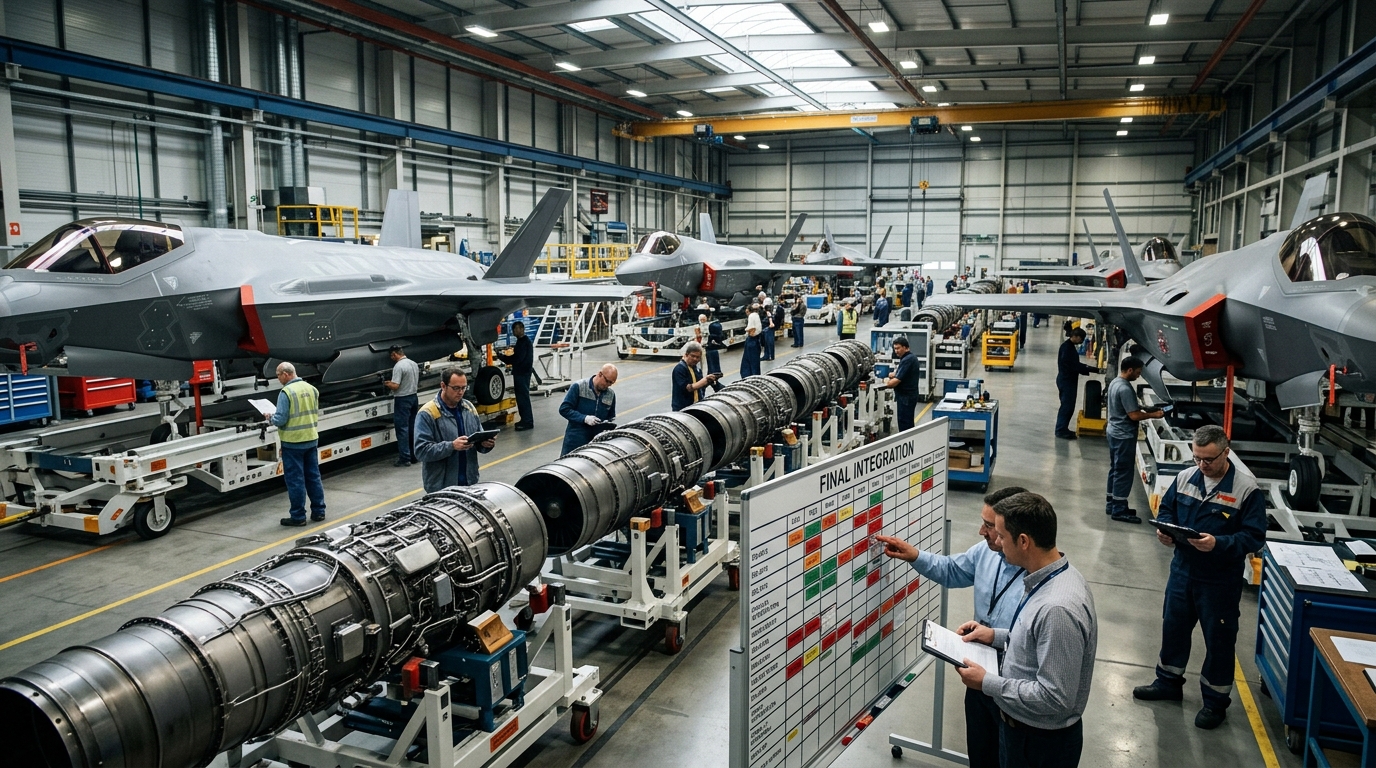
That tension, fat backlogs against constrained throughput, runs across the sector. Production bottlenecks in Western nations, not the usual complaints about insufficient government spending, have become the key problem many NATO countries face today. NATO allies are increasingly treating higher defense spending as a long-term planning assumption, and European revenue has grown double digits across major U.S. contractors. More orders do not automatically mean more earnings if the factory floor cannot keep pace.
For investors, the backlog figures are a genuine asset: they represent locked-in sovereign demand that does not evaporate with a quarterly earnings miss or a trade dispute. Sustained budget growth and long-horizon modernization priorities provide clearer multi-year visibility, rewarding teams that can execute quickly while maintaining reliability, compliance, and lifecycle support. The distinction between which primes can execute and which are sitting on work they cannot ship efficiently is where the real valuation divergence will emerge over the next 18 months.
The defense backlog is not a thesis anymore. It is a management test.