
September 21, 2026
Bonus Content: Copper at $6.65 a Pound. The Comex-London Gap Trade.
Nobody fell asleep on the pricing keyboard.
The first-year price really is $1.
That opens Monthly Money Flows, Jeff Z.’s trading research service:
One new Calendar Stock idea each month, his analysis, and the entry, target, and stop levels he’s watching.
Jeff studies recurring monthly buying patterns for potential stock opportunities. The Blueprint, Crash Course Video Series, and Options 101 help explain his approach.
Training is available after checkout. His next alert arrives when he releases it.
You’re paying to access the research. You choose whether to act on any idea.
One dollar. Twelve months to explore it. Accounting can relax.
Copper at $6.65 a Pound. The Comex-London Gap Trade.
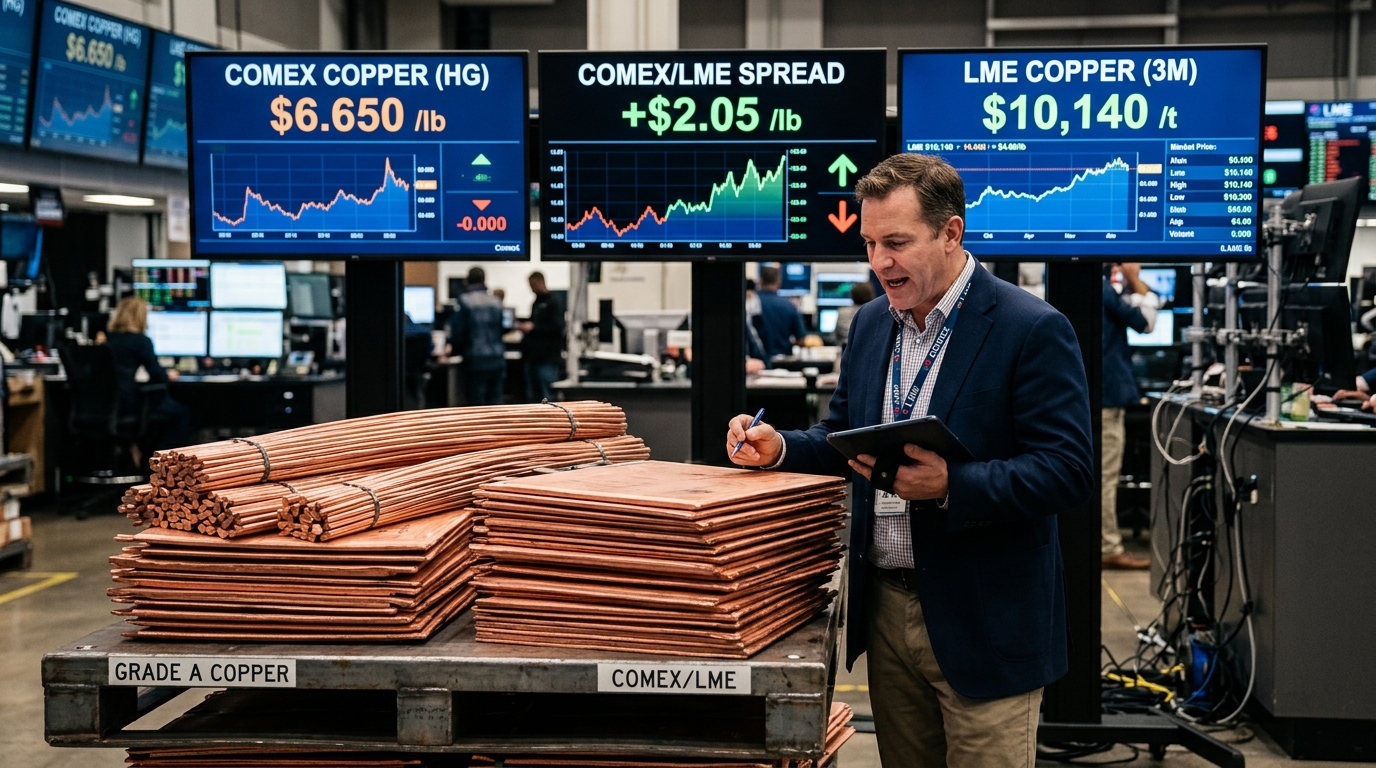
Copper is sitting at $6.65 a pound this morning, up 0.47% on the session and 44.81% higher than a year ago, and the case for treating it as a precious metals story rather than a simple industrial-cycle bet has rarely been stronger. The price is one number. The more instructive figure is the gap between two prices.
What the Spread Is Saying
The spread between Comex and LME copper prices normally sits around $50 per tonne. It is not sitting there now. Analysts describe copper as a “policy trade,” noting that the US has built an increasingly aggressive Section 232 regime around the metal, imposing a 50% duty on semi-finished copper products and intensive copper derivative products while deferring any tariff on refined copper itself, pending a Commerce Department update to the President. That deferred decision is what separates Comex from London.
Any tariff on refined copper, if imposed, would operate as a phased measure starting at 15% in January 2027 and rising to 30% in January 2028. The Comex premium reflects market expectations that such tariffs may come. Traders are paying a forward premium for US-delivered copper to hedge against the risk of duties being announced before existing supply arrangements can be renegotiated.
Applying that framework across matched futures maturities, some banks have argued the market is implicitly assigning only a partial probability to the phased tariff path. Those odds look modest. But no refined copper tariff announcement has followed the Commerce Secretary’s update timeline, and no hard legal deadline exists for a final decision, meaning the uncertainty, and the spread, can persist.
Earlier this week, copper prices dropped to multi-week lows following reports that the Trump administration had postponed a decision on potential tariffs on refined copper. Today’s bounce back to $6.65 reflects the market’s conclusion that postponement is not cancellation.
The Structural Floor Beneath the Policy Premium
Strip out the tariff trade entirely and copper still has a strong fundamental argument. Chile’s state copper commission, Cochilco, said in August that Chile’s 2026 copper production is expected to fall 2.6% to 5.27 million tonnes, before recovering in 2027. Weak output at state miner Codelco and at BHP’s Chilean operations has been a key driver.
On the demand side, the Yangshan premium, a key indicator of Chinese copper demand, climbed to $121 a tonne last week, its highest level since November 2022. Add the longer-dated pull from electrification: Wood Mackenzie projects AI-driven power needs could lift copper demand for grid infrastructure alone to about 1.1 million tonnes per year by 2030.
The Investment Opportunity
For miners with US smelting operations, a refined copper tariff is not a risk. It is a competitive advantage. The US uses roughly twice the amount of refined copper it produces, leaving it reliant on net imports. Most US smelting capacity sits at a small number of facilities, including Freeport-McMoRan’s Miami smelter in Arizona, Rio Tinto’s Kennecott smelter in Utah, and ASARCO’s Hayden smelter in Arizona, which has been discussed publicly as a restart candidate. Freeport-McMoRan and Rio Tinto are the direct beneficiaries if refined cathode attracts duties.
Freeport-McMoRan reported adjusted earnings of $0.74 a share on revenue of $7.03 billion for the quarter ended June 2026, beating estimates of $0.59 a share. For 2026, the company expects second-half copper sales to be more than 20% higher than in the first half. Southern Copper, meanwhile, holds the largest copper reserves among listed companies and carries deep exposure to Latin American production upside as Chilean output recovers.
The ETF route, CPER, tracks Comex futures directly. Because CPER tracks Comex futures rather than spot, returns can diverge from day-to-day physical prices due to rolling and futures curve effects, a feature, not a bug, for investors who want explicit exposure to the tariff-premium side of the trade.
Risks to Monitor
A 15% refined cathode tariff effective January 1, 2027, the scenario under active discussion, would collapse the arbitrage and reverse months of positioning. The silver connection matters here too: industrial silver use now represents a substantial portion of total global demand, and industry data points to another year of market deficit in 2026. If the same AI-grid buildout that is driving copper demand hits supply walls in both metals simultaneously, the pressure on the wider industrial metals complex intensifies.
The Fed remains a counterweight. Copper climbed following the Fed’s widely anticipated interest rate hike but investors remained cautious after the Fed signaled that additional rate increases could be necessary, which could weigh on non-yielding metals.
Bottom Line
Copper at $6.65 a pound is not simply a reflection of today’s supply tightness. It is a composite of Chilean mine underperformance, Chinese physical demand, AI-linked grid buildout, and a Section 232 decision that has been deferred but not dismissed. The Comex-London gap is the market’s real-time probability estimate on that last variable. Copper’s price is now reacting to a policy decision that hasn’t happened yet, not just to current supply and demand. Investors who understand that distinction are reading a different instrument from those watching only the headline price.