
September 18, 2026
A second guidance cut in a month from a top storage deployer signals US supply-chain rot that matters well beyond one stock.
The story being told about Fluence Energy this week is mostly about a single company’s operational failure. The more useful story, for precious metals investors, is what the wreckage reveals about the industrial metals complex underpinning the clean-energy build-out.
Alert: The DeFi Token Set to Explode as Markets Recover
Major institutions are fighting to acquire this DeFi protocol before prices surge in the post-tariff rally that’s already beginning. This isn’t speculation – this platform’s role is so essential to crypto’s financial system that its current price defies all logic.
Just Released: The DeFi token set for massive gains as markets heat up – only $3!
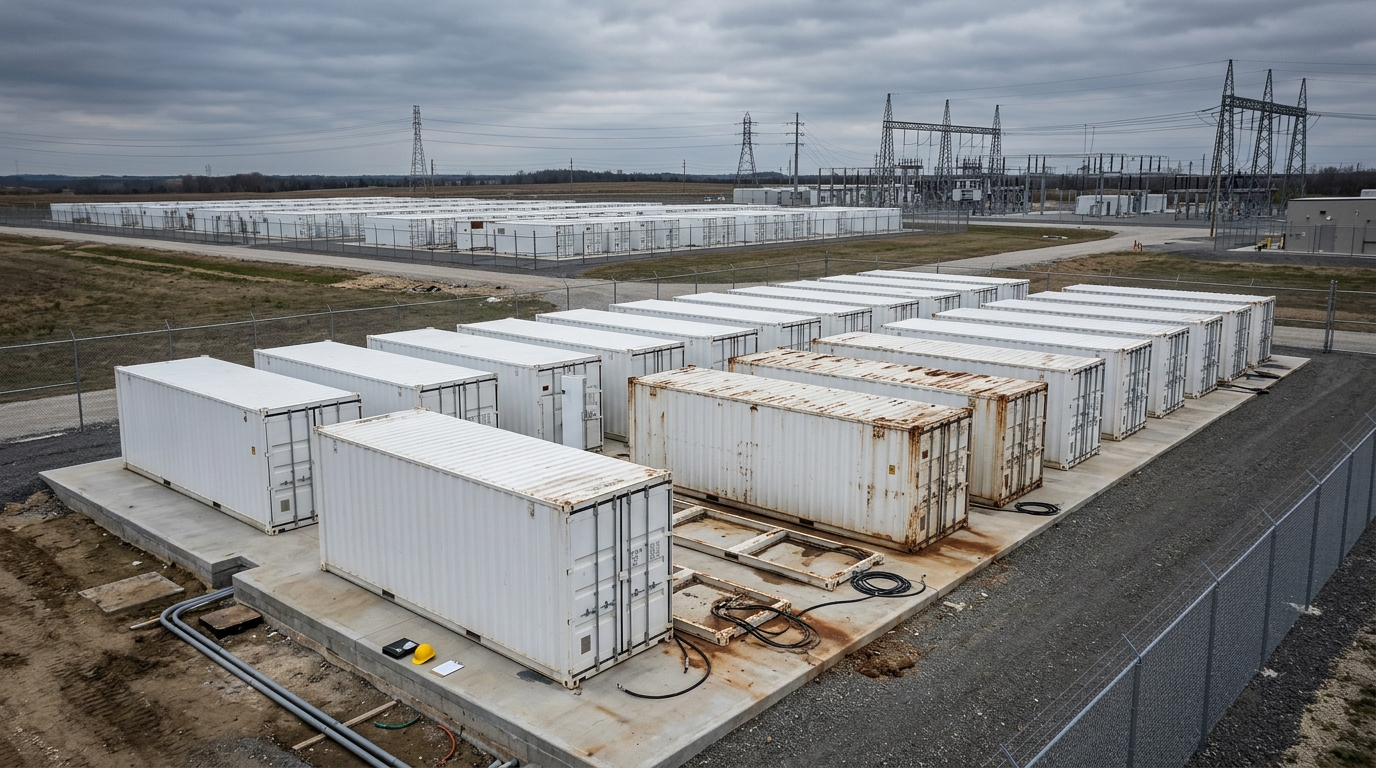
On September 16, Fluence sharply cut its fiscal 2026 outlook, lowering expected revenue to $2.4 billion and forecasting a $200 million adjusted EBITDA loss, blaming ongoing delays at its Houston contract manufacturing facility. That number deserves context: guidance had already been revised downward last month, from earlier expectations of $3.2 billion to $3.6 billion in revenue, down to a range of $2.9 billion to $3.1 billion. Fluence had previously guided to an adjusted EBITDA loss of around $10 million for the year and has now revised that expected loss to closer to $200 million. That is not a slippage; it is a structural breakdown twelve days before the fiscal year ends on September 30.
Barclays downgraded the stock to Underweight and cut its price target to $10 from $16, flagging execution delays, rising capital needs, and softening liquidity. Mizuho lowered its target from $15 to $8 and reiterated Underperform, citing slower data center order conversion and deployment delays, while Piper Sandler started coverage at Underweight with a $6 target, warning margin durability as the company works through its current execution issues.
What the Collapse Actually Means
The key issue is execution, not demand. Fluence management has kept stressing strong demand and a large backlog, especially around grid-scale storage and data center power needs, but has also pointed to ongoing US supply chain constraints and delays ramping its Houston contract manufacturing facility as a key driver of slower, less profitable revenue conversion. That distinction matters enormously for anyone thinking about battery metals fundamentals.
5 Nasdaq Stocks Under $5 That Aren’t What You Think
Most stocks under $5 come with a reputation. These don’t.
Each company on this list is tied to major trends like AI, cybersecurity, and next-gen infrastructure.
They may not have the spotlight yet, but they are building real businesses in real markets. That combination is not always easy to find at this price level.
If Fluence were losing projects to weaker demand, the signal for lithium, cobalt, and nickel would be bearish. But when a well-capitalized deployer stumbles because American manufacturing capacity cannot keep pace with orders, the medium-term demand picture for those metals stays intact even as near-term installation numbers get revised lower.
S&P Global Commodity Insights analysts forecast a 3.0% year-over-year drop in the energy storage sector’s lithium demand in 2026, to about 209,000 metric tons, citing expectations of fewer installations worldwide, and global battery storage installations are expected to decline about 2.7% to roughly 296,617 MWh in 2026. Fluence’s stumble is consistent with that softer cyclical window but does not change the longer structural arc.
Where This Touches Precious Metals
Grid-scale battery storage is a meaningful consumer of industrial metals, particularly nickel and cobalt, which overlap with mining jurisdictions and royalty portfolios that precious metals investors already track. The global energy storage build-out continues to expand over time, driven by accelerating deployment of lithium-ion batteries for utility-scale storage, with lithium, cobalt, nickel, graphite, and manganese sitting inside the bill of materials. A sustained slowdown in US deployment, caused by supply-chain bottlenecks rather than faltering end demand, creates a pricing air pocket in those metals without altering the decade-long demand trajectory that justifies exploration capital in the first place.
Nuclear Energy’s Comeback Could Spark Before 2026
Global energy demand is surging and one overlooked power source is quietly returning to the spotlight. New policy support and supply constraints are setting the stage for a surprising shift in the energy markets.
Management says it is restructuring operations around the Houston contract manufacturing facility, and the company has said its objective is to generate neutral to positive operating cash flow to support its backlog without external capital. Whether that timeline holds is the next question investors should watch.
Bottom Line
Fluence is not a precious metals company, and its supply-chain crisis does not directly move gold or silver. But the episode is a clean illustration of a recurring risk in the clean-energy metals complex: US manufacturing infrastructure is not yet capable of converting record project backlogs into delivered revenue at scale. That gap slows near-term demand for the industrial metals sitting inside those batteries. Royalty and streaming investors with exposure to cobalt or nickel assets should treat this week’s news as a reminder that installation velocity, not just project pipelines, is what ultimately converts resource in the ground into cash flow above it.