
Dear Reader,
I’ve seen this movie before.
People waited too long on Apple.
Too long on Amazon.
Too long on Nvidia.
Not because they didn’t recognize the opportunity…
But because they hesitated.
Artificial intelligence is creating another one of those moments right now.
And a small handful of companies are quietly positioning themselves to dominate this new era.
One is reinventing the internet itself.
Another is revolutionizing cybersecurity with AI.
And one may become the next trillion-dollar stock.
But timing matters.
The biggest gains come before the headlines.
Click here to watch the presentation now.
 |
Good investing,
Alexander Green
Chief Investment Strategist, The Oxford Club
China’s Central Bank Says Slower Credit Is the New Normal. Gold Wins.
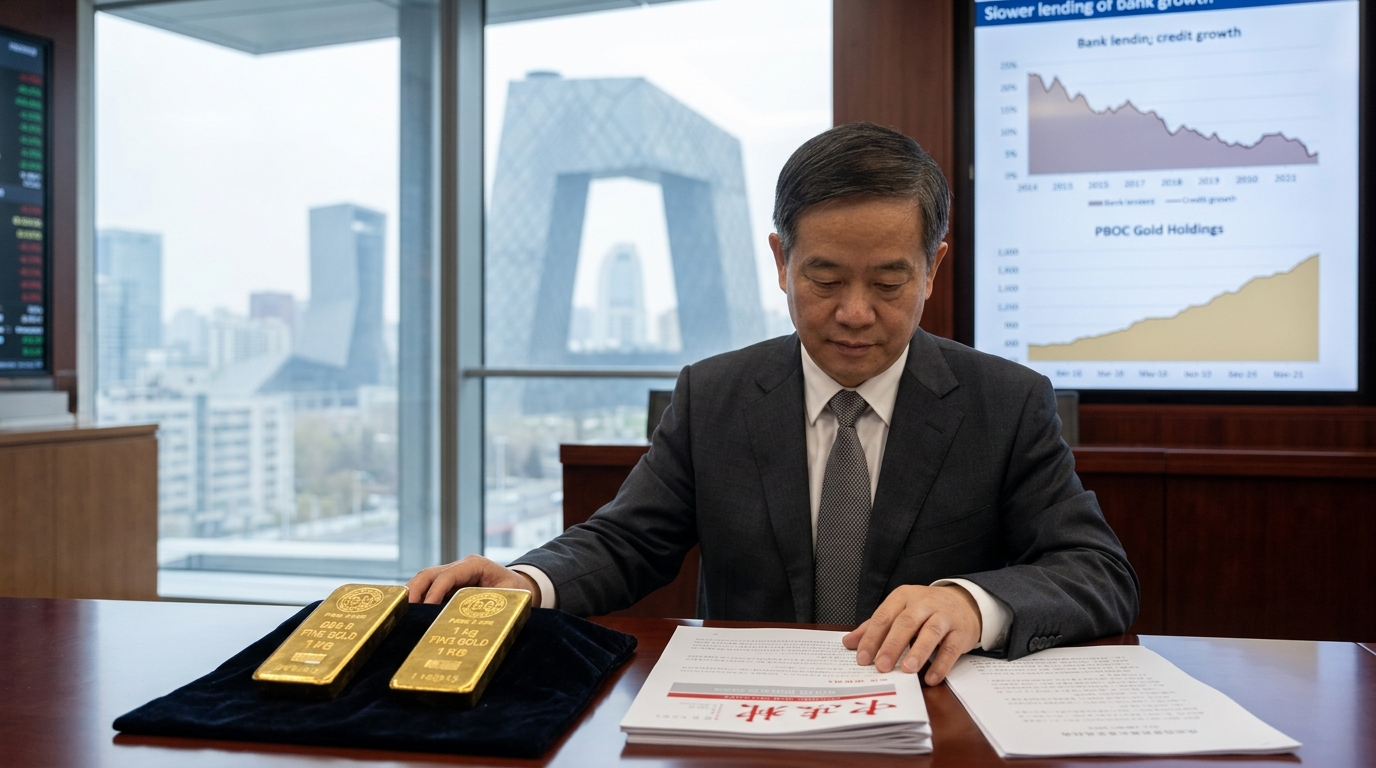
Pan Gongsheng did not bury the lead. Writing in Qiushi, the Communist Party’s flagship theoretical journal, China’s central bank governor declared Wednesday that “slower but higher-quality loan growth is likely to become one of the new normal features of macroeconomic operations.” At the same time, the PBOC will rely less on loan growth targets and more on interest rate tools to guide policy. For precious metals investors, both halves of that statement carry weight.
The slowdown reflects China’s economic shift, with lending to the property sector and local government financing vehicles shrinking and new industries still unable to fully offset the decline. The August lending data, released three days before Pan’s essay, put numbers on that shift: new bank loans returned to positive territory in August but fell well short of analysts’ forecasts after a record contraction in July, with Chinese banks extending just 60 billion yuan in new loans last month. Forecasters had pencilled in 400 billion yuan. Outstanding yuan loans in August grew 4.9% from a year earlier, slowing from 5.1% in July.
What This Means for Copper, Steel, and Cement
China consumes roughly 60% of global refined copper. It is the world’s largest steel market. Both are heavily tied to the one sector Pan identified as the core drag: property. Investment in property development in China dropped 18% year on year in the first six months of 2026, as the country’s housing market slump continues into its fifth year. China’s crude steel output fell 3.6% to about 76.9 million tonnes in July 2026, the weakest July since 2017.
The replacement demand Pan points to is real but structurally light on raw materials. Fast-growing industries such as high-tech manufacturing and green technology, responsible for more than 40% of economic growth in the first half of 2026, rely more on technology, data, and intellectual property than land and factories. That makes them less dependent on bank lending and, crucially, less dependent on bulk commodities. A chip fab uses far less rebar than a housing tower. Steel mill profitability in China dropped sharply to 7.79% in the latest week, as persistently high coke prices squeezed margins, and Chinese steel demand weakened further in the third quarter amid an ongoing slowdown in construction activity.
The Same Institution Is Accumulating Gold
Here is the contradiction that matters for this publication. The PBOC that is standing down from credit expansion is the same PBOC that has been buying gold without interruption for nearly two years. The central bank expanded its gold reserves by about 20.2 metric tonnes in August, lifting total official holdings to about 2,386.6 tonnes, with cumulative additions of about 80 tonnes in the first eight months of 2026. The World Gold Council has also flagged that official buying accelerated in 2026, including a 10-tonne purchase reported for May.
As of mid-2026, China’s gold holdings represent about 9% of its total reserves, according to the World Gold Council, compared with roughly 70% for the United States. That gap is not a rounding error. It is a multi-decade allocation project, and Pan’s credit slowdown does nothing to interrupt it. If anything, a China that is deliberately restraining leverage and rotating toward rate-driven policy has every incentive to continue diversifying reserves away from instruments whose value is tied to credit expansion.
Risks to the Thesis
The bearish case is straightforward. On September 24, 2026, President Trump is scheduled to host Xi Jinping for a summit in Washington. Any trade relief or stimulus signal coming out of that meeting could lift industrial metals and dilute the gold-versus-credit story in the short term. Capital Economics noted that the chances of a near-term rate cut remain slim despite weak household borrowing, which limits the stimulative power of the PBOC’s rate-tool pivot. And copper still carries its own structural tailwinds from grid and energy-transition investment that partially offset construction weakness.
Bottom Line
Pan Gongsheng’s essay is not simply a data point on Chinese credit. It is a structural admission: the credit-fuelled growth model that consumed enormous volumes of copper, steel, and cement is being officially retired. The assets most exposed are industrial metals levered to Chinese construction. The asset best positioned sits in the PBOC’s own vault, which added about 20 tonnes in August. When a central bank tells you credit is slowing and simultaneously keeps buying gold, it is worth listening to both signals at once.