
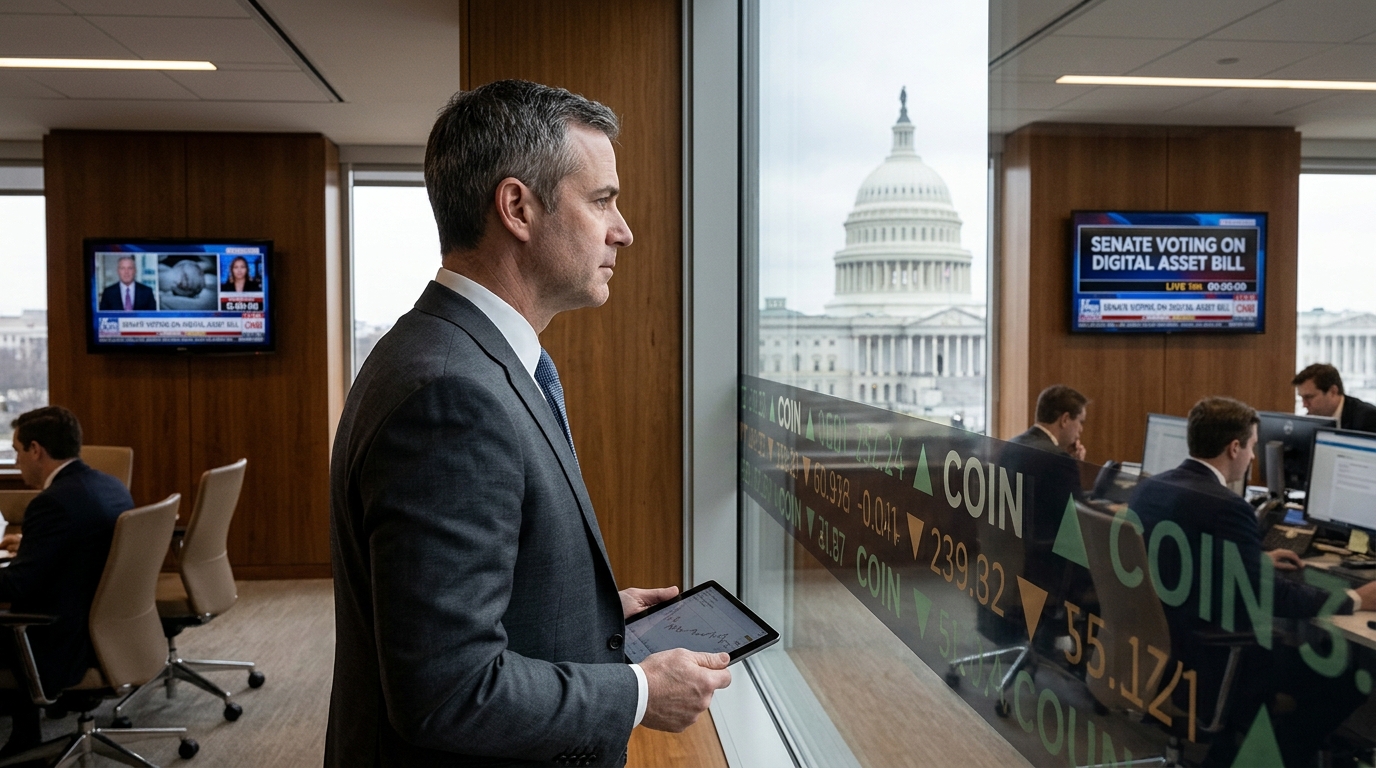
The Senate holds its cloture vote on the Digital Asset Market CLARITY Act at 2:15 p.m. ET on Tuesday. Sixty votes are needed. There is limited floor time once the Senate returns in September before it breaks again in early October. If the motion to proceed fails, the bill is functionally dead for 2026, and Coinbase loses the legislative catalyst it has spent years and tens of millions in lobbying to create.
That is the risk side. Here is the other side: COIN traded between a low of $172.81 and a high of $182.06 on September 11, with shares closing around $175.18. The 52-week range runs from about $139.11 to $402.16. The stock is sitting in the lower quarter of that range heading into a vote that Coinbase’s own CEO has called a potential institutional inflection point. The options market has not priced Tuesday like a binary event. That is the edge.
What Coinbase Is Actually Building
Coinbase has been diversifying its business beyond crypto spot trading. The company has expanded into stocks, commodities and foreign exchange, while non-trading revenue now includes stablecoins and institutional custody. Coinbase ended 2025 with about $376 billion in assets on platform, and it has positioned itself as a major institutional custodian, including for much of the U.S. spot Bitcoin ETF complex.
This is not a pure legislative play. In Coinbase’s Q1 2026 earnings materials and call, the company said prediction markets scaled quickly, reaching over $100 million in annualized revenue in less than two months, and it also highlighted consumer and institutional adoption of derivatives. The business is diversifying with or without Congress. The CLARITY Act accelerates the timeline.
Armstrong has framed potential passage as a key regulatory milestone that could help unlock institutional capital and pave the way for products such as tokenized equities in the U.S. More broadly, the CLARITY Act is designed to draw clearer lines for digital asset market structure, including how the SEC and CFTC divide oversight for different kinds of crypto assets and intermediaries. Until those boundaries are clearer, large institutions tend to move slower.
The Vote Count Problem
Coinbase is not assuming all 53 Senate Republicans will back the CLARITY Act, which means Democratic votes are essential to reach the 60-vote cloture threshold.
Polymarket assigns roughly 18% odds to the bill becoming signed law in 2026, with about $14.8 million traded on the contract as of September 11. But those odds measure the full gauntlet, not just Tuesday’s procedural hurdle. Clearing cloture and getting a presidential signature are different questions. Tuesday’s vote is the first gate, and it is lower than the market’s pessimism implies.
The Trade
A Bull Call Spread on COIN expiring in October captures Tuesday’s binary without betting the full premium on a stock that could move sharply in either direction. Consider the October $175/$200 call spread. With COIN trading near $175, the long call is approximately at the money. The short $200 call caps the upside but sharply reduces the net debit. Maximum loss is the premium paid. Maximum gain is the width of the spread minus that debit, a risk-to-reward ratio that becomes compelling when the underlying thesis has a hard, named catalyst three days away.
Bitcoin’s at-the-money implied volatility sat around 37% in early September, down sharply from a June peak near 65%. COIN options are priced in a similarly compressed volatility environment. That compression means debit spreads are relatively cheap relative to the move that a positive cloture outcome could produce. A cloture failure, by contrast, is broadly expected. The stock near its 52-week low tells you consensus has already leaned bearish.
What Would Break the Thesis
A failed cloture by a wide margin, say five or more votes short, is not a near-term recovery story. Failure to secure the required 60 votes would be a major setback, and the political momentum could dissipate as the 2026 election approaches. Coinbase reported second-quarter revenue of $1.2 billion, down from $1.5 billion a year earlier, with a net loss of $359.5 million, so a failed vote lands on a stock already carrying weak earnings. Position sizing matters here more than conviction level.
Watch for any statement from Democratic negotiators Monday before the floor opens. A public compromise signal on the ethics provision would be the strongest pre-vote bullish tell available. Absent that, Tuesday afternoon is when the trade resolves. Go in defined, go in sized for the binary, and let the catalyst do the work.