
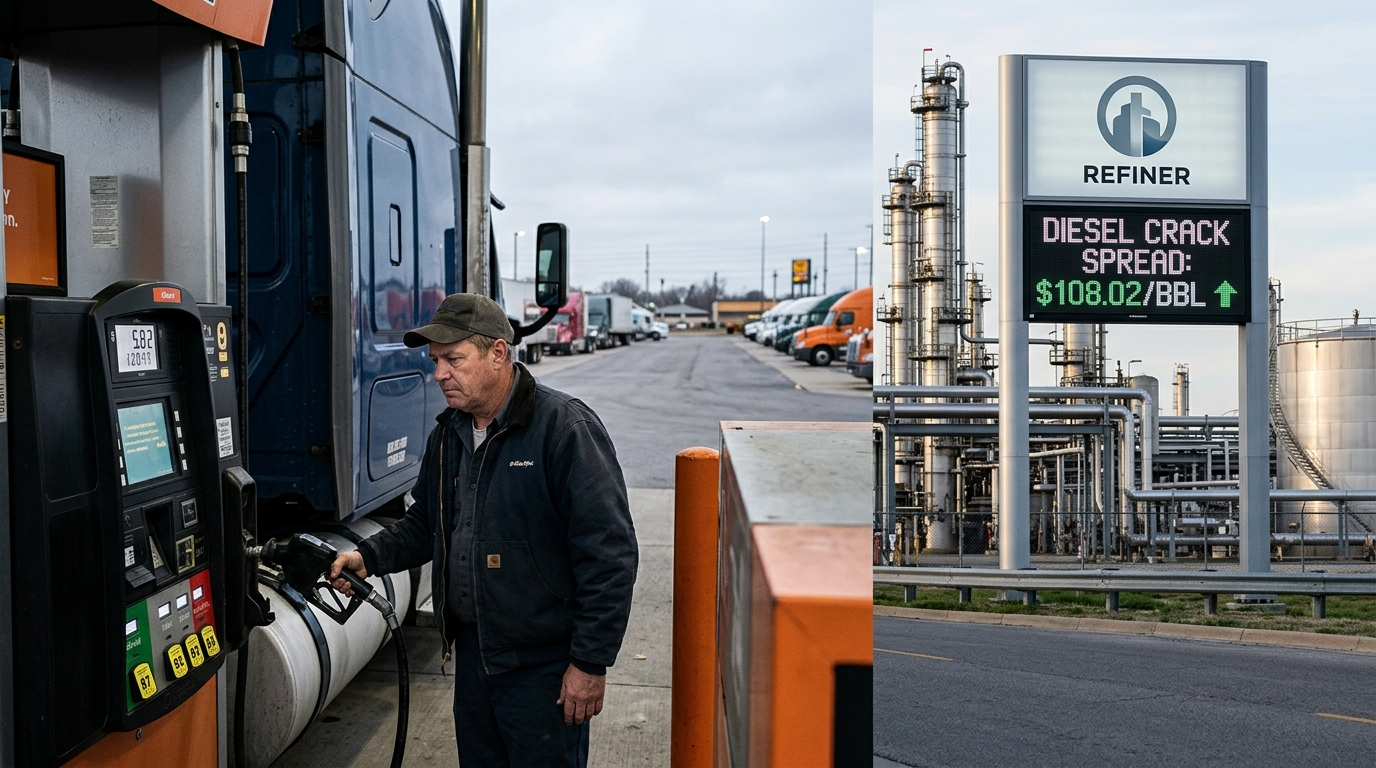
Thursday’s GasBuddy reading of $5.820 per gallon for the national diesel average did something the market had not done since June 17, 2022: it set a new all-time high. The national diesel average surpassed the June 2022 record, with the U.S. diesel crack spread hitting a record intraday $108.02 per barrel on Wednesday, as Reuters reported. That is not a rounding error on the 2022 energy shock. It is a structurally different crisis, and it points to a very different trade.
What a record crack spread tells you is that the diesel problem is not about crude oil. It is about everything that happens after the crude comes out of the ground: refining it, and getting the finished diesel where it needs to go. The crude is relatively available. The finished diesel is not.
Why the Spread Holds
Ukrainian drone attacks on Russian oil refineries have contributed to a tighter global diesel market. Russia has imposed export restrictions this year, but the details and exemptions have shifted, so the cleaner takeaway is that Russian refinery outages and export policy have both been a source of supply volatility. The tightness in diesel supplies is particularly acute on the East Coast, where distillate inventories fell to a record low of 19.3 million barrels in the week ended August 28, based on EIA records that begin in 1990. For context, the EIA has noted that the East Coast generally holds about 30 to 50 percent of the nation’s distillate fuel oil inventory. At 19.3 million barrels, the region is nowhere near that range heading into the season that needs it most.
Global diesel supplies tightened after disruptions linked to Ukrainian attacks on Russian refineries and broader conflict risk in the Middle East, as Reuters reported. Rising exports and low domestic supplies are likely to sustain pressure on diesel prices as heating demand and agricultural activity increase. The seasonal demand calendar does not care about geopolitical ceasefires. Harvest and heating season arrive regardless.
The Long Side: Refiners
The economics of refining margin expansion favor specific operator profiles: U.S. Gulf Coast independent refiners with WTI crude access. Valero (VLO), Marathon Petroleum (MPC), and Phillips 66 (PSX) are the three large independents most exposed to the spread expansion. Their WTI-based crude sourcing means input costs can rise more slowly than Brent-linked refiners, capturing a larger spread on identical output prices.
The combined second-quarter 2026 profits of Marathon Petroleum, Phillips 66, and Valero Energy reached about $12.6 billion, as industry trade press reported while summarizing company results. Valero, the world’s largest independent refiner by throughput capacity at roughly 3 million barrels per day, reported Q2 2026 adjusted EPS of $12.54, above the Street’s roughly $10 estimate. With the crack spread now well above those Q2 averages, Q3 estimates are almost certainly still too low.
Phillips 66’s Gulf Coast access enables it to sell refined products into high-demand markets and capitalize on increased export demand for distillates driven by supply disruptions. This positions Phillips 66 and Valero to benefit from elevated refining margins and strong international demand for refined products. HF Sinclair (DINO) and the broader XLE offer additional exposure with less single-name concentration risk.
The Fade: Truckers and Rails
The other side of that $108 crack spread lands directly on freight operators. For trucking, higher diesel prices matter because fuel is a major operating input. The American Transportation Research Institute’s benchmarking regularly shows fuel as a major, double-digit share of total cost per mile, varying meaningfully by year with fuel prices. Old Dominion (ODFL) and J.B. Hunt (JBHT) carry that exposure fully. Fuel surcharges pass some cost to shippers, but at record diesel levels the lag between cost and surcharge recovery compresses margins in the near term.
Railroads are not immune either. Fuel expenses represent a key input cost for any transportation player, but the specific claim about oil prices being up 8.5 percent from the beginning of 2026 could not be verified from primary pricing data in this edit pass, so it is removed. Union Pacific (UNP) runs a fuel-intensive network. The bull case for rails is relative efficiency against trucks, but efficiency does not eliminate cost when diesel is at an all-time record.
Trader’s Action Plan
The highest-conviction long is refining exposure through VLO and PSX, where Q3 estimates almost certainly undershoot actual margin capture. MPC and DINO extend the same thesis with slight differences in asset mix. Watch the weekly EIA distillate report every Wednesday: as long as East Coast stocks stay below 20 million barrels with September draws ahead, the spread has structural support. The primary risk on the long side is a sudden de-escalation that brings Russian refinery runs and exports back more consistently, which could compress cracks sharply. On the short side, ODFL and JBHT are the cleanest fades: pure diesel consumers with limited ability to recover record fuel costs inside a single quarter. Monitor freight volume data for the first sign that shippers are pulling back orders in response to surcharge shock, which would compound the margin pressure already building from the fuel line itself.