
Apple put a date on its most consequential hardware cycle in nearly a decade. September 9. Invitations went out August 26 under the tagline “Surprise and Shine,” and the lineup is exactly what the supply chain had telegraphed for months: iPhone 18 Pro, 18 Pro Max, and the iPhone Ultra, Apple’s first foldable, arriving alongside nothing at the low end. The standard iPhone 18, Air 2, and 18e are pushed to spring 2027.
That split matters in ways the market has not fully priced into the component ecosystem. For the first time, no budget iPhone ships in September, with only the two Pro models and the foldable remaining, a signal that Apple is shifting the fall launch toward the high end. Every dollar of September hardware revenue will carry foldable-specific bill of materials. That is a different risk profile than prior cycles, and a different opportunity.
What the Foldable Actually Requires
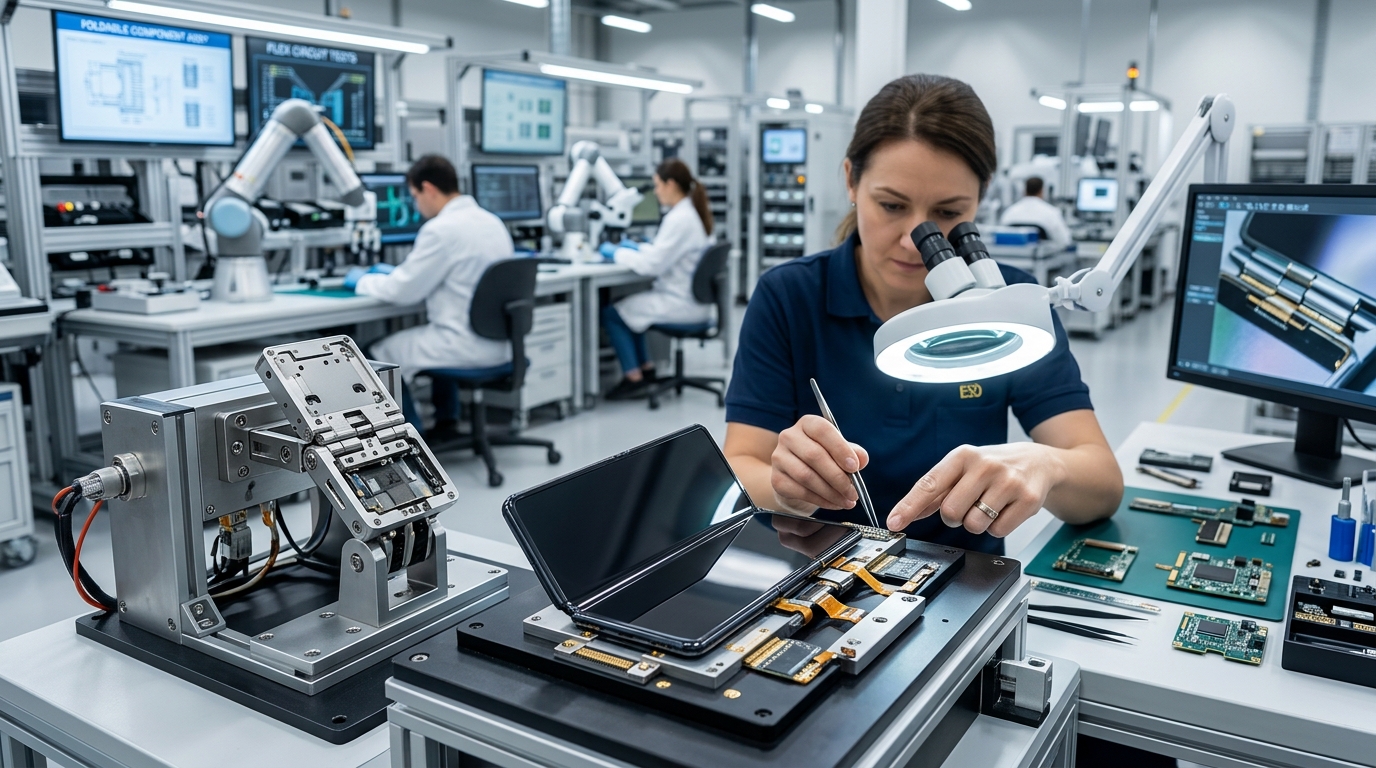
Apple’s first foldable, widely expected to carry the “Ultra” moniker, is rumored to use a short, wide, passport-style book-fold with a roughly 5.5-inch cover display and a roughly 7.8-inch inner display at about a 4:3 ratio. The foldable iPhone is rumored to feature a titanium frame, an ultra-thin design, and a nearly crease-free display. Building that requires components that a standard iPhone does not: ultra-thin cover glass, flexible OLED panels, and specialized RF architecture to handle the antenna geometry of a hinged chassis.
Apple is rumored to be planning to use ultra-thin glass for the foldable iPhone, and Chinese manufacturer Lens Technology has been reported as a likely primary ultra-thin glass supplier, with Corning likely providing raw materials. On the RF side, the picture is locked in through the end of the decade. Broadcom will produce advanced radio frequency components, including FBAR filters, and advanced wireless connectivity technologies at its Fort Collins facility. Reuters reported that Broadcom expanded its partnership with Apple through 2031 to develop and supply custom chips, extending a relationship that analysts estimate generates about 20% of Broadcom’s annual revenue.
That contract, expected to exceed $30 billion, arrived after AVGO had already sold off roughly 25% from its 52-week high. Despite reporting record Q2 FY2026 revenue of $22.2 billion, up 48% year over year, AVGO fell about 11% in after-hours trading after earnings. The Apple deal snapped the slide. AVGO rose about 3% on July 9, 2026, closing around $401. A stock with locked Apple revenue through 2031 sitting well below its annual high, into a confirmed September 9 catalyst, deserves attention.
The Memory Cost Angle Changes the Calculus for AAPL Itself
Here is why the thesis runs through suppliers rather than AAPL directly. The bill of materials cost for the iPhone 18 Pro 256GB model is estimated to be roughly 38% higher than its predecessor, driven by surging DRAM and NAND flash memory prices. Gartner estimates DRAM and NAND flash annual prices in 2026 will increase by about 125% and 234%, respectively. Apple can absorb some of that, but the margin math is hostile heading into an event where pricing surprises to the upside create their own demand uncertainty.
Then there is the post-event fade. AAPL fell 1.5% on the day of its iPhone 17 launch event on September 9, 2025. According to FactSet, Apple shares have lost 3.5% in September, on average, over the last 10 years. Owning AAPL through September 9 means buying a well-leaked event into a historically negative seasonal window.
The Strategy: Call Spreads on AVGO and QCOM
The vehicle is call debit spreads on the component names, structured to expire in mid-to-late October. That window captures both the September 9 catalyst and the initial weeks of device ramp, where supply chain data and pre-order commentary tend to move these stocks more than AAPL itself.
AVGO is the primary candidate. The Apple revenue stream is contracted, visible, and growing through a confirmed foldable cycle that requires the RF and wireless components Broadcom cannot currently be replaced on. Apple has moved to in-house silicon for application processors and is pushing deeper into connectivity silicon, but custom FBAR RF filters and wireless connectivity at the complexity Broadcom delivers are not in that category yet, and Apple is in no position to go alone before 2031.
QCOM is the secondary leg. The modem situation is nuanced. Reports based on prototype and supply-chain documents suggest Apple developed two iPhone 18 Pro logic board variants, one consistent with a Qualcomm modem for U.S. models with mmWave support, and another consistent with Apple’s in-house C2 modem for other regions. That is a lower revenue contribution than prior cycles, but it is not zero. Qualcomm’s Q2 FY2026 earnings call highlighted automotive revenue of $1.3 billion, up 38% year over year, and management said it expects to exit fiscal 2026 at an automotive run rate above $6 billion. A spread with defined risk keeps exposure clean on a name carrying genuine transition uncertainty.
Risk Management
The thesis breaks if the iPhone Ultra launch is delayed post-event, limiting the foldable-specific revenue ramp that underpins the component demand argument. It also weakens if memory cost headlines dominate post-event coverage and compress broader semiconductor sentiment. Size positions so that the full premium at risk is the maximum loss. The debit spread structure enforces that discipline mechanically. What to monitor: pre-order data in the 72 hours after September 9, any supply chain commentary on Ultra initial allocation, and AVGO’s price action relative to its $494 high.
The Beast Verdict
The September 9 event is confirmed, the foldable is real, and pre-event implied volatility on the supplier names remains compressed relative to the magnitude of the cycle underway. AVGO carries a contractual Apple relationship through 2031, is trading well below its annual high, and benefits directly from the RF complexity a foldable chassis demands. QCOM retains a partial U.S. modem role and is diversifying fast enough to revalue on its own. Both offer better risk-to-reward than AAPL itself into a historically negative post-event window. The edge here is in the pipes, not the product.