
August 28, 2026
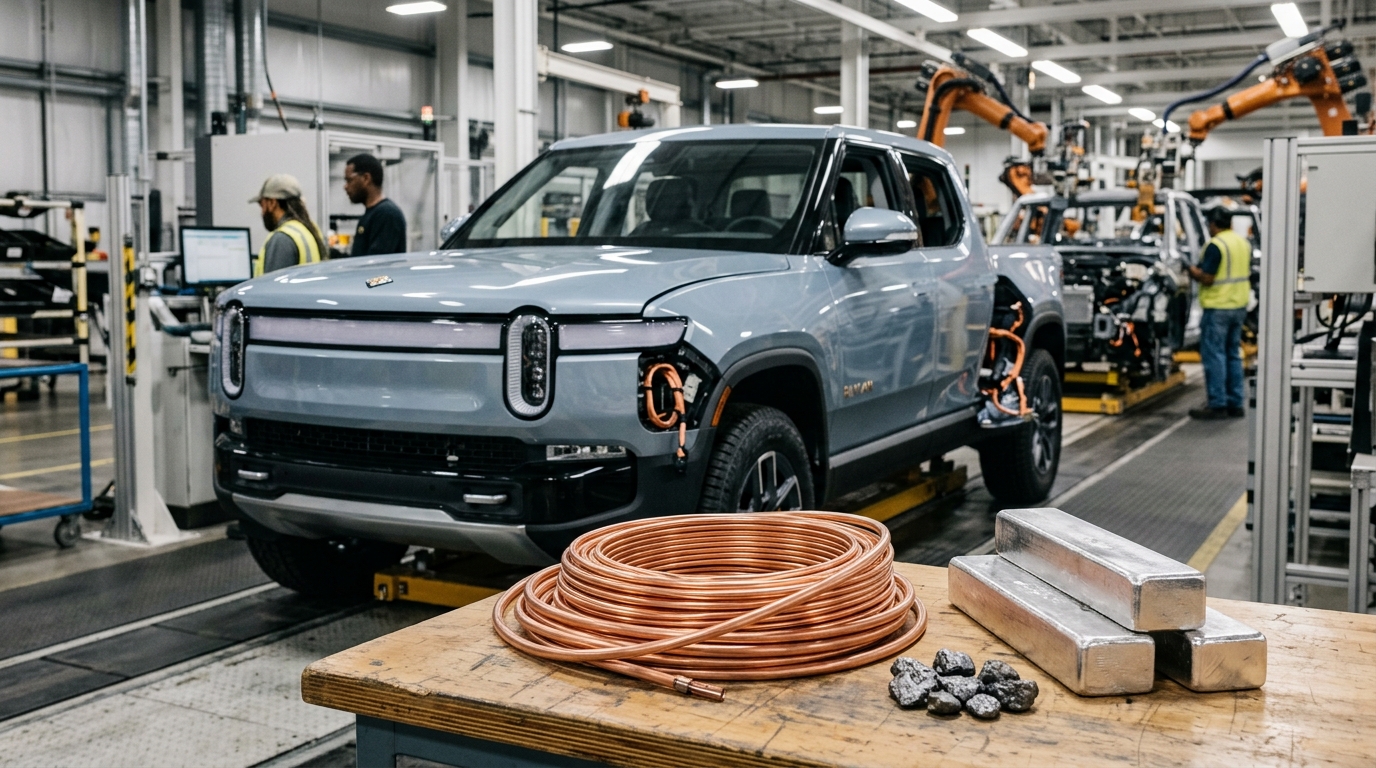
The Rivian R2 ramp and Tesla’s robotaxi push look like an EV story. For precious metals investors, they are a copper, silver, and PGM story.
The financial press has spent this week comparing Rivian and Tesla as competing investment cases. That is a reasonable argument to have. The more useful question for precious metals investors is quieter: what does a genuine step-change in battery electric vehicle production actually pull through in metal demand, and where does that demand hit markets that are already running structural deficits?
The Production Numbers That Matter
Rivian delivered 12,194 vehicles in Q2 2026, beating its own guidance of 9,000 to 11,000 units, and raised its full-year outlook to 65,000 to 70,000 vehicles. To reach that target, the company needs to deliver roughly 42,000 to 47,000 units in the back half of the year, weighted toward Q4, when its Normal, Illinois plant transitions to two shifts. The R2 SUV, built for a much broader buyer pool than the R1 lineup, is the vehicle expected to carry that volume. External R2 deliveries began June 9; only three weeks of that ramp showed up in Q2 figures. The automotive gross loss narrowed to $36 million despite absorbing roughly $100 million in incremental R2 ramp costs. CFO Claire McDonough has committed to a positive automotive gross profit exit rate by year-end.
Tesla, meanwhile, received Nevada Transportation Authority approval following the Authority’s August 20 meeting to operate a robotaxi service in Clark County, with authorization for a fleet of up to 5,000 fully autonomous vehicles in the first 12 months of the permit. The Cybercab, a purpose-built two-seat vehicle with no steering wheel or pedals, has been shown and tested publicly in Austin. A launch event in Austin is scheduled for September 3.
What is “The Presidio Initiative”?
A single $20 million check delivered to a former military base may have launched the biggest megaproject in American history.
The Metal Content Nobody Is Running
Each battery electric vehicle requires roughly 83 kilograms of copper, compared to 23 kilograms in a conventional ICE vehicle. A robotaxi or autonomous EV adds approximately 1 to 2 additional kilograms of copper for the high-speed data wiring needed by cameras, radar, and sensor arrays. Scale that across 70,000 Rivians and the copper demand implied is over 5,800 tonnes from one mid-tier producer’s annual output alone. That is before accounting for Tesla’s 480,126 Q2 deliveries and the broader global BEV fleet.
Silver is the less obvious but more consequential story. Battery electric vehicles consume more silver than ICE vehicles, and autonomous vehicles add further electronics intensity through their sensor and switching architecture. The Silver Institute projects automotive silver demand growing at a 3.4 percent compound annual rate through 2031, reaching approximately 94 million ounces. The silver market is already running its sixth consecutive structural deficit in 2026, projected at 46.3 million ounces, widening 15 percent from the 40.3 million ounce shortfall in 2025.
Hidden in Tesla’s Filing: A $12 Billion “Super Startup”
Pull up Tesla’s most recent SEC filing. Page 5.
And you’ll see a single line showing $12 billion in revenue from a brand-new “super startup” Elon Musk has been quietly incubating inside Tesla.
This new “super startup” has nothing to do with cars or robots or space or AI…
But it sits at the center of what Blackstone calls “a $23 trillion investment opportunity.”
And on October 21, Elon is expected to pull back the curtain and reveal exactly what he’s building.
But Adam O’Dell already knows… and he reveals it all in this urgent video.
On PGMs, the picture cuts two ways. Pure BEV volume growth is a palladium headwind: EVs carry no catalytic converters and therefore consume no platinum, palladium, or rhodium for emissions control. Each ICE vehicle replaced removes that demand from the market. However, the robotaxi thesis is more nuanced. Sensors, fuel cell R&D, and industrial applications are absorbing platinum’s automotive demand loss. Palladium’s structural exposure to the ICE fleet remains its dominant risk as volumes like Rivian’s 70,000-unit ramp accelerate the displacement.
Risks to This Framework
Rivian’s H2 target requires near-doubling its first-half production pace, which is an execution risk no guidance raise eliminates. Any slip in the Normal plant’s two-shift ramp compresses copper and silver pull-through by a proportional amount. On Tesla, the Nevada authorization is a ceiling, and operational constraints and phased deployment would limit near-term incremental metal demand from the robotaxi fleet specifically.
Dr. Skousen: “Only 500 copies of my report today”
I’ve worked for the CIA. Met four US presidents.
But watching Peter Thiel’s playbook changed everything.
He just bet $1 BILLION on one private company. And my research leads me to believe the IPO announcement could come soon.
I’m sharing my free pre-IPO ticker… and releasing my “secret partner” report to only the first 500 people today.
Bottom Line
Rivian’s R2 ramp and Tesla’s Nevada approval are getting analyzed as a stock selection debate. Precious metals investors should read them as demand confirmation. Silver and copper are the metals most directly leveraged to BEV volume growth, and both are running against constrained supply. Palladium faces the opposite pressure as ICE displacement accelerates. The vehicle count is rising. The metal content per vehicle is not shrinking. The supply side is not catching up.