
August 27, 2026
Bonus Content: Eleven Weeks to Prove There’s a Plan B
Your Download Link Will Expire
If you still haven’t downloaded my free “Simple Options Trading For Beginners” guide…
…please take a few seconds and download it right now before your new temporary download link expires.
I eventually plan to charge money for this training, so do yourself a favor and download it now…
That way, no matter what it costs in the future, you’ll have a free copy on your computer.
Make sense?
Eleven Weeks to Prove There’s a Plan B
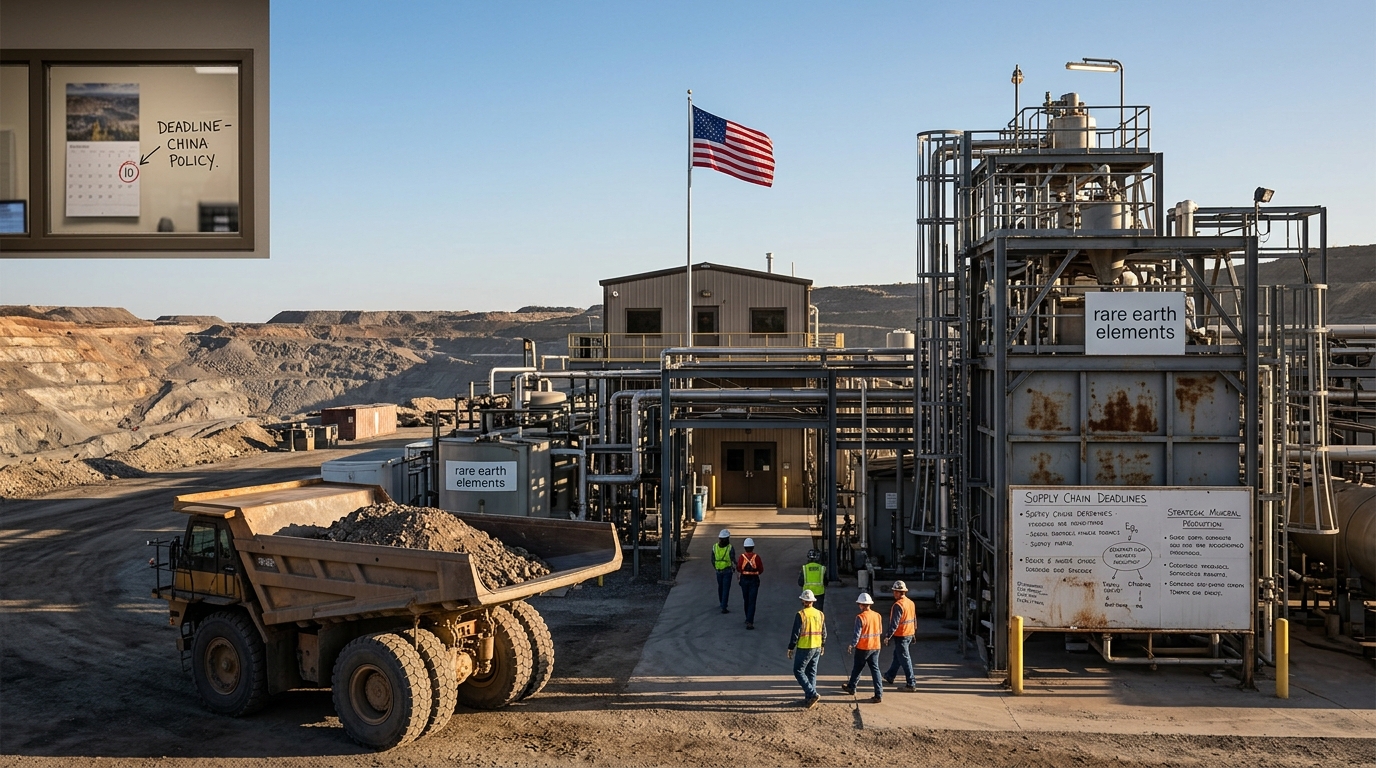
The clock is specific: 77 days from today until Beijing’s one-year suspension of its October 2025 rare-earth export controls runs out. The one-year suspension of China’s expanded rare earth export controls is set to expire on November 10, 2026, with current supply conditions indicating limited progress in reducing global dependence. Battery and EV manufacturers that treated the truce as breathing room rather than a building window are about to find out exactly what that cost them.
The architecture in place right now is already more restrictive than most investors appreciate. The April 2025 restrictions have not been rolled back. A further escalation announced in October 2025 was temporarily suspended for one year, through November 10, 2026, as part of a diplomatic arrangement. That suspension covers the expanded October 2025 package, but the core April 2025 licensing regime on seven rare-earth categories remains fully enforced. Those seven elements, including terbium, dysprosium, samarium, gadolinium, lutetium, scandium, and yttrium, are precisely what high-performance EV motors and defense magnets require. Beijing also moved the goalposts on January 1, 2026: the updated export licensing catalogue expanded the rare-earth section with more granular classifications, including for certain samarium, gadolinium, and lutetium compounds.
When the November truce lapses, the rules that return are not merely inconvenient. Unless Beijing extends, replaces, or modifies that suspension, the expanded October 2025 measures would return, widening the set of exports subject to licensing and review rather than imposing a simple blanket ban. The practical meaning, as the IEA has framed the risk, is that a much larger universe of transactions becomes dependent upon Chinese government permission. If those suspended October 2025 controls were implemented in full, the IEA estimates that $6.5 trillion in annual downstream production outside China could be at risk, with the automotive, electronics, defense, and energy sectors most exposed.
What has Washington actually built in return? More than the headlines suggest, but unevenly distributed. In February 2026, the United States announced Project Vault, formally the U.S. Strategic Critical Minerals Reserve, as an independently governed public-private partnership intended to strengthen the security of critical mineral supply chains, backed by up to $12 billion comprising up to $10 billion in EXIM financing and approximately $2 billion in private capital. Unlike traditional government stockpiles, Project Vault is designed as a demand-driven reserve, with stockpiling decisions guided by long-term purchase commitments from manufacturers rather than centralized government forecasting. That is meaningful insurance. It is not a substitute for domestic separation capacity.
The policy price floor, the more potent instrument, went to one company and has not been extended to peers. The U.S. government entered into a 10-year price protection agreement that effectively guarantees a $110 per kilogram floor for MP Materials’ NdPr against a benchmark price, with the mechanics applying across sold, stockpiled, and internally consumed NdPr products. Rivals were told in January 2026 that Washington was stepping back from offering additional floors. Reuters reported January 28, 2026 that the Trump administration was stepping back from plans to guarantee a minimum price for U.S. critical minerals projects, citing a lack of congressional funding and the complexity of setting market pricing, with officials telling a meeting that Washington was no longer in a position to offer price floors.
That asymmetry matters for stock selection. MP Materials (NYSE: MP) carries a structural advantage no competitor has replicated. Revenue rose 89% to $108.5 million in Q2 2026, driven by higher NdPr oxide and metal sales volumes and stronger market pricing, while Adjusted EBITDA turned positive at $28.5 million versus a $12.5 million loss a year earlier. The company has also said its magnets have been delivered to General Motors for in-car qualification and regulatory testing, with initial commercial deliveries still on track for the fourth quarter of 2026. The $110/kg floor insulates the economics from any Chinese price dumping intended to discourage Western investment. That floor is the thesis.
USA Rare Earth (Nasdaq: USAR) is the more complex, higher-volatility expression of the same theme. The company announced completion of the upsized $1.55 billion capitalization of a U.S. government-backed special purpose vehicle for Serra Verde offtake, covering 100% of Phase I production with guaranteed minimum floor prices for neodymium, praseodymium, dysprosium, and terbium. The August 28 shareholder vote is the next hard catalyst.
The risks are real. A diplomatic extension of the November truce would immediately deflate the supply-shock premium embedded in both stocks. Execution at MP’s 10X facility in Northlake, Texas and at USAR’s Stillwater magnet line must track to schedule. And the broader critical minerals sector remains one executive order away from policy reversal.
But November 10 is not a rumor. It is a date on a deal. Eleven weeks is not enough time for Tesla, GM, or Ford to build a Plan B. It is, however, enough time for investors who already understand the supply chain to position in the producers whose economics do not depend on Beijing’s goodwill.