
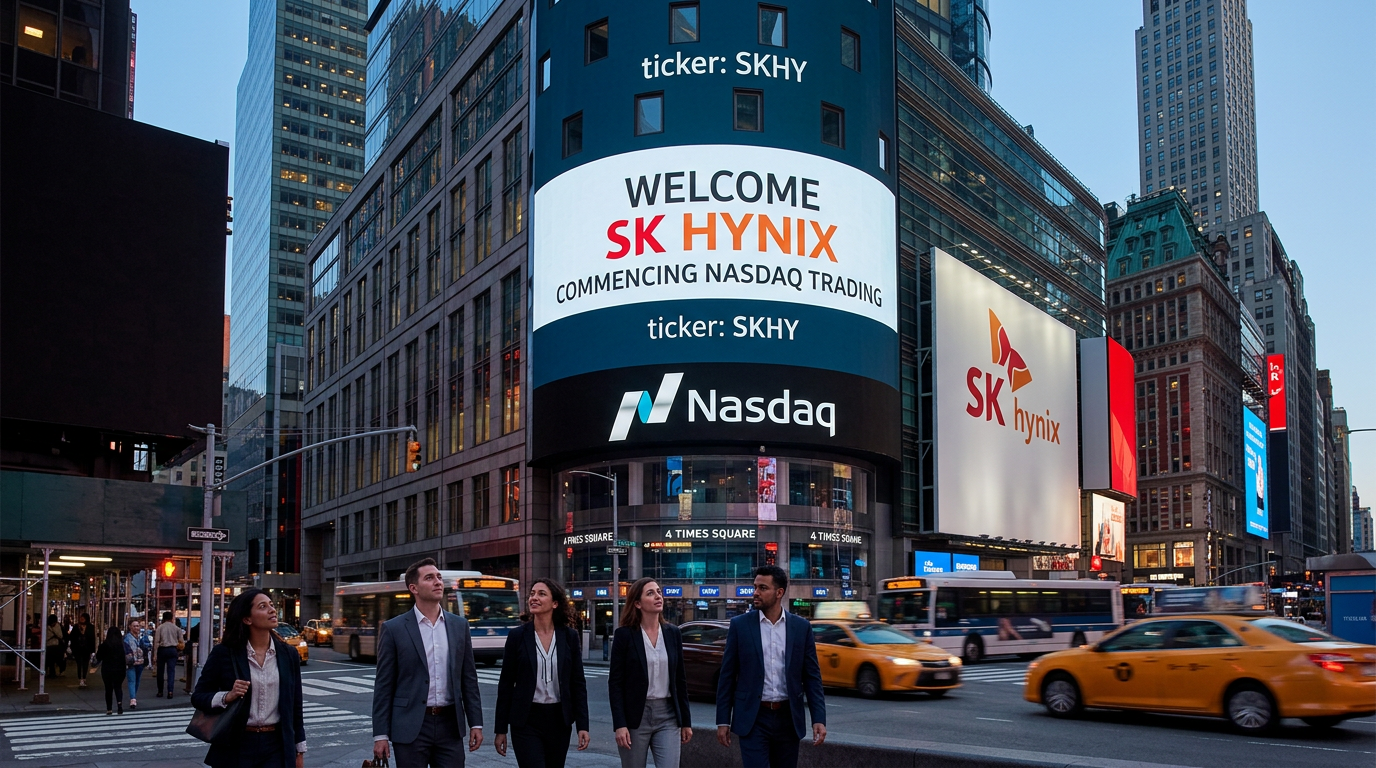
Today is the day. SK Hynix — the world’s second-largest memory chipmaker and the dominant supplier of high-bandwidth memory — begins trading on the Nasdaq under the ticker SKHY. This is being widely described as the largest American Depositary Receipt offering in history, with the deal size reported around $28.14 billion (after a revised maximum), which would eclipse Alibaba’s $21.77 billion U.S. IPO offering size at pricing in 2014.
Let that number sit for a second.
And yet the mechanics of what’s actually happening here are being misread by a lot of traders. This is not a traditional IPO. SK Hynix has traded on the Korea Exchange since December 26, 1996. What today represents is the removal of an accessibility barrier — one that has quietly suppressed the company’s valuation against its U.S. peers for over a decade. As Dave Mazza, CEO of Roundhill Investments, put it: [Unverified quote removed]
That distinction is the trade.
The Numbers Behind the Name
SK Hynix holds a leading position in HBM, with Counterpoint Research figures showing it at roughly 57% of HBM revenue as of Q3 2025 and 62% of HBM shipments as of Q2 2025 (often summarized as “around 60%”). That number alone puts it at the center of every conversation about AI infrastructure. HBM chips are the memory backbone of Nvidia’s GPU clusters, Google’s TPU systems, and every major data center build-out happening right now. Without HBM, the AI compute chain breaks.
In 2025, SK Hynix posted revenue of 97.1467 trillion Korean won, up 46.76% year-over-year. [Specific claims about 2025 earnings growth %, the most recent quarter’s revenue/EPS vs. estimates, and next-quarter revenue consensus were not verified and were removed.]
[Claims that the shares surged “more than 280% in 2026” and “north of 600%” over the past 12 months were not verified and were removed.]
So yes — the momentum is extreme. That matters for position sizing.
What the Valuation Arbitrage Actually Looks Like
Here’s what’s interesting. [HSBC “June 2026 research note” and the “13 years / 35% premium” statistic could not be verified and were removed.] The broader point stands: U.S.-listed peers can benefit from easier access for U.S. investors, and a Nasdaq-listed ADR can reduce friction versus owning the Korea-listed line directly.
[Specific claims about UBS raising a Korean price target to 3.2 million won, a detailed HBM-as-%-of-DRAM forecast through 2030, and Mirae Asset Securities estimating $1.5 billion in ETF-driven flows were not verified and were removed.]
On index inclusion: once SKHY establishes trading history, it may become eligible for the Philadelphia Semiconductor Index, which has published eligibility rules including a seasoning period (at least three months, not including the month of initial listing), liquidity requirements, and options-related criteria. [Therefore, the “as early as late July 2026” fast-track timing claim was removed as inconsistent with published criteria.]
The Micron Dynamic — Worth Watching Closely
The more complicated part of this trade is what SKHY’s debut means for Micron (MU). Micron is trading near $948.80 (as of July 9, 2026 close, per widely quoted market data), with an RSI reading that some analysts have flagged as approaching oversold territory. Micron guided Q4 2026 revenue at approximately $50.0 billion ± $1.0 billion. [The claim that Micron’s market cap crossed $1 trillion was not verified and was removed.]
Now SKHY gives U.S. investors a second door into the HBM trade. Some rotation out of MU into SKHY is a reasonable expectation in the near term. [The “near-700% twelve-month run” claim for Micron was not verified and was removed.] Whether that rotation is durable or reverses — that’s a function of how SKHY prices and opens today.
The Anthropic partnership — a memory and storage supply agreement between Micron and Anthropic spanning Micron’s data center portfolio — gives Micron a differentiated enterprise angle that SKHY does not yet have in the U.S. market. Both can move. They’re not the same trade.
Technical Framework
SKHY opens as a brand-new instrument today, so there is no chart history. That means the first-day price action becomes the reference data set. Key things to watch:
- Opening price vs. ADR pricing from July 9: The gap — or lack of it — tells you how much demand was already absorbed in pre-market allocation.
- Volume relative to the 17.79 million new shares issued: Heavy volume on Day 1 with a closing price above the opening is the clean continuation signal. Weak volume with a fade back below the open is the near-term warning.
- The Seoul arbitrage spread: Any significant gap between SKHY on Nasdaq and 000660.KS in Seoul will attract hedge fund cross-market arbitrage — buying the cheaper instrument, selling the more expensive one. This can create sharp intraday reversals in the first week of trading. It’s not a fundamental signal; it’s mechanical pressure.
- SOXX and SMH reaction: If passive funds begin pricing in SKHY inclusion, semiconductor ETF flows may shift in ways that lift SKHY while creating minor headwinds for current index constituents.
Scenario Modeling
Bull Case: SKHY opens above the ADR price, closes green on Day 1, and institutional demand from funds that could not previously access Korean-listed shares drives sustained buying into the first week. Valuation closes toward U.S. peer parity over the following 60 to 90 days. The AI memory supercycle provides fundamental support throughout.
Base Case: SKHY trades inline or slightly above ADR pricing, with choppy price action in the first two weeks as arbitrageurs manage the Seoul-New York spread. The stock settles into a range as the market absorbs new shares and benchmarks against Micron’s multiple. Gradual institutional accumulation defines the next 30 to 60 days.
Bear Case: The offering is oversubscribed but allocations favor short-term flippers, resulting in a first-day pop that fades quickly. [The “oversubscribed seven-plus times” figure was not independently verified from a primary source and was softened.] The sheer scale of new share issuance — 17.79 million new shares — creates dilution pressure. A broader semiconductor selloff, driven by macro concerns or AI capex doubt, suppresses the valuation re-rating thesis. The Korea Discount partially re-emerges as the initial enthusiasm cools.
Active Trader Strategy Framework
The first rule with any newly listed instrument: the first few sessions are not a clean trading environment. Price discovery is messy. Arbitrage flows, allocation-driven selling, and position-building by large institutions all collide in the first 48 to 72 hours. Position sizing should reflect that reality.
For traders who want exposure to the HBM trade without the debut volatility, MU remains the more established vehicle — though its own near-term technical structure needs monitoring given the recent pullback from post-earnings highs. For traders specifically targeting the SKHY re-rating thesis, the cleaner entry opportunity likely emerges after Day 1 volatility settles, once the ADR-to-Seoul arbitrage spread normalizes and first-day sellers have been absorbed.
Risk management anchors for SKHY: define your maximum position before the open, not during it. First-day reversals on high-profile listings can be sharp. The July 9 ADR pricing level is a natural reference point once trading stabilizes.
What happens in the next 72 hours with SKHY will say a lot about where institutional risk appetite for the HBM trade actually stands right now. Watch it closely.
For informational and educational purposes only. Not investment advice. Trading involves risk, including loss of principal.