
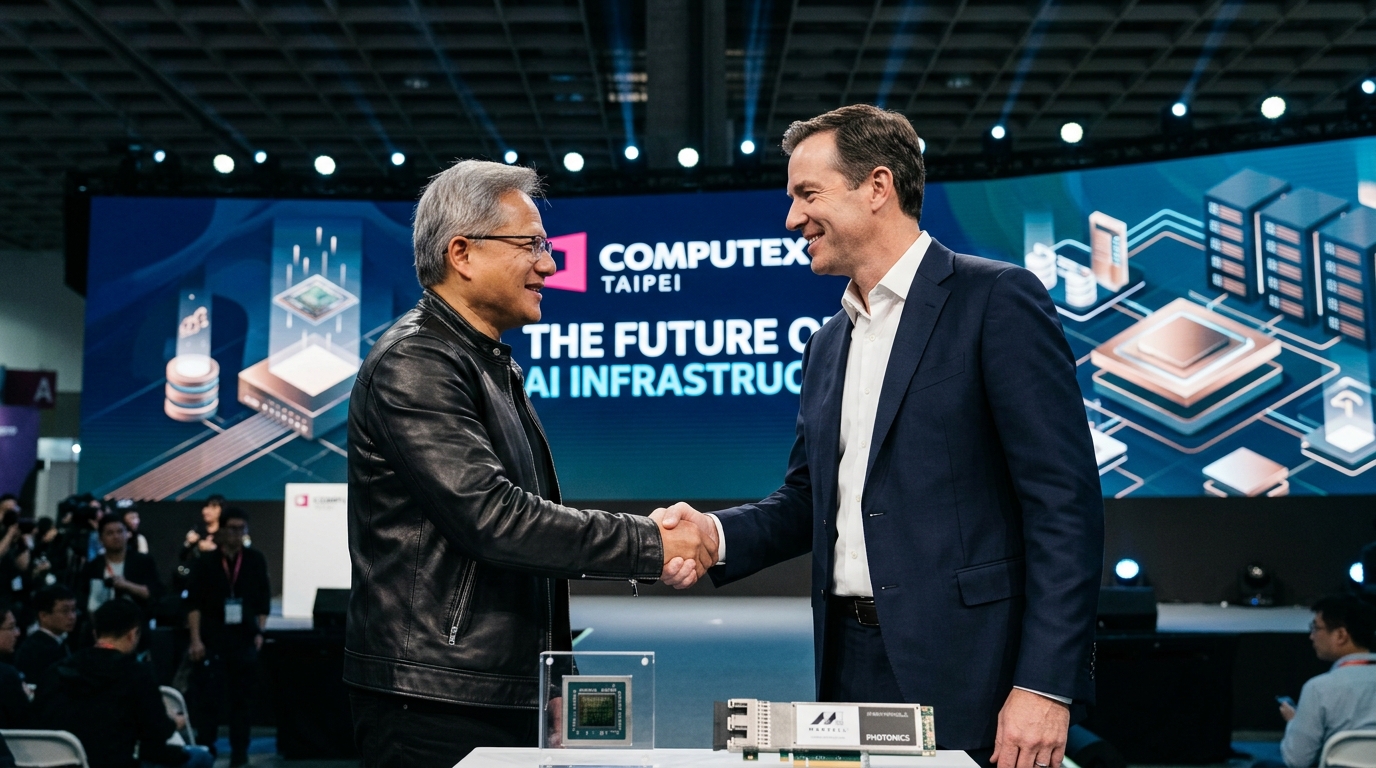
There are stock-moving moments, and then there are market-defining moments. What happened at Computex Taipei on June 2nd was the latter.
Nvidia CEO Jensen Huang took the stage, turned to Marvell Technology CEO Matt Murphy, and told the crowd: “The next company to surpass a trillion dollars in market capitalization.” Marvell shares surged more than 32% that day — the stock’s biggest single-session gain in its history.
Most people are treating this like a celebrity endorsement. That’s the wrong read.
What’s Actually Going On Here
Marvell Technology (NASDAQ: MRVL) is not a company that makes GPUs. It doesn’t compete with Nvidia on training clusters. What it builds is the connective tissue of the AI data center — the networking, optical interconnects, custom application-specific integrated circuits (ASICs), and silicon photonics that allow thousands of GPUs to actually talk to each other at scale.
Huang wasn’t pumping a competitor. He was validating a partner his own company has already committed $2 billion to. Back in March, Nvidia and Marvell announced a strategic partnership through NVLink Fusion, enabling customers building on Nvidia architectures to use Marvell’s custom XPUs and scale-up networking — giving hyperscalers greater flexibility in how they build AI infrastructure.
The part people are skimping on: this isn’t just a narrative. The financials are already moving.
The Numbers Behind the Story
Marvell posted fiscal 2026 revenue of $8.195 billion — a record — growing 42% year-over-year on the back of AI demand. Q1 fiscal 2027 came in at $2.418 billion, up 28% year-over-year, with Q2 guided to $2.7 billion at the midpoint, implying 35% year-over-year growth. Management has significantly raised its outlook for both fiscal 2027 and 2028, now targeting $16.5 billion in fiscal 2028 revenue — up 10% from what it guided just three months prior.
Gross margin sits at approximately 51%, operating cash flow hit a record $638.8 million in Q1 FY27, and the balance sheet holds a current ratio of 3.28. These aren’t speculative numbers.
Slight tangent — but it matters: Marvell has quietly made two strategic acquisitions this year, Celestial AI and XConn Technologies, both completed in February. Celestial brings optical AI connectivity technology. XConn expands CXL switching capability for rack-level memory pooling. These aren’t bolt-ons. They’re pieces of an infrastructure thesis Marvell has been assembling for two years.
Why the Timing Is Different
The AI infrastructure trade has gone through phases. First it was GPUs. Then power and data center REITs. Then hyperscaler capex. The market is now waking up to the connectivity layer — the silicon that moves data between all those GPUs at the speeds AI workloads demand. That’s Marvell’s entire business.
Management flagged “exceptional AI-related bookings” and said demand is accelerating across 800G and 1.6T optical solutions, 51.2T Ethernet switches, and custom XPU programs. The book-to-bill picture looks healthy. The next earnings event is estimated for late August — and if the revenue acceleration thesis holds, the catalyst calendar could get interesting fast.
What Could Go Wrong
Customer concentration is real. A significant portion of Marvell’s data center revenue is tied to a handful of hyperscalers. If one of those customers pivots to in-house silicon — something Google and Amazon are already doing to varying degrees — the revenue impact could be sudden. Valuation isn’t cheap either; the stock trades near 70x forward earnings after the Computex surge, which means execution risk gets priced in fast if guidance disappoints.
There’s also the macro overhang. AI capex spending is under scrutiny across Wall Street, and any signal that hyperscaler build-out is moderating could drag the entire semiconductor infrastructure sector lower regardless of company-specific fundamentals.
The Bigger Picture
The AI infrastructure race has expanded beyond pure computing power into data transmission and advanced connectivity. That’s what Huang was signaling at Computex — not just a partnership announcement, but a structural shift in where AI dollars flow next. Marvell is positioned at the intersection of custom silicon and optical networking, two areas underpinning the next phase of AI spend.
Whether or not it reaches a trillion-dollar valuation is almost beside the point. The question worth asking is whether the market has fully priced in what custom ASIC and photonics revenue could look like by fiscal 2028 — and right now, that answer appears to still be unfolding.
Worth a closer look before the next earnings cycle lands.