
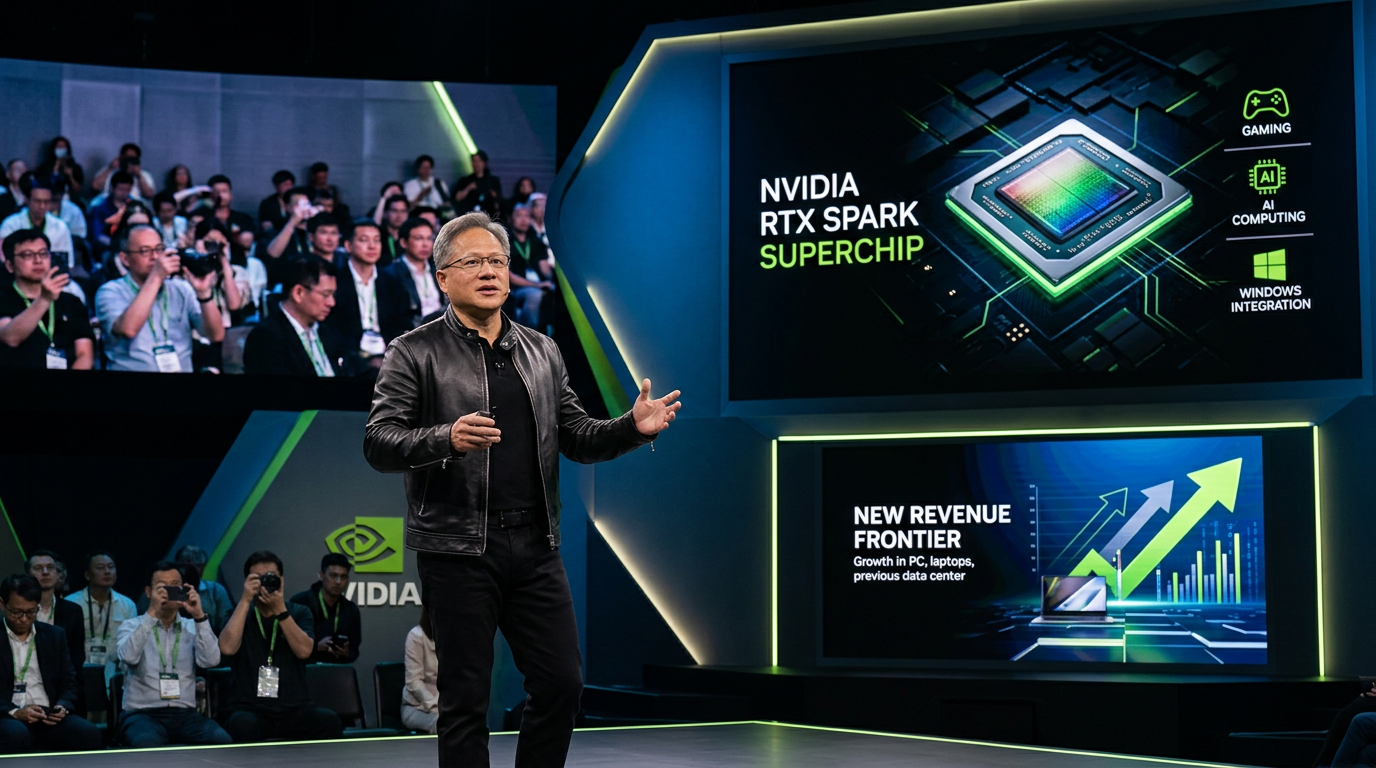
Something shifted this week that most investors aren’t fully pricing in yet. On June 1, at Computex 2026 in Taipei, Nvidia CEO Jensen Huang stood on stage and unveiled the RTX Spark Superchip – a system-on-chip built specifically for Windows laptops and desktops. Not a server. Not a data center rack. A personal computer.
That’s a big deal. Nvidia’s entire valuation story has been built on hyperscaler AI spending. This move is something different.
Here’s what matters structurally: the RTX Spark fuses Nvidia’s Blackwell GPU architecture with an Arm-based N1X CPU, co-designed with Taiwan’s MediaTek, manufactured on TSMC’s 3-nanometer process, and supporting up to 128GB of unified LPDDR5X memory. It is not an incremental upgrade to existing laptop GPUs. It’s a ground-up rethink of how an AI-native PC chip should be built – and it goes directly at Intel and AMD in a market they’ve shared for decades.
The market reaction was immediate. Nvidia jumped 6.3% on the news, adding roughly $319 billion in market cap in a single session. Dell surged 10.7%. HP gained 9.2%. Microsoft climbed 2.3%. Intel fell 4.7%.
Slight tangent, but it matters: this is not just a consumer hardware story. Tech giants including Microsoft, Amazon, Meta, and Google have all been ramping nuclear and power infrastructure investments to feed their AI systems. The demand chain runs from the chip in your laptop all the way to the grid. Nvidia is threading itself through every link of that chain.
The Investment Angle
- Revenue diversification: Nvidia plans to release over 30 laptop models and 10 desktop models using the new architecture – a platform rollout, not a single product bet.
- Platform depth: The RTX Spark is purpose-built for personal AI agents running on Microsoft Windows. That deepens the NVDA-MSFT ecosystem in ways that compound over time.
- Timing: Products launch fall 2026, meaning meaningful revenue impact likely lands in Q3 and Q4 earnings reports.
The risks are real. Custom silicon from hyperscalers is growing – projected to reach 27.8% of the AI chip market in 2026, up from 20.9% in 2025. Nvidia’s valuation remains elevated. And with CEO Jensen Huang projecting the AI chip revenue opportunity could reach at least $1 trillion through 2027, the stock already reflects a lot of optimism.
What’s interesting is the setup here. Nvidia’s dominant 85–92% share of the AI accelerator market is the story everyone knows. The PC chip pivot is the one most people are still catching up to.
Worth watching closely as fall product launches approach. Full breakdown of the competitive dynamics – and what this means for TSMC and MediaTek specifically – is the part of this trade that hasn’t been fully told yet.