
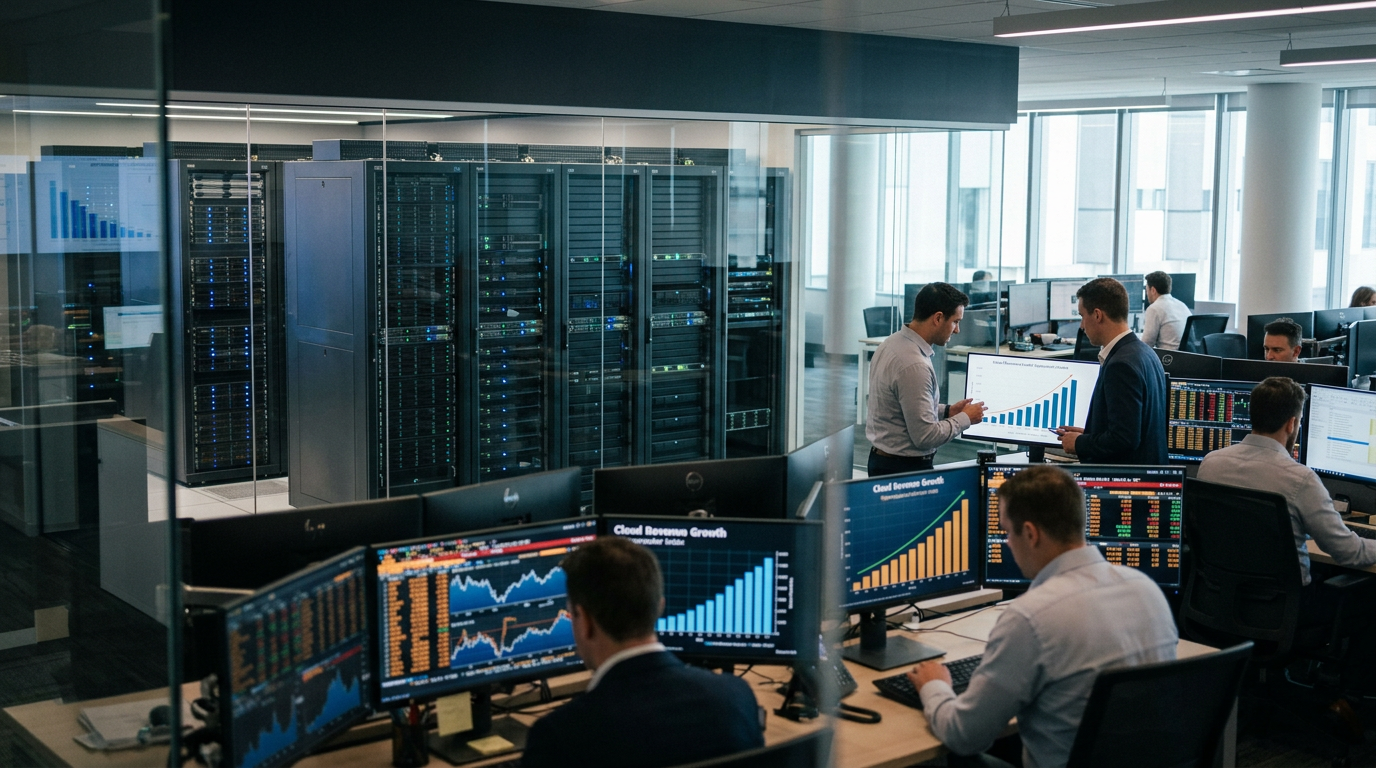
The Macro Setup: Why Cloud Is Back in Focus
After eighteen months of enterprise IT budget tightening, cloud spending is reaccelerating at a pace that is surprising even the most optimistic institutional models. Combined hyperscaler revenue – spanning Amazon Web Services, Microsoft Azure, and Google Cloud – crossed $210 billion on an annualized basis as of Q1 2026, representing a 28.4% year-over-year composite growth rate, the fastest since Q3 2022. For active traders, the signal is not simply that cloud is growing – it is that the rate of change is inflecting upward, and capital rotation is following that inflection with measurable conviction.
Hyperscaler Financials: The Numbers That Matter
Amazon Web Services reported Q1 2026 revenue of $29.3 billion, up 21.7% year-over-year, with operating margins expanding to 38.1% from 30.5% in the prior year period. Microsoft Azure grew 33% in constant currency, contributing an estimated $42 billion annualized run rate to the Intelligent Cloud segment. Alphabet’s Google Cloud posted $12.3 billion in quarterly revenue, a 29.2% increase, and crucially, sustained operating profitability for the fifth consecutive quarter with a 9.4% operating margin.
Analyst consensus price targets reflect the reacceleration thesis. Morgan Stanley carries a $240 target on Alphabet (GOOGL), implying approximately 18% upside from current levels near $203. Deutsche Bank upgraded Amazon (AMZN) to a $245 target citing AWS margin leverage as the primary earnings driver through 2027.
Sector Rotation and Institutional Flows
Institutional positioning data from CFTC and 13F filings through March 2026 shows a net increase of $18.7 billion in technology sector exposure over the trailing ninety days, with cloud-exposed software names – including Snowflake (SNOW), Datadog (DDOG), and MongoDB (MDB) – attracting disproportionate inflows. Snowflake’s forward price-to-sales multiple has compressed from 22x to 14x over the past twelve months, even as product revenue growth reaccelerated to 26% in its most recent quarter. That compression-plus-reacceleration dynamic is precisely the setup that systematic growth funds are programmed to exploit.
Technical Structure and Key Levels
The Nasdaq-100 (QQQ) is trading above its 200-day moving average at $478 and has reclaimed the $495–$498 VWAP range established during the Q4 2025 consolidation. Volume on up days has exceeded the 20-day average by 14%, suggesting institutional accumulation rather than retail momentum. Traders monitoring individual names should note that DDOG is coiling in a tight range between $138 and $147, with RSI at 56 – neither overbought nor oversold – presenting a technically clean decision point ahead of its next earnings print.
- AWS annualized revenue: $117.2 billion, growing 21.7% YoY
- Azure growth rate: 33% in constant currency, Q1 2026
- Google Cloud operating margin: 9.4%, fifth consecutive profitable quarter
- Snowflake forward P/S: 14x vs. 22x twelve months ago
- QQQ 200-day MA support: $478
For informational and educational purposes only. Not investment advice. Trading involves risk, including loss of principal.