
October 30, 2026
Bonus Content: Gold Breaks Below $4,000 as GDP Surprise Stirs Hike Fears
Dear Reader,
There’s an important message Dr. Ron Paul believes is lost on those who are listening to the mainstream narrative.
“The people running our country are living in a fantasy world. And if you’re not careful, you and millions of other Americans will pay the price,” says Dr. Paul.
While most people have focused on record stock prices, and the promises of AI… Dr. Paul is warning about a new emerging threat.
He says this is EVEN WORSE than Socialism, and explains everything you’re seeing in the news today…
From higher groceries… gas prices… power bills… even rising stocks.
“Assets are soaring on paper… and yet real life has gotten much harder for most Americans,” says Dr. Paul.
“This is NOT what happens in normal booms. So what comes next will not be good. Especially when it comes to your money.”
So please, as a citizen of this country, pay attention to what is happening.
Because the con that’s taken over Washington could not only affect the money you spent your career saving…
It could also disrupt your current source of income – whether it’s Social Security… a pension… dividends… annuity… or your salary, if you’re still working.
Which is why you must begin preparing now.
And why Dr. Paul recently helped put together a short video presentation that explains the #1 first step every American should take to prepare for what’s coming next.
I strongly suggest you take a look at this fascinating new interview with Dr. Paul.
Sincerely,
A.J. Wiederman
Senior Writer, Stansberry Research
Gold Breaks Below $4,000 as GDP Surprise Stirs Hike Fears
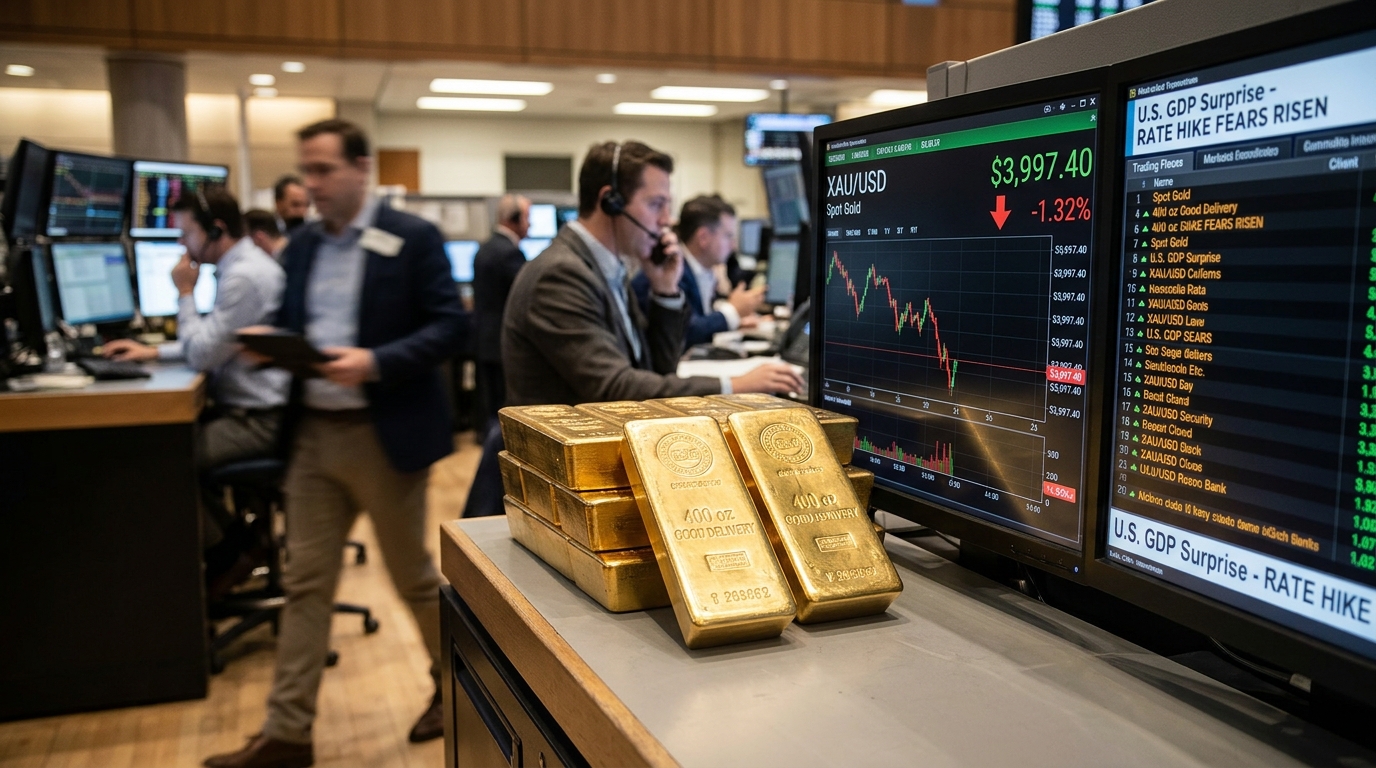
Gold crossed a threshold this morning that matters more as a signal than as a number. Spot bullion slipped below $4,000 for the first time since late July, trading near $3,997 as of early Friday after shedding roughly 1.3% on Thursday. The trigger was not the Federal Reserve, which held rates steady at its October 28 meeting. It was the data that followed.
Thursday’s advance GDP estimate showed the US economy growing at a 3.4% annualized rate in Q3, above the 3.2% consensus and well above Q2’s 2.2% pace. September PCE inflation rose 0.5% on the month, with headline PCE running at 3.6% year over year. Together, those two figures kept a December rate hike firmly on the table, and precious metals adjusted accordingly.
Why Silver Fell Further and Faster
Gold is down roughly 3% for October and sits at three-month lows. Silver has suffered far worse. XAG dropped to around $50.74 on Friday, a decline of more than 3.5% in two sessions and its lowest level since November 2025. Silver is on track to fall about 15% in October.
The divergence is structural, not random. Industrial use accounts for roughly 55% to 60% of annual silver demand, according to the Silver Institute and Metals Focus. That dual identity, part monetary metal, part manufacturing input, cuts both ways. When rate-hike expectations climb and growth worries creep in simultaneously, silver can lose support from both its investment and its industrial demand bases at once. Manufacturers thrifting silver content in solar panels has added a third headwind: Metals Focus has forecast photovoltaic silver demand to fall roughly 19% in 2026 as cells require less metal per unit.
The gold-to-silver ratio has pushed back toward multi-year highs as a result. That ratio, now around 78, historically signals silver is cheap relative to gold, but cheap relative to history does not mean a floor has formed when rate policy is the dominant driver.
The ratio’s signal is real, but ratio analysis alone cannot override the rate cycle. Rising real Treasury yields dismantled one of the most crowded precious-metals positions in years when September’s selloff began, and the same mechanism is now driving October’s move.
Miners Amplified the Damage
The GDX miners index fell about 3.8% Thursday, outpacing gold’s decline by a factor of more than two. That leverage works in both directions, and right now it is working against holders. Agnico Eagle, GDX’s largest holding at roughly 11.4% of the fund, dropped 3.9% despite reporting solid Q3 results the same day: 814,012 ounces of gold produced and net income of $1.353 billion. The market looked past those numbers. All-in sustaining costs climbed to $1,648 per ounce and quarterly production came in below year-ago levels, while the macro headwind from Thursday’s data overwhelmed company-specific positives.
This is the classic miner problem in a rate-hike cycle. Producers trade on expected future margins, not today’s gold price, and a December hike raises the discount rate applied to those future cash flows even before it touches the gold price itself.
What $4,000 Breaking Changes
The psychological weight of $4,000 as support has been considerable since gold first crossed it on the way up. With the level now broken on a closing basis, traders who sized positions around that floor face a choice. Markets currently price roughly a 75% to 85% probability of a December quarter-point hike, and two Fed officials voted for an immediate move at this week’s meeting. Principal Asset Management’s Seema Shah has flagged the possibility of hikes in both December and early 2027, which would extend the ceiling on gold’s upside.
The bear case sits near $3,940 if Friday’s monthly close gives way and December pricing firms further. The base case keeps gold in the $3,980–$4,070 range through month-end as long as no additional data shock arrives before the December 8–9 meeting.
Bottom Line
What changed Thursday was not the Fed’s intention, it was the economy’s refusal to cooperate with the case for easing. A 3.4% GDP quarter and a 0.5% monthly PCE reading did what the Fed itself could not: they made December feel inevitable rather than possible. Gold at three-month lows, silver at November 2025 lows, and GDX down more than 6% in a month all reflect the same recalibration. For investors holding miners or silver, the question is whether that recalibration is complete or still in progress. With the December meeting six weeks away and no major softening in the data, there is no obvious catalyst to reverse it before then.