
September 14, 2026
Bonus Content: Gold at $4,300 Faces a 5.75% Rival. Who Wins?
Dear Friend,
In 1976, a Chevron drilling team tapped an energy source so powerful it could run a city.
No fuel costs. No carbon. No supply chain.
They proved it worked. Then they killed the project.
Unocal proved it worked. Killed it.
Texaco proved it worked. Killed it.
Three of the largest oil companies on Earth confirmed the same thing.
And all three buried the results for the same reason: it would have destroyed their core business.
For fifty years, the official line was “the technology isn’t ready.”
The technology was fine. The threat was too big.
Now one company has spent sixty years perfecting what Big Oil refused to touch.
Google just locked in a 15-year contract. Bill Gates wrote a $100 million check. And on October 20th, the government hands it a competitive edge no other energy source gets.
Big Oil had fifty years to act. They chose not to.
See the company that didn’t wait >>
“The Buck Stops Here,”
Kelly Maguire
Behind the Markets
Gold at $4,300 Faces a 5.75% Rival. Who Wins?
Gold is sitting at roughly $4,300 an ounce this morning, down about 1.3% overnight, and the proximate cause is straightforward. August inflation came in at 3.4% year-over-year, and markets now put the odds of a rate rise on Wednesday at roughly 90%. That number matters because it frames everything that happened in the corporate bond market on September 10, and what those deals mean for anyone holding the metal.
What’s Driving the Market
The bond market offered a useful X-ray of the rate environment last Wednesday. The traditional post-Labor Day rush in US investment-grade corporate bonds, normally one of the busiest windows on Wall Street’s calendar, just turned in its weakest showing since 2020. Yield volatility had kept many CFOs on the sidelines. Then two large issuers forced the window open anyway.
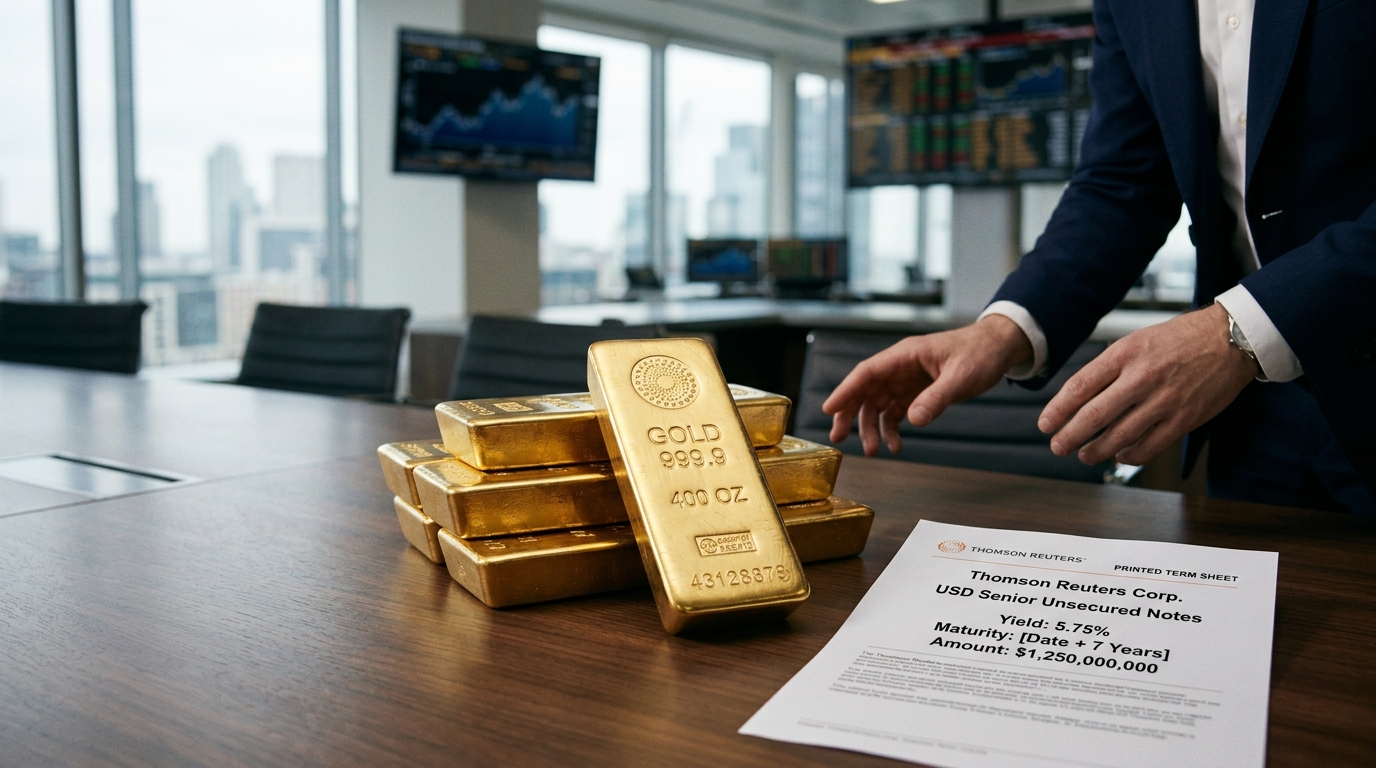
Thomson Reuters announced the pricing of a major multi-currency debt raise, including a US$1.3 billion U.S. public offering of notes issued by subsidiary TR Finance LLC and a C$1.0 billion Canadian private placement. The U.S. offering covers $800 million in 5.100% notes due 2028 and $500 million in 5.750% notes due 2033. On the same day, Vistra priced a registered underwritten public offering of $1.5 billion in junior subordinated notes due 2057, consisting of $850 million in Series A notes and $650 million in Series B notes, each issued at 100% of face value, with Series A bearing 7.00% and Series B bearing 7.25%.
Focus on Thomson Reuters for a moment. This is a well-understood, investment-grade business with a global franchise in legal, financial, and news data. The 2033 notes are guaranteed by Thomson Reuters Corporation, alongside other subsidiary guarantors. Investors lending to that business for seven years are collecting 5.75% annually, in cash, every six months, guaranteed.
Gold yields nothing. That is not a complaint, it is a structural fact. The metal earns no coupon, pays no dividend, and generates no cash flow. In a world where rates were near zero, that cost was negligible. Today it is not. A $100,000 allocation to the Thomson Reuters 2033 notes earns $5,750 per year. The same sum in gold earns exactly zero, regardless of where the price goes.
The Investment Opportunity
This is not an argument to sell gold. It is an argument to understand precisely what investors are choosing against when they hold it. The Federal Reserve’s September 2026 meeting has become one of the most consequential monetary policy events of the year, with markets now pricing in a meaningful probability of a 25-basis-point rate hike, a dramatic reversal from months ago when economists anticipated rate cuts. Fed Chair Kevin Warsh’s Jackson Hole remarks, combined with persistently elevated oil prices and sticky inflation readings, have shifted the policy outlook.
The 2-year Treasury yield moved higher after Warsh’s speech, indicating a real response in interest-rate markets. That matters for gold because real yields are the metal’s most reliable competition. When cash and quality credit pay generously in real terms, the case for a zero-yield asset requires a stronger justification: war, currency debasement, systemic banking stress, or persistent above-target inflation that erodes bond purchasing power faster than the coupon compensates.
The current environment actually contains some of those conditions. Hotter-than-expected August CPI data showed headline inflation at 3.4% year-over-year and core CPI rising 0.3% month-over-month. If inflation stays above 3% and the Fed keeps hiking, a 5.75% nominal coupon may not look so generous in real terms by 2028. Gold, on the other hand, carries no reinvestment risk and no credit exposure.
Risks to Monitor
The bull case for gold rests on one critical question: does Wednesday’s hike, if it comes, mark the peak or the start of a new tightening sequence? One prominent view holds that a hike probably will not come in September but will arrive by October or December, suggesting the door to future tightening remains firmly open and markets should prepare for a higher rate environment extending well into 2027. A prolonged tightening cycle would sustain the coupon advantage of investment-grade credit over gold for years rather than months.
The bear case for gold is equally specific: higher rates lift the return on cash and bonds, which pay interest that metals do not. If real yields rise another 50 to 100 basis points from here, gold at $4,300 will face genuine selling pressure from investors rotating toward paper that pays.
Bottom Line
Thomson Reuters raising $500 million at 5.75% for seven years is not headline news for most investors. For gold holders, it should be. It is a precise, daily benchmark of what the market requires to rent money to a quality borrower, and it is what gold must outperform in total return terms to justify its zero-yield profile. Credit spreads have hovered in the 70 to 80 basis point range even as supply surged, and average yields near 5% have kept fixed-income buyers engaged. That engagement has a cost, and it shows up every day in gold’s opportunity cost. The metal can still win that competition, but investors need to know the score before Wednesday’s announcement changes it.