
August 30, 2026
Bonus Content: Seoul’s Chip Boom Turns Into a Gold Story
Dear Reader,
According to a former Wall Street insider who’s been tracking Trump’s every move…
President Trump is preparing to unleash a stunning triple-shock bombshell on Washington.
Creating a frenzy all across America the moment it goes live.
In fact, Trump’s triple-bombshell will be so seismic, it’ll trigger a $7.5 trillion chain reaction in the markets.
With one corner of stocks erupting by up to 1,000% in 12 – 24 months.
This isn’t being covered on CNBC… and Fox Business isn’t talking about it.
But the smart money on Wall Street is already moving fast:
- Stanley Druckenmiller just dropped $81 million…
- David Tepper: $270 million…
- Peter Thiel: $273 million…
- Ken Griffin: $1.7 billion…
- Warren Buffett: $5.4 billion….
That’s because Trump’s bombshell plan is his priority #1.
He’s fired up about this.
Based on undeniable evidence you’ll see today for the first time, Trump’s plan could go down in history as one of the greatest ‘America first’ initiatives of our lifetime.
It’ll be bigger than the Apollo program and even bigger than the Manhattan Project.
And Trump wants to see initial results within 90 days.
By then the biggest gains will have long since vanished into thin air.
So get the full story here on Trump’s triple-shock bombshell before it’s too late.
To Your Profits,

Adam O’Dell
Chief Investment Strategist, Money & Markets
P.S. This opportunity could deliver 10X gains in a year.
Good enough to turn $100,000 into $1 million.
The kind of gains that made NVIDIA’s early investors rich beyond their wildest dreams.
Seoul’s Chip Boom Turns Into a Gold Story
The Bank of Korea moved again Thursday. The central bank raised its benchmark rate for a second consecutive meeting, moving to contain inflation risks fueled by stronger-than-expected economic growth amid an unprecedented semiconductor boom. The Base Rate rose 25 basis points to 3.00%, in a 6-1 decision. It marked the first back-to-back rate hikes in three years and seven months, following a streak of seven consecutive increases from April 2022 to January 2023.
The proximate causes are familiar: core inflation rose 2.6% year over year in July, a signal of persistent underlying price pressure. The BOK also cited rising housing prices, and Seoul apartment transaction prices rose 2.5% month on month in June, the highest monthly increase in five years. Policymakers also raised their growth forecast for 2026 to 3.3%, versus a May forecast of 2.6%. Governor Shin Hyun-song described the move as “preemptive,” and said the rare back-to-back hike would help stabilize inflation, housing prices, and the foreign exchange market.
What’s Driving the Market
Most coverage today will frame this as a South Korean macro story. The angle that matters for precious metals investors is different. The BOK does not hike in isolation. Reuters reported Thursday that BOJ Deputy Governor Ryozo Himino called for timely rate hikes to avoid a future inflation spike, and flagged a weak yen as an inflation accelerant. Two of Asia’s largest economies are now tightening in the same direction at the same time, with real rates climbing in Seoul and Tokyo simultaneously.
That matters for gold through two channels. First, it compresses the dollar’s rate advantage. Reuters reported Thursday that gold prices drifted higher as attention turned to Fed Chair Kevin Warsh’s Jackson Hole remarks. The metal is not collapsing on the BOK news, because synchronized Asian tightening is not straightforwardly bearish. It chips away at dollar exceptionalism, and a structurally softer dollar is one of gold’s more reliable supports over the medium term.
Second, a firming won changes the arithmetic of Korean gold demand. When local currency strengthens, gold purchased in dollars becomes cheaper on a local-price basis, which historically lifts retail and institutional appetite. The BOK itself noted that the won-dollar exchange rate fell significantly as supply-demand conditions improved and the U.S. dollar weakened.
The Investment Opportunity
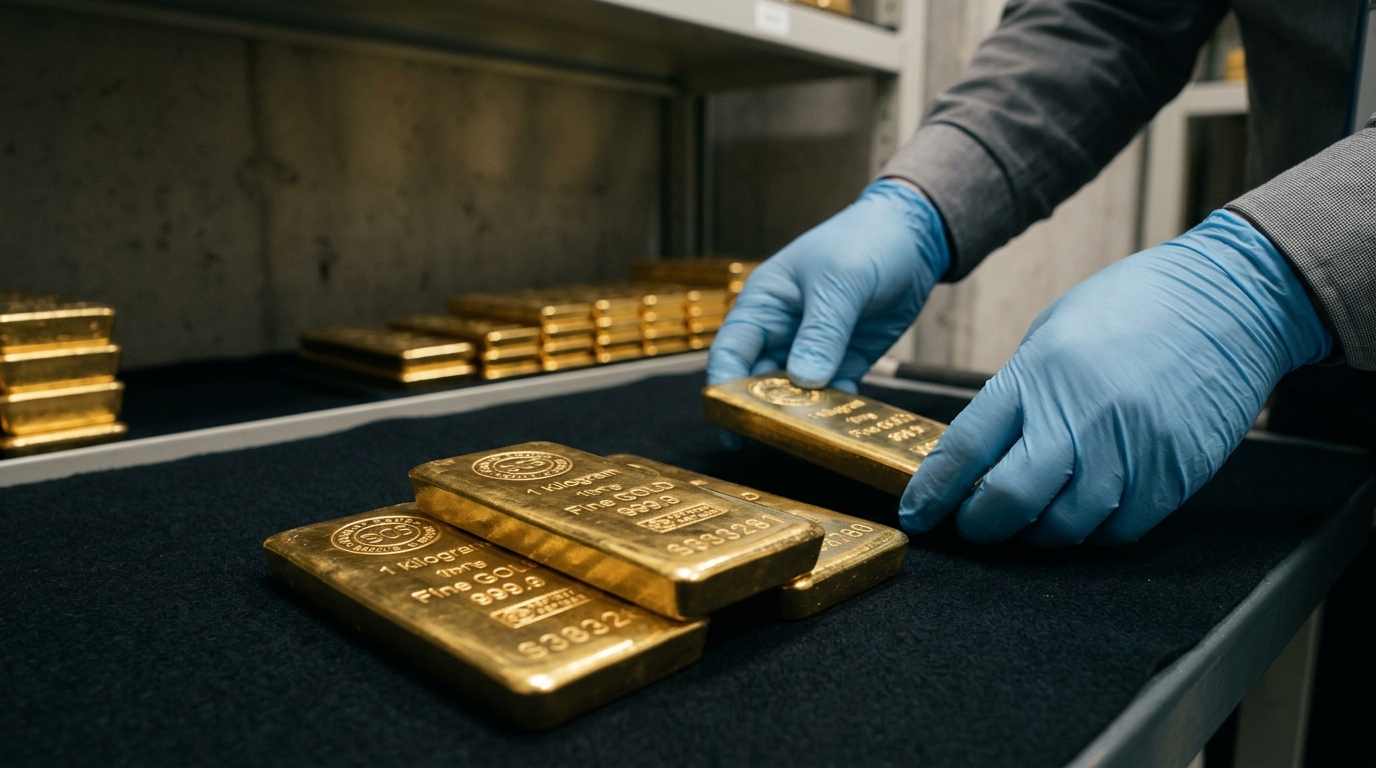
The more consequential connection between Seoul’s rate decision and gold is institutional. The BOK resumed gold buying this year after a 13-year pause. The BOK disclosed that it held about 355 billion won (about $250 million) worth of gold ETFs in the second quarter, marking its first foray into gold in 13 years. Beyond ETFs, local reporting has said the BOK established a channel to buy domestically produced physical gold and has considered purchases on the order of roughly 4 to 5 metric tons per year.
The bank currently holds about 104.4 tonnes of gold, about 3.5% of total reserves. That underweight is a structural argument for continued accumulation regardless of where rates go next. Local reporting has also said the bank aims to gradually raise gold holdings rather than making large one-time purchases, signaling a medium- to long-term approach to diversifying reserves away from the dollar.
For investors, the most direct exposure to Korean semiconductor-driven wealth and the associated gold demand runs through EWY, the iShares MSCI South Korea ETF, which is heavily weighted toward Samsung Electronics and SK Hynix. Those holdings are also a key engine behind the income growth that can keep inflation sticky, feeding the cycle that can sustain renewed interest in gold locally.
Risks to Monitor
Markets remain divided on the path from here. If the terminal rate proves too high and Korean growth stalls, semiconductor capex could roll over, weakening the income dynamic that is pushing gold demand higher locally.
More broadly, attention is turning to Fed Chair Kevin Warsh’s speech at the annual Jackson Hole symposium on Friday, August 28, 2026. If Warsh signals a hike rather than a hold, the dollar could reassert and gold faces near-term turbulence regardless of what Seoul does.
Bottom Line
The BOK’s chip-boom inflation problem is gold’s opportunity in disguise. A central bank that spent 13 years on the sidelines of the gold market is now re-entering with ETFs in hand and a domestic purchase framework in place, precisely as its currency firms and regional real rates converge upward. The dollar’s yield edge over Asian assets is narrowing. That is the force worth tracking today, not the 25 basis points alone.