
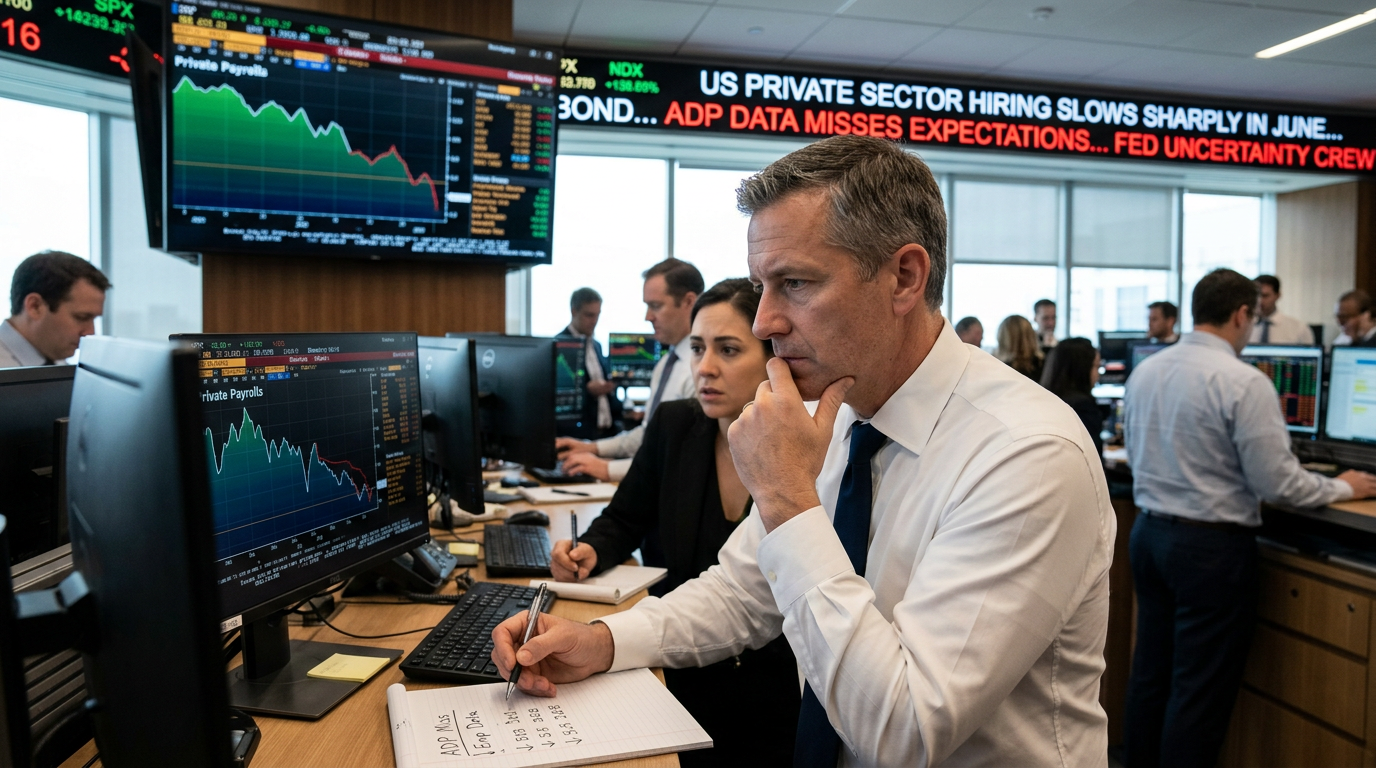
Let’s talk about what is actually happening in the labor market right now, because the consensus framing is getting it wrong in both directions simultaneously.
Private sector hiring slowed more than expected in June, with ADP reporting 98,000 new jobs added — a miss that may give the Federal Reserve further justification to keep rates on hold as it navigates sticky inflation and an increasingly narrow labor market. The ADP National Employment Report showed seasonally adjusted private employment growth of 98,000 for the month, down from 122,000 in May and short of the consensus estimate of 110,000.
That number is not a disaster. But look past the headline.
Nearly half of the month’s gains — 48,000 — came from education and health services, sustaining the narrow growth pattern that has defined much of 2026. All but 2,000 of the new positions were in services. Manufacturing, construction, technology — functionally absent. Job creation was uneven in June. Financial activities and information were among the gainers, while leisure and hospitality delivered a sixth month of weak hiring. Six consecutive months of soft hospitality hiring is not a blip. That is a trend.
Now here is the data point Wall Street glossed over this morning.
Vanguard said its proprietary data on 401(k) account openings suggest a weaker labor market than others have indicated. Vanguard’s data on some 2,500 companies and 5 million workers shows near-zero employment growth in June — a gain of roughly 12,000 jobs when scaled to the U.S. labor market. The company also pointed out a noticeable decline in hiring among 21- to 24-year-olds, amounting to a net hiring rate of 0.72%, the lowest since August 2020.
That last number matters. The youngest cohort of workers is the leading edge of labor demand. When their hire rate hits COVID-era lows while the stock market is near all-time highs, something is not adding up.
The Fed’s Impossible Math
Here is the problem. A Reuters poll found that 72 of 102 economists expect no Fed rate moves for the rest of 2026, a figure shaped in part by CPI inflation running at 3.8%, its highest reading since May 2023. The Fed’s own target is 2%. The distance between 3.8% and 2% is not trivial. And the market is pricing in a Fed that sits still.
The Federal Reserve had been worried earlier this year about the sluggish jobs market but has since turned its focus to inflation, now running about 4% on an annual basis — double what the Fed would like.
So the central bank is watching two things break in opposite directions at the same time: inflation that demands tighter policy, and a labor market that is quietly softening in ways the headline numbers obscure. The Mortgage Bankers Association’s chief economist has drawn a hard line, stating that the MBA continues to anticipate that the Fed’s next move will be a rate hike, and that means mortgage rates are unlikely to drop anytime soon.
The market does not believe that. Treasury yields have maintained their surge on concerns that the Fed will restrict monetary policy further this year. The bond market is at least partially pricing it. Equities are not.
Tomorrow Is the Deciding Data Point
Wall Street expects 115,000 new nonfarm payroll positions and an unemployment rate holding steady at 4.3%. The number drops Thursday morning — one day early because Friday is a federal holiday.
What happens next depends almost entirely on whether the actual number comes in above or below that 115,000 consensus.
If NFP surprises to the upside: Bank of America economists see a strong jobs report pushing the Fed to raise rates more aggressively than the market currently expects. Combined with sticky inflation, that strengthens the case for reversing prior cuts. A strong jobs report would likely push markets toward their call for three hikes in 2026. Risk assets would reprice sharply.
If NFP misses: The case for holding rates stable strengthens, but the softness in the underlying labor mix — particularly the Vanguard 401(k) data and the youth hiring collapse — suggests something structural is unfolding underneath the surface numbers. A miss here would not be the clean dovish signal the market might initially treat it as.
The Hidden Risk
What the consensus is getting wrong is the combination trade. A slowing labor market and persistent 4% inflation is not a scenario monetary policy handles cleanly. Rate cuts risk inflaming prices. Rate hikes risk accelerating the labor softening. The Fed is not navigating a tradeoff. It is navigating a trap.
After an extraordinary first half powered by artificial intelligence and corporate earnings, Wall Street is entering July with momentum but also heightened expectations. The next phase of the rally will likely depend on whether economic data continues to support growth. There are concerns about what the Federal Reserve will do next and how it could potentially impact markets and the economy.
For traders, the playbook is straightforward even if the outcome isn’t. Treasury volatility should stay elevated through Thursday. Defined-risk structures on rate-sensitive sectors — regional banks, homebuilders, and high-multiple growth names — offer the cleanest expression of an NFP surprise in either direction. For investors with longer time horizons, the quiet deterioration in youth hiring and leisure-sector payrolls is worth watching. Those are not AI-cycle variables. They are consumer-cycle variables. And the consumer cycle is starting to tell a different story than the index.
The number drops at 8:30 a.m. Thursday. The market gets a four-day weekend to sit with whatever it says.