By Nora Eckert and Kalea Hall
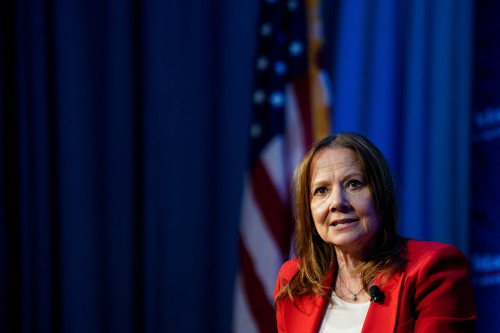
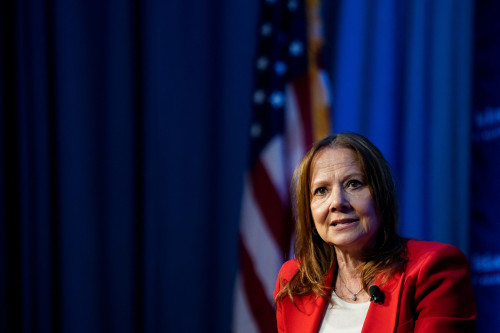
DETROIT, Jan 12 (Reuters) – General Motors CEO Mary Barra said the Trump administration’s push to loosen fuel-economy rules has affected the automaker’s business even more than its fast-changing trade policies.
Speaking at an Automotive Press Association event ahead of this week’s Detroit auto show, Barra said the administration’s regulatory shifts, such as killing a $7,500 electric-vehicle tax credit and moving to roll back tailpipe-emissions rules, prompted GM to rapidly adapt its product plans.
“We had to make some fairly significant changes,” Barra said, referring to decisions to cut billions of dollars’ worth of EV investments while leaning in harder to combustion-engine vehicles.
U.S. President Donald Trump has championed slashing fuel economy regulations that guided the industry for years, in a push to make it easier to sell gasoline-powered cars. He also cut a $7,500 consumer tax credit on electric models in late September, causing demand to plummet.
Barra said GM still believes EVs eventually will take off in the U.S. as charging becomes easier and prices come down, and said GM still sees battery-powered vehicles as “the end game.”
“It will take longer without the incentives, but I still think we’ll get there over time,” Barra said of the transition to being fully electric.
She reiterated that GM is developing plug-in hybrid vehicles, which can run on fully electric power before the car switches to an internal combustion engine, and that the company is evaluating traditional hybrids as well. But she said GM will continue to focus more on EVs because they are a superior product for customers.
Several major automakers have pulled back from their EV ambitions, including GM’s crosstown rival Ford Motor, which last month took a $19.5 billion writedown as it axed several EV programs.
GM this month said it would record a $6 billion charge to unwind some electric-vehicle investments, following a $1.6 billion third-quarter charge.
“I’m a little surprised at some [automakers] that are really pulling away very quickly, because we don’t know what will be in ‘29, ‘30, ‘32,” Barra said, adding that she wants GM to maintain flexibility to adjust to how regulations may shift in future administrations.
The National Highway Traffic Safety Administration last year proposed significantly reducing the fuel economy requirements from model years 2022 to 2031, requiring 34.5 miles per gallon on average by 2031, down from 50.4 miles per gallon (21.4 km per liter).
(Reporting by Nora Eckert and Kalea Hall in DetroitEditing by Mike Colias and Matthew Lewis)