By Stephen Culp
NEW YORK, Dec 30 (Reuters) – U.S. stocks slumped on Tuesday, while gold bounced back on the penultimate trading day of 2025.
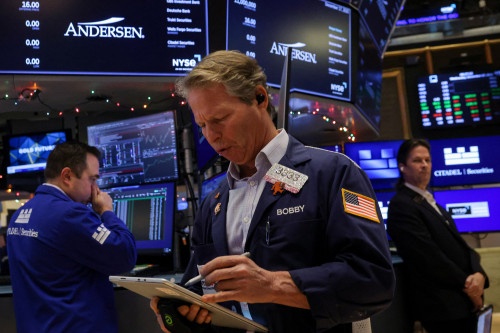
All three indexes dipped into negative territory in a light-volume pre-holiday session in a subdued ending to a volatile year.
Having weathered a year of tariff wars, the longest government shutdown in U.S. history, and roiling geopolitical strife, all three U.S. indexes, along with their global counterparts, are set to log robust, double-digit gains.
“At the end of the day, solid corporate profits can make up for a lot of sins,” said Ryan Detrick, chief market strategist at Carson Group in Omaha. “And in 2025, strong earnings have justified the bull market that we’ve seen this year.”
“We see no major cracks to suggest a recession is coming,” Detrick added. “We’re optimistic the labor market will get better and this bull market will probably have another few tricks up its sleeve in 2026.”
Minutes from the U.S. Federal Reserve’s last meeting of the year showed most of the group agreed to cut rates, but the debate about the risks facing the U.S. economy revealed deep divisions among the policymakers.
“The Fed minutes only further confirm that there are really two sides to potential future policy, and the divide likely will continue to grow,” Detrick said. “The reality is inflation is still a tad hot, and the Fed should be looking to cut interest rates to support the weakening labor market in 2026.”
On the geopolitical front, efforts to resolve the Russia-Ukraine war were complicated by Russian President Vladimir Putin’s warning that Russia’s negotiating stance will toughen following its accusations that Kyiv attacked Putin’s residential complex in Roshchino. Ukraine denies the accusations and said the Kremlin fabricated the incident to block peace negotiations.
The Dow Jones Industrial Average fell 94.87 points, or 0.20%, to 48,367.06. The S&P 500 fell 9.51 points, or 0.14%, to 6,896.23 and the Nasdaq Composite fell 55.27 points, or 0.23%, to 23,419.08.
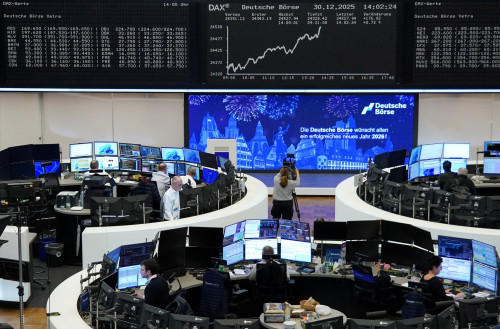
European shares hit another record closing high amid thin, year-end trading, with banking and commodity-linked stocks giving the STOXX 600 a boost.
MSCI’s gauge of stocks across the globe fell 0.62 points, or 0.06%, to 1,020.07.
The pan-European STOXX 600 index rose 0.6%, while Europe’s broad FTSEurofirst 300 index rose 13.87 points, or 0.59%.
Emerging market stocks rose 2.43 points, or 0.17%, to 1,404.09. MSCI’s broadest index of Asia-Pacific shares outside Japan closed higher by 0.13%, to 722.72, while Japan’s Nikkei fell 187.44 points, or 0.37%, to 50,339.48.
Gold and silver prices rebounded from the prior session’s steep selloff, which was largely attributable to year-end profit-taking following the precious metals’ bumper year.
Gold remains poised to register its best year of gains since 1979.
Spot gold rose 0.3% to $4,344.75 an ounce, while spot silver rose 5.4% to $76.20 per ounce.
The dollar held its gains following the release of the Fed minutes, but remained on course for its steepest annual drop in eight years.
The dollar index, which measures the greenback against a basket of currencies including the yen and the euro, rose 0.23% to 98.23, with the euro down 0.23% at $1.1745.
Against the Japanese yen, the dollar strengthened 0.26% to 156.44.
In cryptocurrencies, bitcoin gained 0.74% to $87,888.55. Ethereum rose 0.71% to $2,955.35.
U.S. Treasury yields ticked higher, essentially unchanged after the Fed minutes were released.
The yield on benchmark U.S. 10-year notes rose 0.4 basis points to 4.12%, from 4.116% late on Monday.
The 30-year bond yield rose 0.1 basis points to 4.805%, from 4.804% late on Monday.
The 2-year note yield, which typically moves in step with interest rate expectations for the Federal Reserve, fell 1.9 basis points to 3.446%, from 3.465% late on Monday.
Oil prices held firm amid fading hopes of an imminent Russia-Ukraine peace deal and rising Middle East tensions concerning Yemen.
U.S. crude dipped 0.22% to settle at $57.95 per barrel, while Brent settled at $61.92 per barrel, down 0.03% on the day.
(Reporting by Stephen Culp; Additional reporting by Stella Qiu, Vidya Ranganathan and Dhara Ranasinghe; Editing by Lisa Shumaker)