By Ella Cao, Daphne Zhang and Lewis Jackson
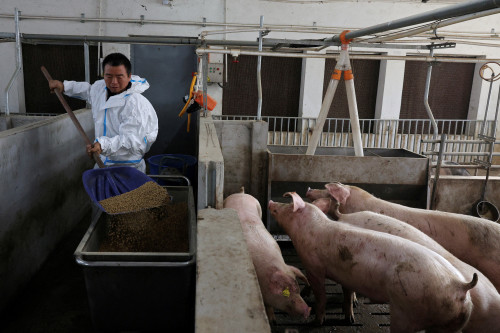
BEIJING, March 24 (Reuters) – Rising grain prices fuelled by the Iran war are lifting animal feed costs in China, the world’s biggest pig market, piling pressure on producers already hit by weak demand and hog prices at 16-year lows.
Since the start of the war on February 28, futures for soymeal and corn – two key feed ingredients – have climbed to multi-month highs on the Dalian exchange, driven in part by the oil price rally, higher freight rates and rising fertiliser costs, two analysts said.
In March, spot prices for soymeal and corn in China have risen by over 200 yuan per ton and around 100 yuan per ton – 7% and 4% respectively – increasing real-time feed costs.
Prices for other inputs, including lysine and methionine – essential amino acids – as well as fishmeal and vitamins A and E have risen between 6% and 77% this month due to the war, according to Rosa Wang, an analyst at Shanghai JC Intelligence Co.
“Prices for most raw materials used in animal feed have experienced a significant increase in March, partly driven by the ongoing conflict in the Middle East,” said Lin Guofa, senior analyst at consultancy Bric Agriculture Group.
OVERCAPACITY AND WEAK DEMAND
Chinese hog producers, who account for half of the world’s pigs, are grappling with higher costs even as they contend with falling pork prices due to overcapacity and weak demand.
China’s most-active hog futures contract fell to a contract low of 9,980 yuan ($1,448.16) per ton on Monday. Cash prices tumbled to 9.69 yuan per kg – the lowest in 16 years, according to JCI.
“Raising a hog that weighs about 60-62.5 kg currently costs 12.2-12.5 yuan per kg. This means farmers lose 280-350 yuan for each pig they sell,” said Lin.
PLUNGING HOG PRICES, NEGATIVE MARGINS
Smaller farmers, who account for less than 30% of China’s pig production, risk being pushed out of business as they are especially vulnerable to price swings, analysts said.
“For small farmers now, either you sell your pigs cheap or you grit your teeth and bear it, get through this price drop, and then wait for the pig price to rebound,” said Fu Zhenzhen, feed analyst at Beijing Orient Agribusiness Consultants.
Li, a 600-head pig farmer in northern Hebei province, said he has been losing money since last year.
“We are being roasted by fire now. Pork prices are so low, but feed costs have jumped sharply in March,” Li said.
Since last year, Chinese authorities have intensified efforts to rein in overcapacity, urging breeders to cut sow numbers and manage slaughter rates, while recently buying frozen pork for state reserves to stabilise prices.
China’s sow herd totalled 39.61 million head at the end of December, remaining above the normal holding level of 39 million.
“Going forward, pork prices will mainly depend on how aggressively companies trim their herds,” said Pan Chenjun, senior animal protein analyst at Rabobank in Hong Kong.
($1 = 6.8915 Chinese yuan renminbi)
(Reporting by Ella Cao, Daphne Zhang and Lewis Jackson; Editing by Tony Munroe and Shri Navaratnam)